
- Catalogs
- ifm electronic
- Industrial imaging 2016. Vision sensors for recognition and assessment of objects and scenes.


Industrial imaging 2016. Vision sensors for recognition and assessment of objects and scenes.

Industrial imaging 2016. Vision sensors for recognition and assessment of objects and scenes.
- Integration: Easy integration into production processes with simple parameter settings and ready-to-use PLC function blocks.
- Robustness: Compact and robust design with high protection ratings and wide temperature ranges.
- Components: Incorporates illumination, optics, evaluation, and output logic in an industrial housing.
- Contour Sensor (O2D): For object recognition, verifying contours, and monitoring presence, position, and orientation.
- Pixel Counter (O2V): Inspects objects by counting pixels, used for quality assurance in assembly and packaging.
- Code Reader (O2I): Decodes 1D and 2D codes, performs OCR tasks for product identification.
- 3D Sensor (O3D): Uses time-of-flight measurement for 3D object detection, suitable for level measurement and completeness monitoring.
- Ease of Use: User-friendly interfaces with password protection.
- Flexibility: Handles various object sizes and orientations with extensive assessment parameters.
- Documentation: Offers data logging and fault memory capabilities.
- White, Infrared, and Red Light Lenses available in wide-angle, standard, and telephoto options with specific order numbers.
- Includes protective glass and plastic lenses, plastic diffuser, and daylight filter for infrared types.
- Infrared lenses available in telephoto and standard options, with stainless steel variants.
- Details on operating distances and field of view sizes for standard and telephoto lenses.
- ifm electronic gmbh, located in Essen, Germany, with contact details provided.
- Website and warranty information, along with product categories like position sensors and industrial imaging.
Catalog excerpts
Vision sensors for recognition and assessment of objects and scenes. Industrial imaging
Open the catalog to page 1
Gesamtkatalog EN 2015_Stilvorlage LK FrutigerOT_2010 DE_GB.qxd 17.11.14 12:50 Seite 3
Open the catalog to page 2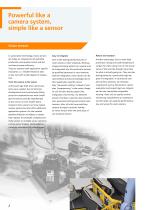
In automation technology visions sensors are today an integral part of assembly, production and quality control and last not least increase efficiency. They are cameras with application-specific evaluation, i.e. reliable electronic eyes at low cost with a high degree of integration. From the camera to the sensor. A few years ago high-price camera systems were needed. Due to technical developments and continuously falling prices for components ever more intelligent functions could be implemented at low cost in an ever smaller space. Compact vision sensors not only replace camera systems but also...
Open the catalog to page 3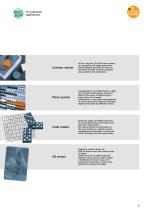
Contour sensor As for a toy box: The O2D vision sensor can recognise and assign previously defined objects and their contours or structures in order to check completeness, position and orientation. Comparable to a counting frame or slide rule, the O2V vision sensor counts all pixels of the areas of identical grey-Pixel counter scale values of an image. Furthermore, it can group accumulations of certain grey-scale values to individual objects and assess by different criteria. Code reader 3D sensor Today bar codes are widely used and can be understood as font styles to be read from right to left. 2D...
Open the catalog to page 4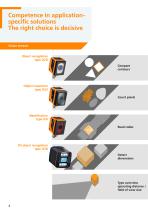
Competence in applicationspecific solutions The right choice is decisive Vision sensors Object recognition type O2D Compare contours Object inspection type O2V Count pixels Identification type O2I Read codes 3D object recognition type O3D Detect dimensions Type overview operating distance / field of view size
Open the catalog to page 5
For objects with defined geometry. For assessment of presence and completeness, for position detection and for sorting tasks. Use for quality assurance in assembly automation and on machine tools.
Open the catalog to page 6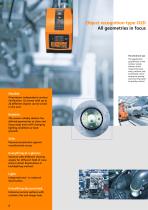
Object recognition type O2D All geometries in focus The electronic eye The application possibilities of the contour sensor efector dualis range from presence, position and orientation monitoring via sorting and counting tasks to quality control. Flexible: Orientation-independent contour verification. 32 scenes with up to 24 different objects can be saved in the unit. Reliable: The sensor reliably detects the defined geometries at close and long range even with changing lighting conditions or backgrounds. Password protection against unauthorised access. Variants with different viewing angles for...
Open the catalog to page 7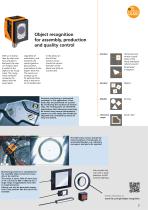
Object recognition for assembly, production and quality control With an intuitive step-by-step interface and good / bad parts the user can simply create a model of the object to be recognised. The recognition software compares the object with the saved ideal, regardless of orientation, and transmits the results (good or bad, position, orientation) to the higher-level PLC. The sensor can manage up to 32 separate tasks with a maximum of 24 models each. In the photo on the left the contour sensor checks the correct diameter of the wheel nut drills on a brake disk. Horizontal and vertical coordinates...
Open the catalog to page 8
Object inspection O2V Checking variable features of objects and scenes Whereas common vision sensors check parts on the basis of defined contours (like the contour sensor O2D) the new O2V pixel counter compares on the basis of variable features. Flexible: Extensive assessment parameters for a reliable object inspection by means of variable features. 32 scenes with up to 24 different objects can be saved in the unit. Everything at a glance: Variants with different viewing angles for different field of view sizes. Safe: Password protection against unauthorised access. Everything documented: Data...
Open the catalog to page 9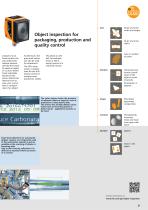
Outer and inner width and height Object inspection for packaging, production and quality control Instead of a defined contour the user determines relative features used by the sensor to assess an object or a scene. Within freely selectable tolerances the sensor determines features such as area, size, roundness or compactness of an object. Furthermore, the grey-scale values can also be used for assessment. The O2V vision sensor is reliably used for the full / empty control of transport and production vessels. Outer and inner radius Area in number of pixels The photo on the left, for example, shows...
Open the catalog to page 10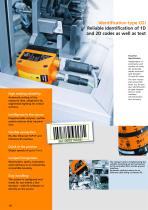
Identification type O2I Reliable identification of 1D and 2D codes as well as text Powerful identification Independent of orientation and number of codes the multicode reader automatically decodes 1D and 2D codes. High reading reliability: Automatic setting of the exposure time, adaptation by segmented lighting for critical surfaces. The new version also solves OCR tasks, e.g. for product identification by type designations or serial numbers. All information such as expiry Intelligence in the sensor: Programmable outputs, verifier system reduces data transmission. Flexible connection: RS-232,...
Open the catalog to page 11
Identification for industrial automation date or production date can now be read directly. Further functions include the output of the code position via the process interface, adjustable total quality parameters, individual illumination settings for each configuration in a group, integrated fault memory and access protection with password. The professional software of the multicode reader takes the high reading reliability of the Data Matrix code to a new dimension. Top choice for price/performance: the multicode reader provides high functionality and performance at the price of a sensor. Optimum...
Open the catalog to page 12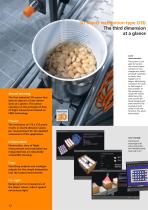
3D object recognition type O3D The third dimension at a glance Level measurement: Award winning: The first industrial 3D sensor that detects objects in three dimensions at a glance. The sensor operates on the principle of time of flight measurement based on PMD technology. The sensor is suitable for continuous level measurements of nontransparent solids and bulk materials in tanks, silos, hoppers or in heaps. Monitoring conveyors for level or belt usage is also possible. In the measuring range the sensor determines the level via the defined background and transmits the analogue level value or...
Open the catalog to page 13All Ifm electronic catalogs and technical brochures
 Orange Book 2025 (English)
100 Pages
 Processes in the Food Industry
72 Pages
 IO-Link Catalogue 2018/2019
164 Pages
 OGD582
2 Pages
 O1D
O1D18 Pages
 LW2720 - Radar Level Sensor
7 Pages
 Brochure Level Sensors
36 Pages
 Capacitive ATEX sensors
2 Pages
 SB series
2 Pages
 Ifm Newsbook 2018/2019
109 Pages
 General catalogue 2018/2019
878 Pages


Archived catalogs
 IFM NEWSBOOK 2019
112 Pages
 ifm Connection technology
48 Pages
 Sensors for motion control
12 Pages
 ifm pumps
4 Pages
 ifm fans
4 Pages
 NEWSBOOK 2019/2020
134 Pages
 Identification systems
16 Pages
 Position sensors
20 Pages
 ifm compressors
4 Pages
 Systems for mobile machines
44 Pages
 ifmpressions
18 Pages
 DF1214
2 Pages
 DF2212
2 Pages
 DF1212
2 Pages
 DF1100
2 Pages
 Systems for mobile machines 2016
25 Pages
 Connection technology from ifm.
32 Pages
 Automation at first hand.
17 Pages


- Ifm connector
- Ifm power supply
- Display module
- Ifm flow meter
- Ifm DC power supply
- Panel PC
- Industrial panel PC
- Panel PC with touch screen
- Digital imager
- Ifm data connector
- AC/DC power supply
- Ifm temperature sensor
- Ifm volume flow meter
- Ifm liquid flow meter
- Visible imager
- Measuring device
- Fanless panel PC
- Angular encoder
- Management software solution
- Ifm resistance temperature sensor