
- Catalogs
- ifm electronic
- Food Industry-Smart Automized Solutions for your Applications


Food Industry-Smart Automized Solutions for your Applications

Food Industry-Smart Automized Solutions for your Applications
- Colour Sensors: Detect objects based on colour with five selectable tolerance steps. Suitable for production control.
- Contrast Sensors: Detect registration marks or printed colour bars by determining the difference between the target and background.
- Sensors for Transparent Objects: O5G series sensors detect transparent objects like film, glass, and PET bottles, which normal photoelectric sensors cannot.
- 3D Sensors: Use PMD 3D ToF-Chip technology for object recognition, with infrared lighting and various field of view sizes.
- 1D/2D Code Readers: Detect multiple codes in one image, with easy setup via a teach button or smartphone app.
- Vision Sensors: Inspect objects based on defined shapes and contours, suitable for production and quality control.
- AS-i Gateways and Controllers: Various gateways are listed, including EtherNet/IP and PROFINET gateways, each with specific order numbers and descriptions.
- I/O Modules: Details on input/output modules for control cabinets and hazardous areas, including digital and analogue inputs/outputs, with specific order numbers.
- AS-i Safety Technology: Information on safety monitors, safety at work specifications, and safety modules. The section emphasizes the importance of safety monitors in ensuring safe states during data transmission disruptions.
- Power Supplies: Specifications for AS-i switch power supplies and 24 V DC power supplies, including current, output voltage, nominal voltage, and efficiency.
- Safety Devices: Includes safety light curtains, safety light grids, safety relays, and RFID-coded safety sensors, with detailed specifications and order numbers.
- Accessories: A list of accessories such as flat cables, connectors, and protective caps, with corresponding order numbers.
- Wiring Simplification: The use of a two-wire flat cable significantly reduces the need for individual wiring of sensors and actuators, saving on terminals, splitter boxes, and cable trays.
- Safety Features: The AS-i safety monitor ensures system safety by monitoring data exchange and maintaining safe states during failures or disruptions.
- Product Specifications: Detailed technical specifications for each product type, including protection ratings (IP ratings), response times, and material compositions.
- Compliance and Standards: Products conform to safety requirements such as type 2/SIL 1 or type 4/SIL 3, ensuring high safety standards.
Catalog excerpts

FOOD INDUSTRY AUTOMATION TECHNOLOGY
Open the catalog to page 1
Clean solutions for your applications FOOD INDUSTRY · Automation technology With over 50 years of experience in sensors and control systems we know how to achieve maximum process reliability and plant uptime: our portfolio covers innovative, high-quality position sensors, level, temperature and pressure sensors as well as diagnostic systems with high temperature and cleaning resistance, which comply with the required standards and directives. In addition, connectors, also with the protection rating IP 68 / 69K. In a total of 185 countries worldwide, ifm’s customers are supported by independent...
Open the catalog to page 2
IO-Link features moneo. The all-you-want software for industrial evolution Production environment Industrial communication AS-i / Safety technology Application report Leksands Knäckebröd Application report staedler automation AG Application report Hassia Mineralquellen This industry-specific catalogue is available for download on our website at: ifm.com/gb/food
Open the catalog to page 3
ifm – the company matching your requirements close to you: Our worldwide sales and service team is here to help you at any time. Engineering “Made in Germany”: German engineering available worldwide. Flexible: Not only our service but our broad product portfolio perfectly suit the most varying requirements. Innovative: More than 1,000 patents and in 2020 about 90 patent applications. Reliable: 5-year warranty on ifm products. System instead of just components ifm provides you with a broad portfolio for flexible automation of your production. Our range of more than 7,800 articles guarantees flexibility...
Open the catalog to page 4
We are there for you Close contact with our customers is part of our success. We have consistently developed our sales network right from the start. Today the ifm group of companies is represented in more than 95 countries – according to the motto “ifm – close to you!” Your personal application support and service are at the heart of our operation. For the introduction of new products and technologies we support you with workshops and seminars in our training centres or in your plant. Security by success Since its foundation in 1969, the ifm group has constantly grown, now having more than 7,300...
Open the catalog to page 5
The ifm sales platform Overview: The ifm product range is clearly structured and the individual product platforms ensure quick orientation. Selectors: Choose between the most important technical data and you will get the product selection suitable for your requirements. Compare: You can compare the technical data of up to 3 products. Differences are marked in colour. Search and find: Enter the search term in the full text search and get suggestions for products, topics and product groups. Order: We provide a quick-order and csv import function for the shopping basket on the product pages. More...
Open the catalog to page 6
Easy purchasing You are in control of everything in the shopping basket: quantity, modes of shipment and payment. We provide you with everything you can expect from a modern shop. Customers relying on long-standing tried-and-tested articles can quickly order by entering the article number in the shopping basket. This saves time, in particular when a product has to be quickly reordered. Navigation in the menu structure is no longer necessary. For all types of display Whether PC, laptop, tablet or smartphone – the design of the sales platform adapts to any screen size thus increasing user-friendliness....
Open the catalog to page 7
Your start into the industrial revolution. IO-Link solutions from ifm. Simple: The sensor parameters can be set from the controller or the master. No crawling or climbing required to set the sensor. Transparent: Many sensors supply measured values to the switching signals via IO-Link. The goal is a constant product quality with less energy and raw material consumption. Reliable: Transmission that is prone to errors and conversion of analogue signals is replaced with digital measured value transmission. Low-cost: Process information, switching status, diagnostic functions are transmitted without...
Open the catalog to page 8
Head start with Use the advantages! Today IO-Link sensors from ifm give the user completely new options. Additional sensor data, for example, is generated to achieve maximum efficiency and cost saving. This allows process transparency from the machine to ERP to optimise your existing automation. Furthermore IO-Link has a lot more to offer: No external influence of the signal Tamper free Data transfer is based on a 24 V signal. Screened cables and associated grounding are no longer necessary. No wrong settings by operators. No measured value losses The entire measured value transmission is digital....
Open the catalog to page 9
Who says we can only do hardware? moneo. The all-you-want software for industrial evolution. One thing is clear: proper industrial digitisation example because the level is running low or begins with the sensor and extends into the the vibration on a fan rotor is dangerously IT structure. If you are already using IO-Link in increasing, moneo wil immediately alert and your plant, you have taken the first important inform you by e-mail. This allows you to step towards more efficiency and less unplanned schedule maintenance in good time or initiate downtime. And you are ready for the second manual...
Open the catalog to page 10
moneo|starterkit brings hardware component that is precisely tailored to the require- motors on fans, pumps and ments of the software and acts as a many other machines to a new level. powerful, reliable node in the network The complete package based on well- infrastructure. It provides the software coordinated hardware and software modules with the necessary computing power, stores and backs up data and condition of your system and to plan serves as an interface for software up- maintenance requirements in advance. dates and system maintenance. And it's more user-friendly and conve- moneo|appliance...
Open the catalog to page 11
moneo|OS is the convenient software basis and management tool for all software products of the moneo IIoT toolkit. In moneo|OS, you can easily manage your moneo licences. In addition, the intelligent, easy-to-use data flow model enables you to combine individual pieces of sensor data into meaningful values. This makes it possible to quickly analyse and optimise your processes.
Open the catalog to page 12All Ifm electronic catalogs and technical brochures
 Orange Book 2025 (English)
100 Pages
 Processes in the Food Industry
72 Pages
 IO-Link Catalogue 2018/2019
164 Pages
 OGD582
2 Pages
 O1D
O1D18 Pages
 LW2720 - Radar Level Sensor
7 Pages
 Brochure Level Sensors
36 Pages
 Capacitive ATEX sensors
2 Pages
 SB series
2 Pages
 Ifm Newsbook 2018/2019
109 Pages
 General catalogue 2018/2019
878 Pages
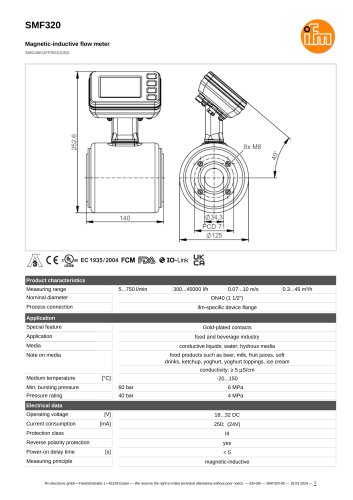


Archived catalogs
 IFM NEWSBOOK 2019
112 Pages
 ifm Connection technology
48 Pages
 Sensors for motion control
12 Pages
 ifm pumps
4 Pages
 ifm fans
4 Pages
 NEWSBOOK 2019/2020
134 Pages
 Identification systems
16 Pages
 Position sensors
20 Pages
 ifm compressors
4 Pages
 Systems for mobile machines
44 Pages
 ifmpressions
18 Pages
 DF1214
2 Pages
 DF2212
2 Pages
 DF1212
2 Pages
 DF1100
2 Pages
 Systems for mobile machines 2016
25 Pages
 Connection technology from ifm.
32 Pages
 Automation at first hand.
17 Pages


