
- Catalogs
- Idrotecnica Srl
- Water demineralizer as Reverse Osmosis Serie IDRO RO

- Products
- Catalogs
- News & Trends
- Exhibitions
Water demineralizer as Reverse Osmosis Serie IDRO RO
1 / 2 PagesView full catalog
Water demineralizer as Reverse Osmosis Serie IDRO RO
Product catalog summary
Overview of Reverse Osmosis Process:
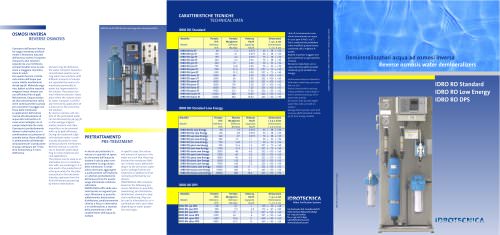
Reverse osmosis is a process that artificially reverses the natural phenomenon of osmosis. It involves applying pressure to a concentrated solution to transport water through a semipermeable membrane, effectively reducing the salt content in water by 96-99.5% and removing organic matter, bacteria, and impurities with up to 99% efficiency. The process is widely used for desalination of sea or brackish water in industrial and civil applications and can be combined with ion-exchange processes for ultra-pure water production in the pharmaceutical and electronic industries.
Reverse osmosis is a process that artificially reverses the natural phenomenon of osmosis. It involves applying pressure to a concentrated solution to transport water through a semipermeable membrane, effectively reducing the salt content in water by 96-99.5% and removing organic matter, bacteria, and impurities with up to 99% efficiency. The process is widely used for desalination of sea or brackish water in industrial and civil applications and can be combined with ion-exchange processes for ultra-pure water production in the pharmaceutical and electronic industries.
Technical Specifications:
The document provides detailed specifications for various models of reverse osmosis systems, including IDRO RO Standard, IDRO RO DPS, and IDRO RO Low Energy series. Each model is described with its delivery capacity, power consumption, and dimensions. The systems are designed to handle water with 1,500 ppm NaCl at 15°C, with average NaCl rejection rates of 98.8% for standard models and 97.5% for low energy models.
The document provides detailed specifications for various models of reverse osmosis systems, including IDRO RO Standard, IDRO RO DPS, and IDRO RO Low Energy series. Each model is described with its delivery capacity, power consumption, and dimensions. The systems are designed to handle water with 1,500 ppm NaCl at 15°C, with average NaCl rejection rates of 98.8% for standard models and 97.5% for low energy models.
Pre-Treatment Requirements:
In cases where the water contains species that may shorten membrane lifespan, additional pre-treatment is necessary. IDROTECNICA offers solutions such as quartzite filtration, softening, de-chlorination, disinfection, and chemical or physical conditioning, tailored to the water's origin and characteristics.
In cases where the water contains species that may shorten membrane lifespan, additional pre-treatment is necessary. IDROTECNICA offers solutions such as quartzite filtration, softening, de-chlorination, disinfection, and chemical or physical conditioning, tailored to the water's origin and characteristics.
Product Features and Applications:
The IDRO RO series is designed for high purity water production, featuring a two-stage reverse osmosis system for the DPS series and low-pressure membranes for the Low Energy series. These systems are fully automated, environmentally friendly, and require minimal maintenance. They are suitable for various applications, including manufacturing, electronics, chemical, cosmetic, food processing, irrigation, and healthcare facilities.
The IDRO RO series is designed for high purity water production, featuring a two-stage reverse osmosis system for the DPS series and low-pressure membranes for the Low Energy series. These systems are fully automated, environmentally friendly, and require minimal maintenance. They are suitable for various applications, including manufacturing, electronics, chemical, cosmetic, food processing, irrigation, and healthcare facilities.
Advantages:
The IDRO RO systems offer several advantages, such as producing sterile water, treating high-salt-content water, and operating without chemical reagents for regeneration. The systems are noted for their long membrane lifespan and reduced maintenance needs, making them ideal for industries, hospitals, laboratories, hotels, and communities.
The IDRO RO systems offer several advantages, such as producing sterile water, treating high-salt-content water, and operating without chemical reagents for regeneration. The systems are noted for their long membrane lifespan and reduced maintenance needs, making them ideal for industries, hospitals, laboratories, hotels, and communities.
See more
Catalog excerpts

41 sategag" sfeiig swsr "s^jmssr*, ^"jl'^i',''*'7^*" ■╕-~i^!l_. mmm 9ssss
Open the catalog to page 2All Idrotecnica Srl catalogs and technical brochures
 Water Softener Series BM
4 Pages
 Water Sterilizer UV Puro
2 Pages
 Water Purifier Osmodemi
6 Pages

*Prices are pre-tax. They exclude delivery charges and customs duties and do not include additional charges for installation or activation options. Prices are indicative only and may vary by country, with changes to the cost of raw materials and exchange rates.
About DirectIndustry
DirectIndustry is a marketplace that offers B2B players a complete experience, from product sourcing to purchase. DirectIndustry is an entity of VirtualExpo Group.
Are you a buyer?
Are you a supplier?