


RJ.S Relays und Sockets

RJ.S Relays und Sockets
- Large Switching Capacity: RJ1 relays support up to 12A, and RJ2 relays up to 8A, offering superior performance compared to competitors.
- Durability: Mechanical life expectancy is 30 million operations for AC coils and 50 million for DC coils.
- Design Features: Compact design with high visibility LED indicators and a unique light guide structure for easy identification.
- Environmental Compliance: Compliant with RoHS directive, free from hazardous substances like lead and mercury.
- Certifications: UL recognized, CSA certified, and EN compliant.
- Space Efficiency: Slim design suitable for DIN rail or panel mounting.
- Easy Maintenance: Equipped with release levers for easy relay removal.
- Wiring: Features finger-safe screw terminals and compatibility with RU series relays for increased contact capacity.
- Contact Ratings: RJ1S (1-pole) supports 12A, RJ2S (2-pole) supports 8A.
- Coil Ratings: Supports various AC and DC voltages, with specific power consumption and resistance values.
- Protection: IP40 degree of protection, with specified dielectric strength and vibration resistance.
- Electrical Life Curve: Shows the relationship between load current and operational life.
- Temperature Rise: Graphs depicting coil temperature rise against ambient temperature under different load conditions.
- Driving Circuit: Ensure correct voltage application and consider ripple factors for DC coils.
- Contact Protection: Use appropriate circuits to prevent contact welding and ensure reliability.
- General Precautions: Avoid dropping relays, exposure to strong magnetic fields, and ensure environments are free from contaminants.
The document outlines protection circuits for both AC and DC load power circuits, using resistors, capacitors, diodes, and varistors to suppress arcs and prevent contact welding. Recommendations are provided for different voltage ranges, emphasizing the use of components with appropriate ratings for effective protection.
The SJ Series offers slim, space-saving relay sockets with easy maintenance features. Two types are available: standard screw terminal and finger-safe screw terminal, both compliant with various international standards. Specifications include rated current, insulation voltage, applicable wire size, and dielectric strength. The document also details the physical dimensions and mounting instructions for these sockets.
Instructions for installing and removing relays are provided, highlighting the importance of secure installation to prevent damage. Detailed steps for panel mounting and the use of release levers are included, with cautions to avoid damage during these processes.
These relays are designed with environmental considerations and offer features like non-polarized LED indicators and mechanical flag indicators. Available in plug-in and PCB mount styles, with maximum contact ratings specified. Safety precautions emphasize turning off power before installation or maintenance to prevent electrical hazards.
Contact details for IDEC Corporation and its subsidiaries worldwide are provided, ensuring users can reach out for support or further information.
Catalog excerpts

Think Automation and beyond... RJ/SJ RJ Series Slim Power Relays SJ Series Relay Sockets
Open the catalog to page 1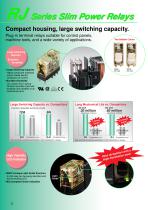
RJ Series Slim Power Relays Compact housing, large switching capacity. Plug-in terminal relays suitable for control panels, machine tools, and a wide variety of applications. Large Switching Capacity Excellent Durability • Large Switching Capacity Highly conductive materials ensure stable electric conduction of current. • Excellent Durability Our unique return spring structure provides improved durability and reliability of all mechanical parts. Large Switching Capacity vs. Competitors Long Mechanical Life vs. Competitors AC Coil (maximum allowable switching current) operations minimum 50 million...
Open the catalog to page 2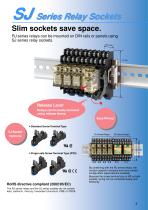
SJ Series Relay Sockets Slim sockets save space. RJ series relays can be mounted on DIN rails or panels using SJ series relay sockets. 15.5 mm Release Lever Relays can be easily removed using release levers. Easy Wiring! • Standard Screw Terminal Type Similar Dimensions • Finger-safe Screw Terminal Type (IP20) RoHS directive compliant (2002/95/EC) By combining with the RU series relays, the contact capacity increases and more contact conguration types become available. Because the screw terminal size is M3 on both sockets, wiring can be completed easily and efciently. The RJ series relays and...
Open the catalog to page 3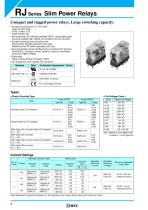
RJ Series Slim Power Relays Compact and rugged power relays. Large switching capacity. • Compact housing only 12.7-mm wide. Large contact rating RJ1S (1-pole): 12A RJ2S (2-pole): 8A • Non-polarized LED indicator available. IDEC’s unique light guide structure enables high visibility of coil status from any direction. • Excellent electrical and mechanical life. Electrical life: 200,000 operations (AC load) Mechanical life: 30 million operations (AC coil) • Environmentally friendly, RoHS directive compliant (EU directive 2002/95/EC). Contains no lead, cadmium, mercury, hexavalent chromium, PBB or...
Open the catalog to page 4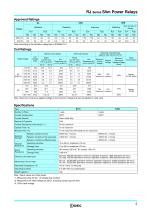
RJ Series Slim Power Relays Approved Ratings UL Note: According to the utilization categories of IEC60947-5-1 Coil Ratings Without LED Indicator Rated Voltage Coil Voltage Code Coil Minimum Resistance (Ω) Pickup ±10% (at 20°C) Voltage Power Maximum Consumption Dropout Continuous Voltage Applied Voltage (Note) Operating Characteristics (against rated values at 20°C) Note: Maximum continuous applied voltage is the maximum voltage that can be applied on relay coils. Specifications Type Contact Conguration Contact Material Silver-nickel alloy Contact Resistance (initial value) (∗1) 10 ms maximum...
Open the catalog to page 5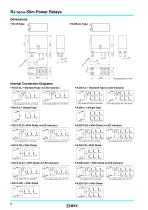
RJ Series Slim Power Relays Dimensions • RJ2S-CL Type Internal Connection Diagrams ∗ • RJ1S-CL-∗ Standard Type (w/LED Indicator) 1 (A1) ∗ • RJ2S-CL-∗ Standard Type (w/LED Indicator) 1 (A1) Coil voltage 24V AC/DC and below Coil voltage greater than 24V AC/DC Coil voltage 24V AC/DC and below Coil voltage greater than 24V AC/DC ∗ • RJ1S-CLD-∗ With Diode (w/LED Indicator) 1 (A1) – ∗ • RJ2S-CLD-∗ With Diode (w/LED Indicator) 1 (A1) – Coil voltage 24V DC and below Coil voltage greater than 24V DC Coil voltage 24V DC and below Coil voltage greater than 24V DC ∗ • RJ1S-CLD1-∗ With Diode (w/LED Indicator)...
Open the catalog to page 6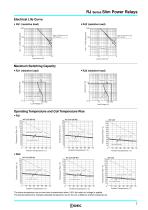
RJ Series Slim Power Relays Electrical Life Curve • RJ1 (resistive load) 250V AC Resistive Load (NO contact) 30V DC Resistive Load (NO Contact) 250V AC Resistive Load (NO contact) 30V DC Resistive Load (NO Contact) Maximum Switching Capacity • RJ1 (resistive load) Operating Temperature and Coil Temperature Rise Load Current 12A × 1 pole Load Current 12A × 1 pole Load Current 12A × 1 pole Load Current 8A × 2 poles Load Current 8A × 2 poles Load Current 8A × 2 poles The above temperature rise curves show characteristics when 100% the rated coil voltage is applied. The slanted dashed line indicates...
Open the catalog to page 7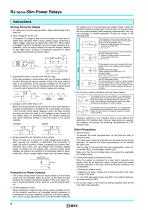
RJ Series Slim Power Relays Instructions 1. To make sure of correct relay operation, apply rated voltage to the relay coil. 2. Input voltage for the DC coil: A complete DC voltage is best for the coil power to make sure of stable relay operation. When using a power supply containing a ripple voltage, suppress the ripple factor within 5%. When power is supplied through a rectication circuit, the relay operating characteristics, such as pickup voltage and dropout voltage, depend on the ripple factor. Connect a smoothing capacitor for better operating characteristics as shown below. the release...
Open the catalog to page 8
SJ Series Relay Sockets Slim, space-saving relay sockets. Release lever allows for easy maintenance in narrow spaces. • 15.5-mm wide • Standard screw terminal and nger-safe screw terminal are available. • Degree of protection IP20 (nger-safe screw terminal) • The release lever makes installation and removal of relays inside small panels simple and quick. • RoHS compliant (EU directive 2002/95/EC) • UL recognized, CSA certied, EN compliant. Standard Approval organization / File No. EC Low Voltage Directive (Finger-safe screw terminal only) Type Standard Screw Terminal Finger-safe Screw Terminal...
Open the catalog to page 9
RJ Series Relay Sockets Dimensions • SJ1S-05B Replacement Parts Description Package Quantity Plastic (gray) Release Lever Accessories Description Aluminum Weight: Approx. 200 g Steel Weight: Approx. 200 g Package Quantity Mounting Clip Used on a DIN rail to fasten relay sockets. To prevent the sockets from damage, position the clip before fastening. Metal (zinc plated steel) Weight: Approx.15 g Plastic (black) Thickness: 5 mm Used for adjusting spacing between sockets mounted on a DIN rail
Open the catalog to page 10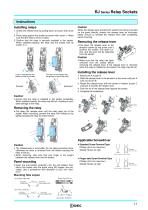
RJ Series Relay Sockets Instructions Installing relays 1. Unlock the release lever by pulling down as shown with arrow ➀. 2. Press relay against the socket as shown with arrow ➁. Make sure that the relay is rmly in place. 3. Conrm that the relay is securely installed in the socket. When installed properly, the relay and the socket look as shown in ➂. When the release lever prevents the socket from being mounted on the panel directly, remove the release lever as instructed below. Ensure to reinstall the release lever after completing panel mounting. Removing the release lever • Pull down the release...
Open the catalog to page 11All IDEC catalogs and technical brochures
 MACHINE TOOLS Industry Solutions
28 Pages
 ROBOTICS Industry Solutions
27 Pages
 Relay Selection Guide
16 Pages
 PUSH-IN PRODUCTS
12 Pages
 PRODUCT GUIDE
44 Pages
 HR6S
HR6S32 Pages
 KW2D SERIES
16 Pages
 LED-Leuchten: LF2B
6 Pages
 LED Illumination Units
28 Pages
 LED-Leuchten: LF1B-N
4 Pages
 Katalog FL1E
16 Pages
 RS485-Kommunikationsmodul
2 Pages
 Automation Organizer
2 Pages
 Web-Server-Modul
4 Pages
 MicroSmart DC12V
4 Pages
 FT1A SmartAXIS
36 Pages
 RTE/GT3/GE1A/GT5P/GT5Y
68 Pages
 Universalrelais RR/RY/RH/RU
59 Pages
 RV8H-Baureihe
6 Pages
 E-Stop Switches
16 Pages
 XA series
7 Pages
 High Performance
4 Pages
 HG1X
HG1X3 Pages
 FL1E
FL1E4 Pages
 product brochure
6 Pages
 All Product Brochure
6 Pages
 Complete Contactors Catalog
60 Pages
 Complete Terminal Blocks Catalog
22 Pages
 Complete Timer Catalog
68 Pages
 Complete Relay & Socket Catalog
68 Pages
 Complete Display Lights Catalog
44 Pages
 Complete Safety Overview
6 Pages
 Complete Power Supply Catalog
22 Pages
 Complete O/I Catalog
22 Pages
 Complete PLC Catalog
68 Pages



- DC power supply
- AC/DC power supply
- Rectangular housing
- Ethernet switch
- Electric gearmotor
- LED lighting
- Industrial network switch
- Plastic housing
- Single-pole switch
- Windows software
- Cloud-based software
- Push-button switch
- Power supply for industrial applications
- Switched-mode power supply
- Waterproof network switch
- Unmanaged switch
- Photoelectric sensor
- Compact power supply
- Indoor enclosure
- VirtualExpo Group
- Our Partners
- Recruitment
- Testimonials