

- Products
- Catalogs
- News & Trends
- Exhibitions
Complete Intrinsically Safe Barriers Catalog

Complete Intrinsically Safe Barriers Catalog
- Explosion Protection: Compliant with IEC60079, suitable for hazardous areas with [Exia] II C classification.
- Power Options: Available in universal AC power voltage (100 to 240V AC) or 24V DC power.
- Installation: Can be mounted on a 35-mm-wide DIN rail or directly on a panel.
- Global Certifications: Approved for use in the USA, Canada, Europe, China, Russia, Japan, and Korea.
- Wiring: Features spring-up terminals for reduced wiring time and supports both separate and common wiring methods.
- Explosion Protection: Certified for various international standards including UL/FM, CSA, ATEX, and others.
- Electrical Specifications: Rated for 250V AC/DC with specific ratings for intrinsically safe circuits.
- Relay and Transistor Outputs: Detailed specifications for contact configuration, rated insulation voltage, and load capacities.
- Environmental Conditions: Operating temperature range from -20 to +60°C, with specific humidity and atmospheric pressure requirements.
- Mounting: Options for panel or DIN rail mounting with specific dimensions and weight for each model.
- Wiring: Examples provided for both relay and transistor output types, with detailed circuit diagrams.
- Explanation of explosion mechanisms and the importance of preventing the coexistence of explosive gas, air, and ignition sources.
- Classification of hazardous areas based on the frequency of hazardous atmosphere presence.
- Types of explosion protection including flameproof, pressurized, and intrinsically safe methods.
- Comparison between Non-incendive (NI) and Intrinsic Safety (IS) standards, highlighting their applications and advantages.
- Details on explosion protection marking and the categorization of gases by explosiveness and ignition temperature.
- Power Supply and Isolation: Designed to prevent electric shock through reinforced isolation, conforming to IEC standards.
- Shield Wire Treatment: Grounded to the panel in non-hazardous areas, not connected to the N terminal on the barrier.
- Standards Compliance: Conforms to CE, ATEX, FM, CSA, NK, and UL standards.
- Common and Connector Types: Available for 8 and 16 circuits, facilitating easy connection to PLCs.
- Switches and Equipment Compatibility: Various switches and pilot lights can be connected with specific requirements.
- Installation: Easy installation with finger-safe spring-up terminals and universal voltage compatibility.
- Safety Precautions: Emphasizes electrostatic protection to prevent fire ignition and explosion.
- Connection Methods: Differences between EB3C and EB3L with specific instructions for sink and source combinations.
- Wiring and Cable Extension: Guidelines for cable types and lengths to ensure intrinsic safety.
- Noise Prevention: Recommendations include checking wiring to avoid noise interference and using noise filters for AC lines.
- Design Flexibility: Explosion-protected panels can be designed similarly to non-explosion protected panels.
- Connectable Illuminated Switches: A wide range of illuminated switches can be connected, enhancing control panel design flexibility.
Catalog excerpts
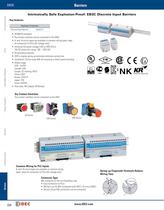
Barriers Automation Software PLCs OI Touchscreens EB3C Intrinsically Safe Explosion-Proof: EB3C Discrete Input Barriers Key features: Explosion Protection Discrete Input Barriers: [Exia] II C • IEC60079 compliant • Dry-contact switches can be connected to the EB3C • 8- and 16-circuit types are available in common wiring types, ideal for connection to PLCs (DC voltage only) • Universal AC power voltage (100 to 240V AC) or 24V DC power (UL rating: 100 ~ 120V AC) • No grounding required • IDEC’s original spring-up terminals minimizes wiring time • Installation: 35-mm-wide DIN rail mounting or direct panel mounting • Global usage USA: UL/FM Canada: CSA Europe: CE marking, ATEX China: CQST Russia: GOST-R Japan: TIIS Korea: KOSHA • Ship class: NK (Japan), KR (Korea) FM LISTED A P P ROV E D Power Supplies Dry Contact Switches Dry-contact switches can be connected to the EB3C. LB Series HW Series Communication Sensors CW Series Common Wiring for PLC Inputs 8- and 16-circuit types are available in common wiring types, ideal for connection to PLCs (DC voltage only). Spring-up Fingersafe Terminals Reduce Wiring Time Connector Type Barriers MIL connector on the non-hazardous side • Easy connection to PLCs • Wiring is cut by 90% (compared with IDEC’s 16-circuit EB3C) • Various 20-pin MIL connectors can be connected 224 www.IDEC.com Finger-safe
Open the catalog to page 1
Barriers EB3C OI Touchscreens Part Numbers Discrete Input Barriers Number of Channels Power Voltage Connection to Non-intrinsically Safe Circuit Input Wiring Method Output Part Number 1 EB3C-R01A 2 EB3C-R02A 3 EB3C-R03A 5 Separate/Common Wiring Compatible 6 EB3C-R05A Relay EB3C-R06A EB3C-R08A EB3C-R10A 8 Common Wiring Only EB3C-R08CA 1 EB3C-T01A 2 100 to 240V AC (UL rating: 100 ~ 120V AC) EB3C-T02A 3 EB3C-T03A Separate/Common Wiring Compatible Transistor (Sink/Source) EB3C-T05A 6 EB3C-T06A 8 EB3C-T08A 10 Automation Software 5 EB3C-T10A 8 Sink 16 Common Wiring Only 8 Transistor Source 16 1 Screw...
Open the catalog to page 2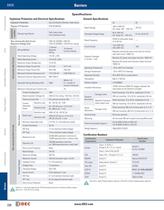
Barriers Specifications Explosion-Protection and Electrical Specifications General Specifications Explosion Protection See Certification Numbers table below Degree of Protection IP20 (IEC60529) Installation Location OI Touchscreens EB3C Safe indoor place (non-hazardous area) AC DC Rated Voltage 100 to 240V AC (UL rating: 100 ~ 120V AC) 24V DC Allowable Voltage Range 85 to 264V AC (UL rating: 85 ~ 125V AC) 21.6 to 26.4V DC 250V AC 50/60Hz, 250V DC 125V AC 50/60Hz, 125V DC (UL rating) Rated Frequency 50/60 Hz (allowable range: 47 to 63 Hz) — Inrush Current 10A (100V AC) 20A (200V AC) 10A Wiring...
Open the catalog to page 3
Barriers EB3C Internal Circuit Block Diagrams AC Power, Relay Output Type DC Power, Transistor Output Type Connector Wiring, Sink Output Type Hazardous Area •••••••• P1 N1 Green P2 N2 Yellow P1 N1 P3 N3 Yellow Yellow Yellow Green P3 N3 Yellow P1 • • • • P16 N1 Yellow + A1 C1 A2 C2 A3 C3 N2 Non-hazardous Area Yellow PLCs N Yellow Green ~ ~ ~ ~ L P2 N2 OI Touchscreens Circuit Diagrams ~ ~ ~ – A1 C1 A2 C2 A3 C3 + – A1 • • • • A16 C1 C2 Automation Software Wiring Examples External Wiring Examples Transistor Sink Output Type (Ex.: EB3C-T08CKD) Transistor Source Output Type (Ex.: EB3C-T08CSD) A5 A6...
Open the catalog to page 4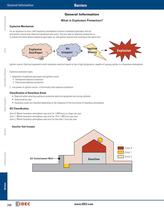
Barriers General Information What is Explosion Protection? Explosion Mechanism For an explosion to occur, both hazardous atmosphere (mixture of explosive gas/vapor and air) and ignition source from electrical equipment must exist. The first step for explosion prevention is to prevent the three factors (explosive gas/vapor, air, and ignition source) from existing at the same time. Explosive Gas/Vapor PLCs OI Touchscreens General Information + Air (oxygen) + Ignition Source Explosion Automation Software Ignition source: Electrical equipment which originates electrical sparks or has a high temperature,...
Open the catalog to page 6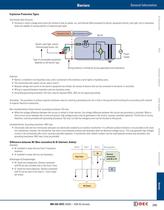
Barriers General Information Explosion Protection Types Hazardous Area Non-hazardous Area OI Touchscreens Intrinsically Safe Structure • Structure in which voltage and current are limited so that no sparks, arc, and thermal effect produced by electric equipment (switch, pilot light, etc) in hazardous areas are capable of causing ignition of explosive gas/vapor. Barrier PLCs Switch, pilot light, sensor, thermocouple buzzer, etc. Power Supply Type of connectable equipment depends on the barrier type. Automation Software Wiring distance is limited by wiring capacitance and inductance. Features:...
Open the catalog to page 7
Barriers General Information NI Structure resistance resistance When the zener is broken, the When the zener is broken, the voltage cannot be limited: high voltage cannot be limited: high voltage is applied to the connecting voltage is applied to the connecting device side, which could lead to device side, which could lead to explosion. explosion. Zener Zener (for Voltage (for Voltage Limitation) Limitation) PLCs OI Touchscreens Structure IS Structure resistance resistance Automation Software Power Supplies The fuse is for current limitation The fuse is for current limitation fuse fuse These...
Open the catalog to page 8
Barriers General Information EB3C (10-circuit) Weight: 380g Dimensions: 171.5 L × 75 W × 77.5 H (mm) • Plastic housing EB3L (10-circuit) Weight: 360g Dimensions: 171.5 L × 75 W × 77.5 H (mm) OI Touchscreens EB3C/EB3L Features Small and lightweight • Small system design No grounding required: less labor, less cost No explosion protection grounding. PLCs Isolation transformer is used. All isolations – not only between primary and secondary, but also cores and bobbins – are reinforced. No isolator = No grounding Power supply part: Electric shock is prevented with reinforced isolation. Conforms to...
Open the catalog to page 9
General Information Barriers PLCs OI Touchscreens Standards Less labor 1. CE Conforms to EMC directive and LVD. EMC directive: Electromagnetism generated by the barrier does not affect other communication equipment. Also, electromagnetism generated by other communication equipment does not affect the barrier. LVD (Low Voltage Directive): For rated voltages 50 to 1000V AC, 75 to 1500V DC. 1. Finger-safe spring-up terminal The finger-safe, captive spring-up terminals prevent electric shock (IP20), and make installation easy. No screw loss. 2. ATEX Adopted by EU, this directive covers electrical...
Open the catalog to page 10All IDEC catalogs and technical brochures
 Web Server Module
2 Pages
 IDEC FL1D SmartRelay
12 Pages
 MicroSmart
28 Pages
 AP22M Series
4 Pages
 IDEC E-S top Switches
6 Pages
 Complete Contactors Catalog
60 Pages
 Circuit Breakers Catalog
12 Pages
 Complete Terminal Blocks Catalog
22 Pages
 Complete Timer Catalog
52 Pages
 Complete Relay & Socket Catalog
76 Pages
 Complete Display Lights Catalog
44 Pages
 Complete Safety Overview
4 Pages
 Sensor catalog
55 Pages
 Complete Power Supply Catalog
20 Pages
 Complete O/I Catalog
29 Pages
 Complete PLC Catalog
64 Pages
 All Product Brochure
6 Pages


- Display module
- LCD display panel
- LED lighting
- Single-pole switch
- Windows software
- Junction block
- IO module
- Push-button switch
- Level probe
- Liquid level sensor
- Switching relay
- Analog I/O
- Technology switch
- Photoelectric sensor
- Multipole switch
- Programming software
- Electromechanical switch
- Touch screen HMI
- Electromechanical relay