
- Catalogs
- IDB Systems Ltd
- ID - 909

ID - 909
ID - 909
- Input Power Options: 100V - 240V AC, 50Hz - 60Hz.
- Resistivity Measurements: Range from 108 to 1016 Ωm. Eight ranges available, with specific full-scale deflection (FSD) at different applied voltages.
- Sample Cell Volume: 28ml.
- Charge Measurements (Optional): Range from 10-6 to 10-8 Coulombs, with three ranges for bipolar FSD.
- Display: 5” TFT Touchscreen with 800 x 480 resolution.
- Dimensions: 530 x 322 x 160 mm, suitable for 19” rack or free-standing.
- Self-Test & Maintenance: Tailored to application.
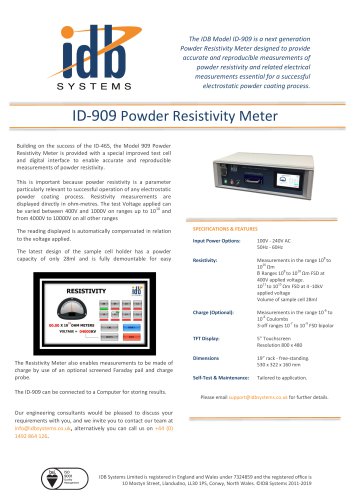
The IDB Model ID-909 is a next-generation Powder Resistivity Meter designed for accurate and reproducible measurements of powder resistivity, crucial for electrostatic powder coating processes. It builds on the success of the ID-465 model, featuring an improved test cell and digital interface.
- Test Voltage: Adjustable between 400V and 1000V for ranges up to 1010 Ωm, and 4000V to 10000V for other ranges.
- Automatic Compensation: Readings are automatically adjusted based on the applied voltage.
- Sample Cell Design: The cell holds 28ml of powder and is fully demountable for easy cleaning.
- Charge Measurement: Optional feature using a screened Faraday pail and charge probe.
- Data Connectivity: Can be connected to a computer for result storage.
For further details, email [email protected]. For inquiries, contact [email protected] or call +44 (0) 1492 864 126.
Catalog excerpts

The IDB Model ID-909 is a next generation Powder Resistivity Meter designed to provide accurate and reproducible measurements of powder resistivity and related electrical measurements essential for a successful electrostatic powder coating process. ID-909 Powder Resistivity Meter Building on the success of the ID-465, the Model 909 Powder Resistivity Meter is provided with a special improved test cell and digital interface to enable accurate and reproducible measurements of powder resistivity. This is important because powder resistivity is a parameter particularly relevant to successful operation of any electrostatic powder coating process. Resistivity measurements are displayed directly in ohm-metres. The test Voltage applied can 10 be varied between 400V and 1000V on ranges up to 10 and from 4000V to 10000V on all other ranges The reading displayed is automatically compensated in relation to the voltage applied. SPECIFICATIONS & FEATURES Measurements in the range 10 to 16 10 Ωm 8 10 8 Ranges 10 to 10 Ωm FSD at 400V applied voltage. 11 15 10 to 10 Ωm FSD at 4 -10kV applied voltage Volume of sample cell 28ml Measurements in the range 10 to -8 10 Coulombs -7 -9 3-off ranges 10 to 10 FSD bipolar The Resistivity Meter also enables measurements to be made of charge by use of an optional screened Faraday pail and charge probe. Charge (Optional): The latest design of the sample cell holder has a powder capacity of only 28ml and is fully demountable for easy cleaning. Input Power Options: Self-Test & Maintenance: The ID-909 can be connected to a Computer for storing results. Please email [email protected] for further details. Our engineering consultants would be pleased to discuss your requirements with you, and we invite you to contact our team at [email protected], alternatively you can call us on +44 (0) 1492 864 126. IDB Systems Limited is registered in England and Wales under 7324859 and the registered office is 10 Mostyn Street, Llandudno, LL30 1PS, Conwy, North Wales. ©IDB Systems 2011
Open the catalog to page 1All IDB Systems Ltd catalogs and technical brochures



- Measuring device
- Industrial tester
- Digital gauge
- Industrial measuring module
- Benchtop measuring module
- Measuring instrument with display
- Digital test equipment
- Laboratory measuring instrument
- High-precision gauge
- Field measuring instrument
- Hand-held gauge
- Process measuring module
- Electrical resistance test kit
- Control measuring instrument
- Ground bond tester
- Resistivity measuring instrument
- Powdery material measuring instrument
- Electrostatic field measuring instrument