


- Company
- Products
- Catalogs
- News & Trends
- Exhibitions
TP02

TP02
The TP02 is a non-steady-state probe designed for measuring thermal conductivity or resistivity with high accuracy. It complies with ASTM D 5334-00, D 5930-97, and IEEE 442-1981 standards, making it suitable for various materials such as soils, sediments, and foodstuffs. The probe uses the transient line source method, which is fast and does not require critical sample sizes.
Design and Functionality
The TP02 consists of a needle with two thermocouple junctions and a heating wire. The design ensures optimal accuracy and minimal sensitivity to thermal gradients. The needle length is 150 mm, and the probe includes a reference temperature sensor (Pt1000) in the base. This configuration allows for accurate measurements independent of medium temperature.
Measurement Principle
The probe operates by measuring the temperature rise (∆T) which depends on heater power (Q) and medium thermal conductivity (λ). The formula used is ∆T = (Q / 4 π λ) (ln t + B). Measurements are direct and absolute, without the need for reference materials.
Specifications
- Test Method: ASTM D 5334-00, D 5930-97, IEEE Std 442-1981
- Needle Length: 150 mm
- Thermal Conductivity Range: 0.1 to 6 W/m.K
- Temperature Range: -55 to +180 °C
- Accuracy: +/- (3% + 0.02) W/mK at 20 °C
- Protection: IP 68 for needle and base, IP 67 for total sensor
Calibration and Standards
TP02 can be calibrated using Calibration Reference Cylinders traceable to NPL. It is suitable for ISO certified labs. Standards can be obtained from ASTM.
Additional Information
Hukseflux offers alternative designs and solutions for measurement and control. The TP02 manual is available for further details. For high accuracy calibration, CRC Calibration Reference Cylinders are available.
Catalog excerpts
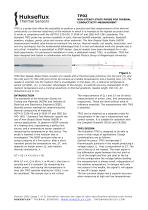
TP02 NON-STEADY-STATE PROBE FOR THERMAL CONDUCTIVITY MEASUREMENT TP02 is a probe that offers the possibility to perform a practical and fast measurement of the thermal conductivity (or thermal resistivity) of the medium in which it is inserted at the highest accuracy level. It works in compliance with the ASTM D 5334-00, D 5930-97 and IEEE 442-1981 standards. The standard TP02 probe has proven suitability in soils, thermal backfill materials, sediments, foodstuff, powders, sludges, paints, glues and various other materials. The Non-Steady-State Probe (NSSP) measurement method (also known as transient line source, thermal needle, hot needle, heat pulse- and hot wire technique) has the fundamental advantages that it is fast and absolute while the sample size is not critical. Hukseflux is specialised in NSSP design. Special models have been developed for in-situ field experiments. For permanent installation in soils, a dedicated model, TP01, is available. TP02 has been designed and tested in collaboration with the Applied Physics Group of Wageningen University. Figure 1 TP02 Non-Steady-State Probe consists of a needle with 2 thermocouple junctions; the hot joint (3), and the cold joint (4) (the cold joint at the tip remains at a stable temperature) and a heating wire, (2). The needle is inserted into the medium that is investigated. In the base, (6), a reference temperature sensor (pt1000), (1), is mounted. Advantages of this design: an optimal accuracy independent of the medium temperature and a minimal sensitivity to thermal gradients. Needle length 150 mm. All dimensions are in mm. INTRODUCTION The standards of the American Society for Testing and Materials (ASTM) and Institute of Electrical and Electronics Engineers (IEEE) describe proven methods for determining the thermal conductivity of materials. ASTM D 5334-00 and D 5930-97 and IEEE Std 442-1981 " Standard Test Methods" specify the use of Non-Steady-State Probes (NSSP) in various applications. In general a NSSP consists of a heating wire, representing a perfect line source, and a temperature sensor capable of measuring the temperature at this source. The probe is inserted in the medium that is investigated. The NSSP principle relies on a unique property of a line source: after a short transient period the temperature rise, ∆T, only depends on heater power, Q, and medium thermal conductivity, λ: ∆T = (Q / 4 π λ) (ln t + B) With ∆T in K, Q in W/m, λ in W/mK, t the time in seconds and B a constant. By measuring the heater power, and tracing the temperature in time (for TP02 typically heating for 100s), λ can be calculated. The sample size is not critical. The measurements of Q, t and ∆T are all direct measurements of power, time, and temperature respectively. These are done without need of reference materials. The measurement with TP02 is absolute. TP02 can be obtained as a separate probe for incorporation in the user's measurement and control system. It is suitable for operation with the Campbell Scientific CR10X and CR1000. TP02 DESIGN The Hukseflux TP02 is designed to be able to cover a wide range of applications. Design considerations are as follows: Optimal Accuracy: TP02 incorporates 2 thermocouple junctions in the needle producing a voltage output, U, that is proportional to ∆T. The one in the tip is not heated. The main signal is the differential signal between this hot joint at 1/3 of the length and the cold joint at the tip. In this configuration the voltage before starting the measurement is always small, independent of the medium temperature. In designs with only one sensor in the needle, the signal U will appear on top off a larger signal. The two junction design has a superior accuracy when measuring at high and low temperatures. V ers io n 1002 (page 1 of 2 ) Huks ef lux re serv es the r ig ht to alter s pec if ic atio ns w ithout pr ior no tic e HUKSEFLUX™ THERMAL SENSORS. WWW.HUKSEFLUX.COM . [email protected]
Open the catalog to page 1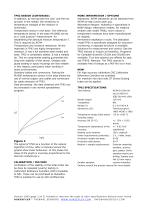
TP02 DESIGN (CONTINUED) In addition, by having both the cold- and the hot junction in the needle, the sensitivity to temperature changes of the medium is minimised. Temperature sensor in the base: The reference temperature sensor in the base (Pt1000) serves as a “cold junction” measurement for establishing the absolute medium temperature T. This is required by ASTM. Temperature and moisture resistance: All the materials in TP02 are highly temperature resistant. It has a full stainless steel needle and base. TP02 is completely sealed. It has a welded tip. This no-compromise sealing guarantees...
Open the catalog to page 2All Hukx catalogs and technical brochures
 Dome protector DP01
5 Pages
 Foil heat flux sensor FHF06
6 Pages
 SR20 PYRANOMETER
4 Pages
 Pyrgeometer with heater IR02
6 Pages
 Ventilation unit VU01
6 Pages
 SRA30-M2-D1
3 Pages
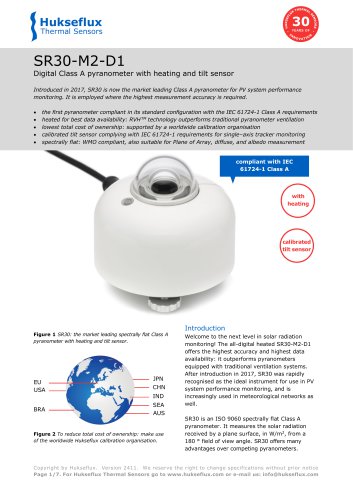 SR30-M2-D1
7 Pages































Archived catalogs
 TRSYS20
4 Pages
 IHF02 heat flux sensor
4 Pages
 SR22 pyranometer
4 Pages
 SR25
SR254 Pages
 SR05-D1A3-PV pyranometer
4 Pages
 SR15 series
4 Pages
 choose the best pyranometer
5 Pages
 TP08
TP082 Pages
 TP01
TP011 Page
 TRSYS01
1 Page
 TNS01
TNS011 Page
 THISYS
3 Pages
 SR11-TR PYRANOMETER
2 Pages
 SR11 PYRANOMETER
2 Pages
 WS01
WS011 Page
 CRC series
1 Page
 GT series
2 Pages
 TPSYS02
1 Page
 THASYS
2 Pages
 IR02-TR
1 Page
 DR01
DR012 Pages
 SR12 PYRANOMETER
2 Pages
 SR20-TR pyranometer
2 Pages
 IR20 & IR20WS PYRGEOMETER
2 Pages
 ALUSYS
1 Page
 SR11-TR
1 Page
 NF02
NF021 Page
 HFP01
HFP011 Page
- Measuring device
- Data logger
- Resistance temperature sensor
- Plastic cap
- USB datalogger
- Waterproof temperature sensor
- Data-logger with screen
- Resistance heater
- Portable gauge
- Battery-powered datalogger
- Pt1000 temperature transducer
- RTD temperature sensor
- Industrial measuring module
- Precision temperature transducer
- Compact temperature probe
- 4-wire temperature sensor
- Rectangular label
- Digital datalogger