


- Company
- Products
- Catalogs
- News & Trends
- Exhibitions
Shadow ring for pyranometers SHR02

Shadow ring for pyranometers SHR02
The SHR02 is a metal shadow ring designed for use with pyranometers to measure diffuse solar irradiance by blocking direct sunlight. It is compatible with Hukx pyranometers and serves as a cost-effective alternative to sun trackers, suitable for meteorological observations, building energy performance, and solar energy studies.
The SHR02 is compatible with SR15 and SR30 sensors, with optional adapters for SR20, SR22, and SR25 models. The package includes components such as a base plate, tilt adjustment stage, central support, sliding bars, shadow ring, and necessary hardware.
The SHR02 blocks direct solar radiation, allowing the pyranometer to measure only diffuse radiation. Regular adjustments are necessary to account for the sun's changing position, with correction factors available to mitigate measurement inaccuracies.
Specifications include dimensions and correction factors to ensure accurate setup and operation.
The installation involves assembling the SHR02, selecting an appropriate site, and aligning the device. Proper alignment is crucial for accurate measurements.
Regular maintenance and quality assurance are recommended to ensure reliable and accurate operation of the SHR02.
Common issues such as high irradiance levels and alignment errors are addressed with solutions provided.
Additional resources include a mounting pattern and an adjustment table for sliding bar settings and correction factors.
Shadow ring devices should be used following ISO TR9901 and WMO Guide 7.3.3.3. Key points include ensuring zero offset of pyranometers, proper alignment of the shadow ring, and using appropriate correction factors.
Instruments should adhere to ISO, ASTM, and WMO standards for solar radiation measurement. Pyranometers are classified according to ISO 9060 and WMO-No. 8 Guide.
The SHR02 is used for diffuse solar irradiance measurements with pyranometers, forming a "diffusometer." It is compatible with various pyranometer models and operates within a temperature range of -40 to +80 °C.
The assembly takes about thirty minutes, involving steps like attaching the base plate and adjusting the horizontal bar. Site selection should ensure a clear horizon, and alignment involves azimuthal, zenithal, latitudinal, and solar altitude adjustments.
Azimuthal alignment can be achieved using a map, GPS coordinates, or sun transit time. Zenithal alignment requires leveling the instrument using set screws.
Instructions for setting up a pyranometer focus on aligning the shadow ring parallel to the equatorial plane based on the location's latitude.
Different mounting procedures are outlined for various pyranometer models, emphasizing proper leveling using a bubble level.
The shadow ring's position should be adjusted throughout the year using sliding bars to account for changes in the sun's altitude.
Regular maintenance includes manual adjustments, data analysis, cleaning, inspection, recalibration, and desiccant replacement.
Steps are provided to ensure proper alignment and adjustment of the shadow ring and pyranometer.
Hukx is a leader in solar radiation and heat flux sensor technology, offering high-accuracy measurement solutions worldwide.
Catalog excerpts

User manual Shadow ring for pyranometers
Open the catalog to page 1
Warning statements Ensure that SHR02 is connected to the protective earth to reduce electrical shock risk and increase instrument operation reliability. Ensure that the installed pyranometer housing is connected to reduce electrical shock risk and increase instrument operation reliability.
Open the catalog to page 2
1 Ordering and checking at delivery 8 1.1 Ordering industrial pyranometers 8 2 Instrument principle and theory 11 2.5 General usage recommendations 15 3 Standards and recommended practices for use 16 3.1 General rules for solar radiation measurement 16 3.2 Specific use in meteorology and climatology 16 3.3 Pyranometer classification standard 17 6.1 Recommended maintenance and quality assurance 34 7.1 Irradiance level too high 36 8.2 Adjustment table: sliding bar settings and corresponding correction factors 40
Open the catalog to page 3
quantities symbol Global horizontal In-plane solar irradiance Gi Diffuse Horizontal Instrument dome radius r Shadow ring radius R Shadow ring rim height h Shadow ring width w Shadow ring sliding x Correction factor diffuse f radiation component Latitude of installation lat Solar declination angle dec Hour angle at sunset t0 in-plane portion diffuse portion value at a chosen reference condition obscured portion contribution related to instrument dome contribution assuming symmetrical instrument
Open the catalog to page 4
Introduction SHR02 is a practical metal shadow ring that helps making diffuse solar irradiance measurements with pyranometers. The shadow ring, also known as a shadow band, prevents direct radiation from reaching the pyranometer, so that the shaded pyranometer measures diffuse radiation only. The combination of a shadow ring and a pyranometer is called a diffusometer by the ISO 9060:2018 standard. The compact SHR02, combined with a Hukx pyranometer, has several advantages over competing models. SHR02 is compatible with most Hukx pyranometers. Hukx pyranometers have very low zero offsets, so that...
Open the catalog to page 5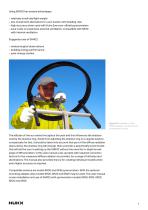
Using SHR02 has several advantages: – relatively small size/light weight – low-investment alternative for a sun tracker with shading-disc – high accuracy when used with Hukx (low zero-offset) pyranometers – save costs on expensive external ventilation; compatible with SR30 with internal ventilation Suggested use of SHR02: – meteorological observations – building energy performance – solar energy studies Figure 0.2 Installation of the SHR02 shadow ring with a Hukx pyranometer is easy. The altitude of the sun varies throughout the year and this influences the shadow cast by the shadow ring. Aside...
Open the catalog to page 6
Figure 0.3 Pyranometer example: SR15, combined with SHR02 forming a diffusometer.
Open the catalog to page 7
The standard configuration of SHR02 is for use with SR15 / SR30 sensor. Common options are: - Mounting adapter for SR20 / SR22 / SR25. Specify PMA01 Table 1.1.1 Overview of versions in the BLK - GLD sticker series. (continued on next page). SHR02 Shadow ring for pyranometers, combined with a pyranometer forming a diffusometer (pyranometer is not included in SHR02 delivery) Arriving at the customer, the delivery should include: 2. 1 x tilt adjustment stage (with engraved rotation scale in °) with pyranometer mounting plate 3. 1 x central support, horizontal bar connected to pyranometer support...
Open the catalog to page 8
For assembling and mounting the shadow ring, the following tooling is recommended: For leveling and/or adjusting the shadow ring, the following tooling is recommended: Consult your pyranometer user manual for tooling recommended for removal of the pyranometer feet.
Open the catalog to page 10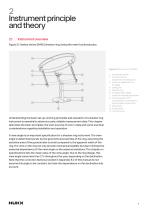
2. thumbscrew for adjustment of sliding bars 3. screw for adjustment of tilt stage 6. tilt adjustment stage 7 screw for latitude adjustment 8. central support with horizontal bar connected to pyranometer support arm Understanding the basic set-up, working principles and operation of a shadow ring instrument is essential to attain accurate, reliable measurement data. This chapter describes the basic principles, the main sources of error in data and some practical considerations regarding installation and operation. A view angle is an important specification for a shadow ring instrument. The view...
Open the catalog to page 11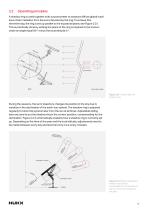
Operating principles A shadow ring is used together with a pyranometer to measure diffuse global irradiance. Direct radiation from the sun is blocked by the ring. To achieve this the entire day, the ring is set up parallel to the equatorial plane; see Figure 2.2.1. This is practically done by setting the plane of the ring compared to the horizon under an angle equal 90 ° minus the local latitude in °. Figure 2.2.1 The principle of a shadow ring. During the seasons, the sun’s trajectory changes its position in the sky due to variation in the declination of the earth-sun system. The shadow ring...
Open the catalog to page 12
Most shadow rings are used with the pyranometer mounted horizontally. Using the incorporated tilt adjustment stage, the pyranometer can also be mounted in a tilted position. In this case, the diffuse irradiance in the tilted plane is measured. To keep the pyranometer shaded, the ring must stay aligned with the equatorial plane. There are two main sources of error that may affect the accuracy of the diffuse irradiance component: – measurement errors – errors due to unintentional blockage by the ring Measurement errors, inherent to the type of pyranometer and data logger used, can generally be...
Open the catalog to page 13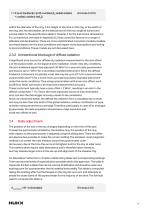
f = 2 (w+h |tan(dec)|) / (pi R) cos3(dec) [t0 sin(lat) sin(dec) + cos(lat) cos(dec) sin(t0)] with R the diameter of the ring, h the height of the rims on the ring, w the width of the ring, dec the declination, lat the latitude and t0 the hour angle at sunset and sunrise. Refer to the specification table in Chapter 4 for the instrument dimensions. For convenience, the table in Appendix 8.2 lists correction factors for a range of latitudes and declinations. There are more sophisticated correction models possible, but these depend on the local conditions and require more assumptions and tuning to...
Open the catalog to page 14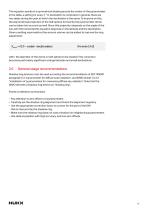
This equation results in a symmetrical shading around the center of the pyranometer. In the table, a setting for every 1 ° in declination is computed. In general, there are two dates during the year at which the declination is the same. To improve on this, the asymmetrical projection of the half-sphere formed by the pyranometer dome can be taken into account as well. Since this projection depends on the angle of the sun with the horizontal this equation depends on the latitude and the declination. Given a setting xsymmetrical the amount xdome can be added to improve the ring adjustment: Xdome...
Open the catalog to page 15All Hukx catalogs and technical brochures
 Dome protector DP01
5 Pages
 Foil heat flux sensor FHF06
6 Pages
 SR20 PYRANOMETER
4 Pages
 Pyrgeometer with heater IR02
6 Pages
 Ventilation unit VU01
6 Pages
 SRA30-M2-D1
3 Pages
 SR30-M2-D1
7 Pages






























Archived catalogs
 TRSYS20
4 Pages
 IHF02 heat flux sensor
4 Pages
 SR22 pyranometer
4 Pages
 SR25
SR254 Pages
 SR05-D1A3-PV pyranometer
4 Pages
 SR15 series
4 Pages
 choose the best pyranometer
5 Pages
 TP08
TP082 Pages
 TP02
TP022 Pages
 TP01
TP011 Page
 TRSYS01
1 Page
 TNS01
TNS011 Page
 THISYS
3 Pages
 SR11-TR PYRANOMETER
2 Pages
 SR11 PYRANOMETER
2 Pages
 WS01
WS011 Page
 CRC series
1 Page
 GT series
2 Pages
 TPSYS02
1 Page
 THASYS
2 Pages
 IR02-TR
1 Page
 DR01
DR012 Pages
 SR12 PYRANOMETER
2 Pages
 SR20-TR pyranometer
2 Pages
 IR20 & IR20WS PYRGEOMETER
2 Pages
 ALUSYS
1 Page
 SR11-TR
1 Page
 NF02
NF021 Page
 HFP01
HFP011 Page
- Temperature probe
- Measuring device
- Data logger
- Resistance temperature sensor
- Plastic cap
- USB datalogger
- Waterproof temperature sensor
- Thermocouple temperature transducer
- Data-logger with screen
- Resistance heater
- Portable gauge
- Battery-powered datalogger
- Pt1000 temperature transducer
- RTD temperature sensor
- Industrial measuring module
- Precision temperature transducer
- Compact temperature probe
- 4-wire temperature sensor
- Rectangular label
- Digital datalogger