


- Company
- Products
- Catalogs
- News & Trends
- Exhibitions
Analog 4-component net radiometer NR01

Analog 4-component net radiometer NR01
The NR01 is a leading 4-component net radiometer designed for scientific-grade energy balance and surface flux networks. It measures global and reflected solar radiation using pyranometers, and downwelling and upwelling longwave radiation using pyrgeometers. The device features a modular design, low weight, and ease of leveling, with heating capabilities to reduce errors from dew deposition.
Key Features
- Modular design with two pairs of identical sensors.
- Spectrally flat Class C pyranometers compliant with WMO standards.
- Heated pyrgeometers for improved nighttime data accuracy.
- Low solar offsets in longwave measurements.
- Easy to mount with a 2-axis leveling assembly.
Applications
The NR01 is suitable for energy balance studies, surface flux measurements, and climatological networks. Its design allows for easy servicing and recalibration, making it ideal for large monitoring networks.
Compliance and Standards
The NR01 complies with ISO 9060 and WMO-No. 8 standards, ensuring accurate measurements of reflected solar radiation. It uses spectrally flat sensors for both global and reflected solar radiation.
Operation
The NR01 connects directly to common data logging systems. Irradiance levels are calculated by dividing the output voltages by sensor sensitivities, with corrections for instrument body temperature.
Specifications
- Spectral range for solar: 285 to 3000 nm
- Spectral range for longwave: 4.5 to 42 µm
- Heater power: 1.5 W at 12 VDC
- Operating temperature: -40 to +80 °C
- Calibration uncertainty: <2.4% for solar, <7% for longwave
Reference Users
The NR01 is used by networks such as the U.S. NEON, Indian DGRE, and UK CEH. Its inclusion in these networks highlights its reliability and performance.
Options and Accessories
- Longer cables available.
- Optional 10 kΩ thermistor.
- RA01 radiometer and CMF01 mounting fixture available.
About Hukx
Hukx is a leader in solar radiation and heat flux sensor technology, headquartered in the Netherlands with global offices. They offer comprehensive support from sensor design to recalibration.
Catalog excerpts
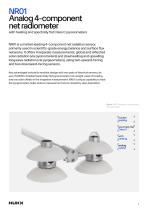
with heating and spectrally flat Class C pyranometers NR01 is a market-leading 4-component net radiation sensor, primarily used in scientific-grade energy balance and surface flux networks. It offers 4 separate measurements: global and reflected solar radiation (via pyranometers) and downwelling and upwelling longwave radiation (via pyrgeometers), using two upward-facing and two downward-facing sensors. Key advantages include its modular design with two pairs of identical sensors, its use of (WMO compliant) spectrally flat pyranometers, low weight, ease of leveling, and low solar offsets in the...
Open the catalog to page 2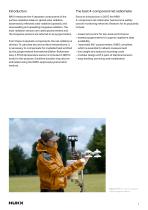
NR01 measures the 4 separate components of the surface radiation balance: global solar radiation (downward), reflected solar radiation (upward), and downwelling and upwelling longwave radiation. The solar radiation sensors are called pyranometers and the longwave sensors are referred to as pyrgeometers. Since its introduction in 2007, the NR01 4-component net radiometer has become widely used in monitoring networks. Reasons for its popularity include: From these 4 separate components, the net radiation is derived. To calculate sky and surface temperatures, it is necessary to compensate for irradiated...
Open the catalog to page 3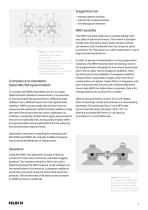
Suggested use – energy balance studies – surface flux measurements – climatological networks Figure 3 Overview of NR01: 1. upfacing pyrgeometer 2. sun screens 3. leveling assembly for x- and y-axis 4. leveling assembly for x- and y-axis 5. upfacing pyranometer 6. downfacing pyranometer 7. leveling assembly for x- and y-axis 8. downfacing pyrgeometer Compliance to standards: Spectrally flat pyranometers To comply with WMO standards and for accurate reflected solar radiation measurement, it is essential to use spectrally flat pyranometers. Reflected solar radiation has a different spectrum than...
Open the catalog to page 4
Until 2022, the U.S. National Ecological Observatory Network (NEON) was the world's largest network employing 4-component net radiometers. After extensive testing, NEON published a list of sensors. We are proud that model NR01 made it onto this list. In 2022, the Indian Defence Geo-Informatics Research Establishment (DGRE) selected NR01 for its 248-station climate monitoring network in the Himalayas. The UK Centre for Ecology and Hydrology (CEH) also included NR01 in its measurement network. NOTE: A sensor being included in a network does not constitute a formal endorsement by the network owner....
Open the catalog to page 5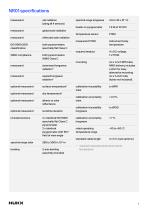
optional measurand optional measurand optional measurand optional measurand included sensors spectral range solar leveling net radiation (using all 4 sensors) global solar radiation reflected solar radiation both pyranometers: spectrally flat Class C both pyranometers: WMO Class C downward longwave radiation* upward longwave radiation* surface temperature* albedo or solar reflectance sunshine duration 2 x identical ISO 9060 spectrally flat Class C pyranometer 2 x identical pyrgeometer with 150 ° field of view angle 2-axis leveling assembly included spectral range longwave heater on pyrgeometer...
Open the catalog to page 6
About Hukx Hukx is the leading innovator in solar radiation and heat flux sensor technology. We are proud to set the standard in high-accuracy measurement, and to be working at the heart of the energy transition. Customers worldwide rely on our bestselling pyranometers and heat flux sensors. From sensor design and selection to supply and recalibration, we support you across the entire lifecycle. Hukx is headquartered in the Netherlands, with locally owned representative sales offices in the USA, Brazil, India, China, Southeast Asia, and Japan. Let us help you select the best sensor for your application....
Open the catalog to page 7All Hukx catalogs and technical brochures
 Dome protector DP01
5 Pages
 Foil heat flux sensor FHF06
6 Pages
 SR20 PYRANOMETER
4 Pages
 Pyrgeometer with heater IR02
6 Pages
 Ventilation unit VU01
6 Pages
 SRA30-M2-D1
3 Pages
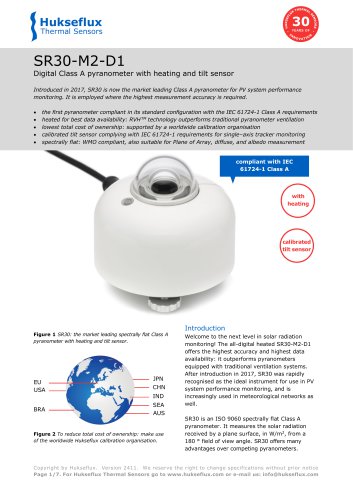 SR30-M2-D1
7 Pages






























Archived catalogs
 TRSYS20
4 Pages
 IHF02 heat flux sensor
4 Pages
 SR22 pyranometer
4 Pages
 SR25
SR254 Pages
 SR05-D1A3-PV pyranometer
4 Pages
 SR15 series
4 Pages
 choose the best pyranometer
5 Pages
 TP08
TP082 Pages
 TP02
TP022 Pages
 TP01
TP011 Page
 TRSYS01
1 Page
 TNS01
TNS011 Page
 THISYS
3 Pages
 SR11-TR PYRANOMETER
2 Pages
 SR11 PYRANOMETER
2 Pages
 WS01
WS011 Page
 CRC series
1 Page
 GT series
2 Pages
 TPSYS02
1 Page
 THASYS
2 Pages
 IR02-TR
1 Page
 DR01
DR012 Pages
 SR12 PYRANOMETER
2 Pages
 SR20-TR pyranometer
2 Pages
 IR20 & IR20WS PYRGEOMETER
2 Pages
 ALUSYS
1 Page
 SR11-TR
1 Page
 NF02
NF021 Page
 HFP01
HFP011 Page
- Temperature probe
- Measuring device
- Data logger
- Resistance temperature sensor
- Plastic cap
- USB datalogger
- Waterproof temperature sensor
- Thermocouple temperature transducer
- Data-logger with screen
- Resistance heater
- Portable gauge
- Battery-powered datalogger
- Pt1000 temperature transducer
- RTD temperature sensor
- Industrial measuring module
- Precision temperature transducer
- Compact temperature probe
- 4-wire temperature sensor
- Rectangular label
- Digital datalogger