
- Catalogs
- HUBER+SUHNER
- WHITE PAPER

- Company
- Products
- Catalogs
- News & Trends
- Exhibitions
WHITE PAPER

WHITE PAPER
The document discusses the importance of selecting the appropriate connector for network performance, comparing classic interfaces like 7/16, N, and 4.1/9.5 with the newer 4.3-10 interface. It highlights the impact of connector choice on network design, particularly in LTE networks where PIM (Passive Intermodulation) performance is critical.
Historical Interfaces
The N connector, developed in the 1940s, is a medium-size RF connector. The 7/16 interface, from the 1960s, is used in cellular networks and requires high torque for stable PIM performance. The 4.1-9.5 connector, designed in the 1970s, offers a balance between robustness and space efficiency. All these interfaces depend heavily on torque for electrical performance.
Evolution of 4.3-10
The 4.3-10 connector, developed by HUBER+SUHNER, addresses the need for compact, high-performance connectors in mobile networks. It is lighter and smaller, fitting within a 1-inch flange, and offers superior PIM performance without the need for high torque.
Features and Benefits of the 4.3-10
This connector separates the electrical and mechanical planes, allowing for lower force requirements and eliminating the need for high torque. It supports screw, hand-screw, and push-pull mechanisms, all providing consistent PIM and return loss performance. The design is robust, with protected contact surfaces, making it suitable for field use.
Performance Characteristics Comparison
The document includes a table comparing the 4.3-10 with other connectors in terms of frequency range, PIM, return loss, RF leakage, and mechanical data. The 4.3-10 offers superior performance with lower torque requirements and greater flexibility in installation.
Applications
The 4.3-10 is ideal for new base stations, distributed antenna systems (DAS), in-building architecture, and small cell applications. It is particularly suited for environments with space constraints and high electrical performance demands.
Conclusion
With increasing wireless data usage, network infrastructure must provide adequate coverage and bandwidth. The 4.3-10 connector meets modern requirements for compactness, robustness, and reliable electrical performance, offering significant advantages in communication systems.
Catalog excerpts

WHITE PAPER4.3-10: choosing the right connectorEdition 2014 Claudia Bartholdi Product Manager RF division HUBER+SUHNER AG Herisau, Switzerland
Open the catalog to page 1
WHITE PAPER 4.3-10: choosing the right connector Introduction Choosing between classic interfaces such as 7/16, N or 4.1/9.5 connectors and the new interface 4.310 can have a significant impact on how a particular network will perform. There are several important considerations to make when choosing a connector, including the network design and the choice of the Mobile Telecommunications System used. This paper will compare and contrast these two categories of connectors (classical and new), highlighting their differences in terms of electrical and mechanical performance in particular applications....
Open the catalog to page 2
WHITE PAPER 4.3-10: choosing the right connector Historical Interfaces The N connector (in full, Type N connector) is a threaded, weatherproof, medium-size RF connector. It was invented in the 1940s and was one of the first connectors capable of carrying microwave-frequency signals. The 7/16 interface was developed in the 60’s and is used in cellular networks and base stations as well as in other communications equipment. At that time large corrugated cables and high transmitted power were a challenge for the N type interface. Historically the 7/16 interface had a slotted outer contact. Then...
Open the catalog to page 3
WHITE PAPER 4.3-10: choosing the right connector Evolution 4.3-10 HUBER+SUHNER as a leading global supplier of RF products is an active partner of a developing group which is designated to provide innovative solutions for the telecom market. The new 4.3-10 connector system is designed to meet the rising performance needs of mobile network equipment and at the same time reducing its size to support ongoing space reduction requirements. The connector 4.310 satisfies the requirement for compactness with the ability to fit within a 1 inch flange (25.4 mm). It is also considerably lighter than other...
Open the catalog to page 4
WHITE PAPER 4.3-10: choosing the right connector The decoupling of the electrical and mechanical plane gives the possibility of realizing the connection with a lower coupling torque. There is no longer the need for a high torque value to reach high electrical performances. On the contrary, this design even facilitates a hand-screw solution or a push pull design due to its innovative design. The coupling mechanism is no longer influencing PIM or return Loss performances and all of the 3 configurations (screw, hand-screw or push pull connectors) are performing in the same way. For better handling...
Open the catalog to page 5
Page 6 WHITE PAPER 4.3-10: choosing the right connector
Open the catalog to page 6
WHITE PAPER 4.3-10: choosing the right connector Applications The 4.3-10 is the ideal choice for applications in new base stations as well as for solutions for distributed antenna systems (DAS), in-building architecture and in small cells applications. In base stations the 4.3-10 can be used for interconnections both in the remote radio head as well as for the interface on the antenna and on the jumpers. In multi-operator, multiband DAS where RF signals have to be combined, terminated, or distributed to the antenna. In small cells applications, the 4.3-10 is particularly suited for the challenging...
Open the catalog to page 7All HUBER+SUHNER catalogs and technical brochures
 SENCITY® Road Antenna
2 Pages
 SENCITY® Road MULTI Antenna
2 Pages
 SENCITY® Tram MULTI Antenna
2 Pages
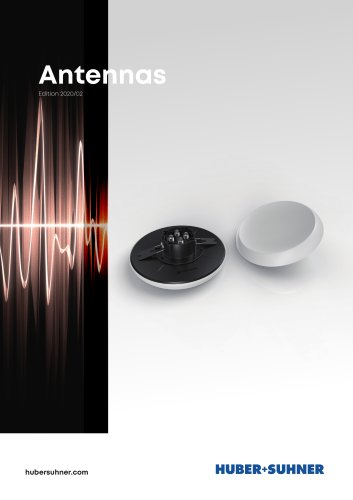 Antennas edition 2020
109 Pages
 Automotive products
72 Pages
 RF Connectors General Catalogue
573 Pages
 Fiber Optics MTP® assemblies
34 Pages
 Broadcast Solutions overview
8 Pages
 Fiber management Systems
40 Pages
 Data center solutions
238 Pages
 Connected Mobility
24 Pages
 Microwave cable assemblies
194 Pages
 RF cables
72 Pages
 Fiber Optic Cables
178 Pages
 Antennas edition 2019
105 Pages
 FO components
11 Pages
 Lightning protection
206 Pages
 RF components
44 Pages
 Space
Space140 Pages
 Railway products
208 Pages
 Aviation
28 Pages
 4.3-10 coaxial connector
20 Pages
 SENCITY®OMNI-S MIMO
2 Pages
 Network-Cubes
8 Pages
 Automotive Innovations
12 Pages
 Defense
146 Pages
 FO LISA
202 Pages
 FO equipment and products for LAS
152 Pages
 Enclosures and wall outlets
36 Pages
 DC solutions North America
208 Pages
 Railway cable systems - Overview
16 Pages
 Airfield Lighting
4 Pages
 19"fiber panels and modules
40 Pages
 Wires & Cables
156 Pages
 19" fiber panels and modules
40 Pages
 Milcat 7
2 Pages
 VITA 67
2 Pages
 Microbend L
2 Pages
 Solutions for Small Cells / DAS
156 Pages
 FO Cabling Systems
64 Pages
 FO Cables
160 Pages
 Automotive products
68 Pages
 Air traffic control
28 Pages
 Solutions for Defense applications
146 Pages
 Standard Fiber optic Assemblies
72 Pages
 RADOX® Milcat 7
2 Pages
 Resistive components
36 Pages
 Lightning protection
200 Pages
 High Density Solutions
72 Pages
 Board to Board connections
32 Pages
 Aviation
28 Pages
 RADOX® Coil winding industry
64 Pages
 Train to ground
16 Pages
 Railway products
200 Pages
 Railway connectivity
24 Pages
 Passive Components
36 Pages
 FO tools equipment
10 Pages
 FO LC Portfolio
24 Pages
 Feeder installation training
60 Pages
 DC Segment Transportation
12 Pages
 DC Segment Healthcare
12 Pages
 DC Segment Finance
12 Pages
 DC Segment Colocation
12 Pages
 Connectors accessories
13 Pages
 Cabling Systems
64 Pages
 Coaxial Connectors 4.3-10
4 Pages
 Test+Measurement Guide
32 Pages
 Fiber Optic - LC portfolio
24 Pages
 RF Connectors
478 Pages
 Railway Products
156 Pages
 Fiber optic - FC portfolio
4 Pages
 Fiber optic - FSMA portfolio
4 Pages
 RF - Guide
159 Pages
 RADOX - Fiber optic cable
2 Pages
 RF cable - SPUMA 400
4 Pages
 Lightning and EMP protection
12 Pages
 Series SMA - Coaxial Connectors
40 Pages
 RF - Product portfolio
28 Pages
 QMA - Connectors
16 Pages
 Passive intermodulation
12 Pages
 MMPX - Connectors
24 Pages
 Fiber Optic - OptiBox 4i
2 Pages
 Fiber Optic - SC portfolio
8 Pages
 Fiber Optic - CLIK!
12 Pages
 RADOX - RAILCAT CAT7
2 Pages
 Space-SUCOFLEX TVAC
12 Pages
 Space-SUCOFLEX 300
24 Pages
 Multiport Solutions
12 Pages
 Medical
20 Pages
 Communication on board
2 Pages
 Automation Machinery
20 Pages
 Coil winding Industry RADOX
68 Pages
 Rail CBTC
12 Pages


Archived catalogs
 Power Sub-Miniature PSM
4 Pages
- Electrical cable
- Data connector
- Rectangular housing
- Ethernet switch
- Metal connector
- Surge protector
- Power cable
- Polymer connector
- Circular connector
- Plastic housing
- Screw-in connector
- Socket electrical connector
- Insulated cable
- Terminal box
- Industrial connector
- Managed switch
- DIN rail lightning arrester
- Male connector
- Flexible cable