
- Catalogs
- Hottinger Brüel & Kjaer
- Sound Quality Head and Torso Simulator Types 4100 and 4100-D


Sound Quality Head and Torso Simulator Types 4100 and 4100-D
1 /2Pages
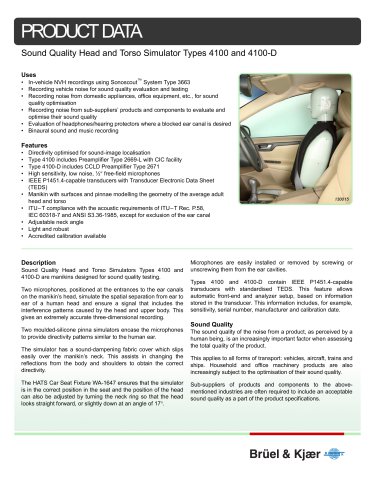
Sound Quality Head and Torso Simulator Types 4100 and 4100-D
1 /2Pages
Catalog excerpts
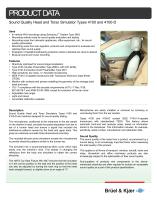
Uses • In-vehicle NVH recordings using Sonoscout™ System Type 3663 • Recording vehicle noise for sound quality evaluation and testing • Recording noise from domestic appliances, office equipment, etc., for sound quality optimisation • Recording noise from sub-suppliers' products and components to evaluate and optimise their sound quality • Evaluation of headphones/hearing protectors where a blocked ear canal is desired • Binaural sound and music recording Features • Directivity optimised for sound-image localisation • Type 4100 includes Preamplifier Type 2669-L with CIC facility • Type 4100-D includes CCLD Preamplifier Type 2671 • High sensitivity, low noise, free-field microphones • IEEE P1451.4-capable transducers with Transducer Electronic Data Sheet (TEDS) • Manikin with surfaces and pinnae modelling the geometry of the average adult head and torso • ITU-T compliance with the acoustic requirements of ITU-T Rec. P.58, IEC 60318-7 and ANSI S3.36-1985, except for exclusion of the ear canal • Adjustable neck angle • Accredited calibration available Description Sound Quality Head and Torso Simulators Types 4100 and 4100-D are manikins designed for sound quality testing. Two microphones, positioned at the entrances to the ear canals on the manikin's head, simulate the spatial separation from ear to ear of a human head and ensure a signal that includes the interference patterns caused by the head and upper body. This gives an extremely accurate three-dimensional recording. Two moulded-silicone pinna simulators encase the microphones to provide directivity patterns similar to the human ear. The simulator has a sound-dampening fabric cover which slips easily over the manikin's neck. This assists in changing the reflections from the body and shoulders to obtain the correct directivity. The HATS Car Seat Fixture WA-1647 ensures that the simulator is in the correct position in the seat and the position of the head can also be adjusted by turning the neck ring so that the head looks straight forward, or slightly down at an angle of 17°. Microphones are easily installed or removed by screwing or unscrewing them from the ear cavities. Types 4100 and 4100-D contain IEEE P1451.4-capable transducers with standardised TEDS. This feature allows automatic front-end and analyzer setup, based on information stored in the transducer. This information includes, for example, sensitivity, serial number, manufacturer and calibration date. Sound Quality The sound quality of the noise from a product, as perceived by a human being, is an increasingly important factor when assessing the total quality of the product. This applies to all forms of transport: vehicles, aircraft, trains and ships. Household and office machinery products are also increasingly subject to the optimisation of their sound quality. Sub-suppliers of products and components to the above-mentioned industries are often required to include an acceptable sound quality as a part of the product specifications.
Open the catalog to page 1
Subjective Listening Tests The final evaluation of the sound quality of a product is normally made using a selected group of people - a jury in a listening test. To have the jury listen to the sound in reality, for example each jury member driving a car and then reporting on the sound quality, is very time-consuming and costly. To overcome this, Type 4100 can be used to make a high-quality binaural recording of the product's noise, which can be saved to a mobile device or PC. This can then be simultaneously presented to all members of the jury off-site. To avoid bias errors in this process, it...
Open the catalog to page 2All Hottinger Brüel & Kjaer catalogs and technical brochures
 Artificial Mastoid Type 4930
6 Pages
 Power Amplifier Type 2718
2 Pages
 DISCOM Mobile
6 Pages
 DISCOM NVH Analysis Systems
4 Pages
 TEDS Microphones
8 Pages
 LDS V8
4 Pages
 LDS Comet USB
4 Pages
 LDS Laser USB
16 Pages
 2690-A
16 Pages
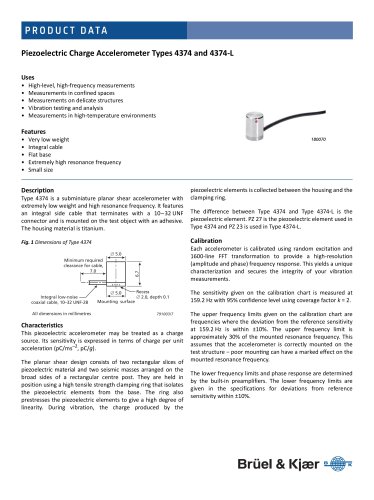 4374
43742 Pages
 4326-A-001
8 Pages
 4152
41524 Pages
 4191
41912 Pages
 2719
27192 Pages
 LDS V8900
4 Pages
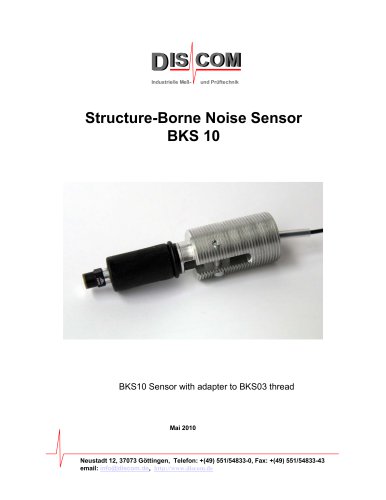 BKS 10
8 Pages
 1704-A-001
4 Pages
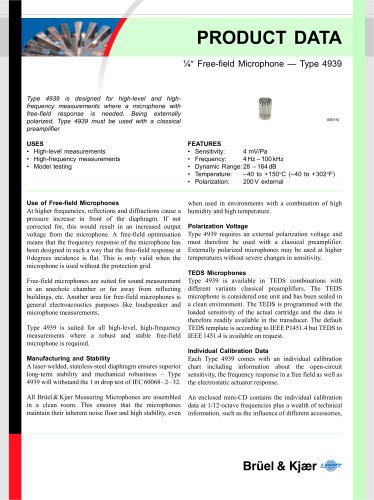 4939
49392 Pages
 4138
41384 Pages
 4101-B and 4965-B
4 Pages
 Sonoscout NVH Recorder
8 Pages
 LDS Power Amplifiers
8 Pages
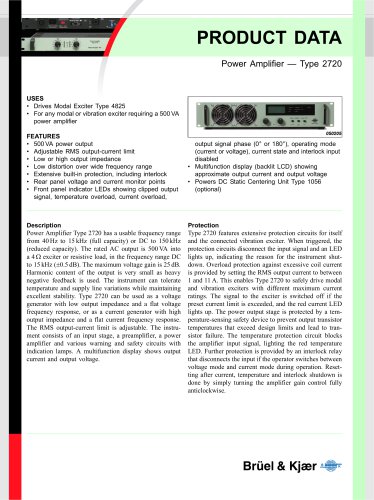 Type 2720
2 Pages
 Type 2721
2 Pages
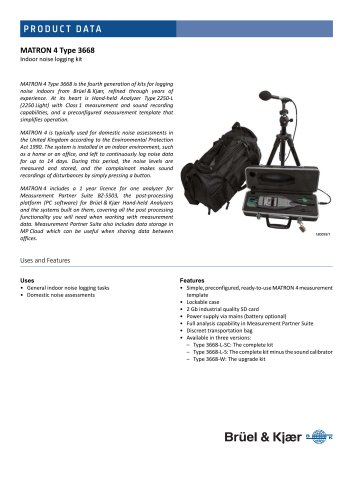 TYPE 3668
4 Pages
 3656-A
4 Pages
 TYPE 2270-S
28 Pages
 LDS V994
2 Pages
 TYPE 8702
16 Pages
 BZ-7848-A
40 Pages
 TYPE 9718-A:bp0317
12 Pages
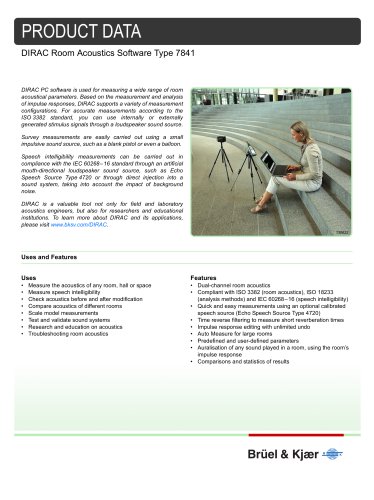 TYPE 4720:bp1974
12 Pages
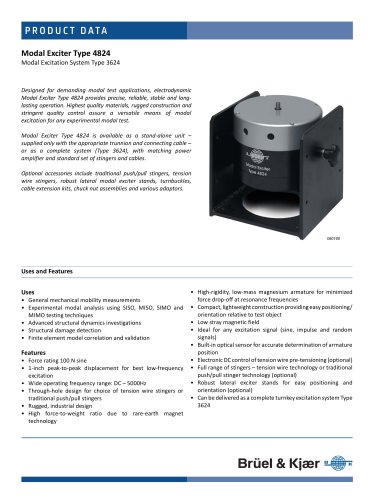 TYPE 4824:bp1936
4 Pages
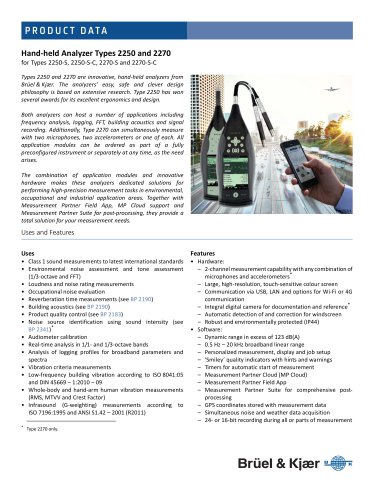 SOUND LEVEL METER:bp 2025
28 Pages
 Transducers and conditioning
188 Pages
 Noise Sentinel Overview
3 Pages
 Analyzer Catalogue
39 Pages
 Noise Logger Type 3659
1 Page
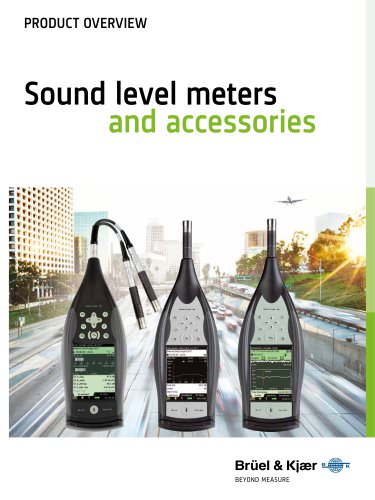 Sound level meters
17 Pages




Archived catalogs
 B&K 2245 Sound Level Meter
8 Pages
 HBK 2255 Sound Level Meter
10 Pages
 Data Analysis Software
6 Pages
- Power supply unit
- DC power supply
- AC/DC power supply
- Brüel & Kjaer calibrator
- Brüel & Kjaer accelerometer
- Analog I/O
- Single-output power supply
- Digital indicator
- Portable analyzer
- Communication gateway
- Measurement software
- Brüel & Kjaer signal amplifier
- Turntable
- Piezoelectric accelerometer
- Tabletop power supply
- Tilt sensor
- Ethernet gateway
- Automated software
- Real-time analyzer
- Laboratory analyzer