
- Catalogs
- Hottinger Brüel & Kjær A/S
- TYPE 8702


TYPE 8702

TYPE 8702
PULSE Reflex is a suite of post-processing applications designed to enhance the PULSE software environment. It provides tools for offline analysis, processing of time data, and experimental modal analysis. The user interface is designed for ease-of-use, with a consistent workflow across applications, facilitating data viewing, storage, and reporting through an SQL database.
- Offline analysis of recorded time data.
- Vibration and acoustic analysis, including rotating machinery analysis.
- Support for stationary and non-stationary FFT, CPB, and broadband analysis.
- Sound quality analysis and human vibration analysis.
- Batch processing and simultaneous parallel analysis with different filter settings.
- Data import/export from various formats and systems, including PULSE LabShop and PULSE Data Manager.
This is the foundational framework for all PULSE Reflex applications, providing project file and data import, metadata management, offline calculations, graphical displays, and integrated reporting tools. It supports a wide range of file formats for data import and export.
Enhances the Base Type 8700 with powerful viewing and reporting tools, including fast, template-based reporting to Microsoft Word and PowerPoint, and user-interactive template setup for customized reports.
Central components include the Time Editor, Process Chain, and Display Manager. These tools allow for efficient data processing, analysis, and reporting. The Process Chain enables graphical setup of analysis processes, which can be stored and reused.
- Type 8703: Adds advanced spectrogram display and interactive filters.
- Type 8704: Provides fixed bandwidth FFT-based order analysis.
- Type 8705: Offers tracked FFT and order analysis.
- Type 8706: CPB analysis according to international standards.
- Type 8710: Calculation of sound quality metrics.
The PULSE Reflex Base Type 8700 is a Windows-based analysis software that supports multiple signal groups and offers node-locked or floating licenses. It requires a high-performance PC with specific system requirements, including Windows 10 Pro or Enterprise, Intel Core i7 processor, and 32 GB RAM.
The software supports various analysis types, including FFT, order analysis, and CPB analysis. It allows for the extraction of RPM profiles from FFT vs Time outputs and conversion to tachometer pulse trains. The document details the use of tracked order analysis for high accuracy in rotating machinery.
The PULSE Reflex Standardized CPB Option Type 8706 conforms to IEC, DIN, and ANSI standards, providing octave analysis with digital filters. The document recommends using tracked order analysis for high order numbers in machinery like gearboxes and turbines.
The software supports various file formats for function and time data import/export, including PULSE ASCII, universal files, and wave files. It also allows exporting results to Microsoft Excel and project files for archiving and sharing.
The software offers multiple graph types for data visualization, including waterfall, Campbell diagram, and bar graphs. It supports complex displays and acoustic post-weighting. Reporting is facilitated through templates in Microsoft Word, Excel, or PowerPoint, with automatic updates from project data.
The software uses a Microsoft SQL Server database for data management, allowing for database creation, deletion, backup, and restoration. It supports metadata customization for efficient data searching and sharing via external files.
Type 8710 integrates sound quality metrics into the processing framework, including articulation index, loudness, sharpness, and tonality. These metrics can be calculated as overall values or versus time.
The document describes the PULSE Reflex Data Viewer Type 8701, which enhances data review and display capabilities, and the Basic Processing Type 8702, which includes time data editing and batch processing features.
The document lists various PULSE Reflex software types and their corresponding maintenance agreements. It also provides contact information for Brüel & Kjær and notes on document accuracy and updates.
Catalog excerpts
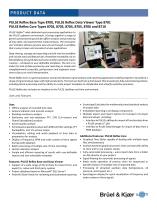
PULSE Reflex Base Type 8700, PULSE Reflex Data Viewer Type 8701 PULSE Reflex Core Types 8702, 8703, 8704, 8705, 8706 and 8710 PULSE Reflex™ adds dedicated post-processing applications to the PULSE software environment. It brings together a range of generic post-processing tools for offline analysis and processing of time data, and experimental modal analysis. The innovative user interface delivers genuine ease-of-use through a workflow that is easy to learn and consistent across applications. Data viewing, storage and reporting are built into the workflow and include tools and features for immediate traceability via an SQL database, for quick data overviews and for automatic report creation - all based on user-definable templates. The aim is to make the task of data processing and reporting as simple and straightforward as possible, giving testers and engineers more time to focus on result interpretation. PULSE Reflex Core is a general purpose sound and vibration signal analysis and reporting application enabling engineers to perform a range of signal analysis types with high productivity. The tools are built into a framework that provides for fully automated operation, including batch processing and the ability to create project templates to standardize and simplify repetitive processes. PULSE Reflex also includes an interface to the PULSE LabShop real-time environment. Uses and Features Uses • Offline analysis of recorded time data • General vibration and acoustic analysis • Rotating machinery analysis • Stationary and non-stationary FFT, CPB (1/n-octave) and Overall (broadband) analysis • Sound quality analysis • Simultaneous parallel analysis with different filter settings, FFT bandwidths, and 1/n-octave setups • Visualization, editing and audio playback of time data in preparation for analysis • Display of frequency, RPM and order content of time signals during audio playback • Batch processing of multiple sets of time recordings • Human vibration analysis • Simple and efficient reporting of results with user-definable layouts and user-selectable metadata Features: PULSE Reflex Base and Data Viewer • Support of a wide range of file formats for import from, and export to, native and third party systems • Project database based on Microsoft® SQL Server® • Powerful Data Viewer for reviewing and automated reporting • Scratchpad Calculator for mathematical and statistical analysis of project data • Embedded reporting in all display components • Multiple export and import options for transport of project data and setups, including: - Interface to PULSE LabShop for import of function data from a PULSE project (*.pls) - Interface to PULSE Data Manager for import of data from a PDM database Additional Features: PULSE Reflex Core • Graphical Time Editor capable of dealing with multiple input files simultaneously • Analysis based on graphical process chain concept with ability to store and re-use analysis setups • Fully automated processing - auto-import data from a folder on disk directly to your project • Signal filtering for automatic processing of signals • Batch mode operation of process chain for sequenced or parallel analysis of multiple sets of imported data • Processing of streamed auxiliary data (temperature, oil pressure, wind speed, etc.) • Spectrogram display for quick visualization of frequency and order content of time signals
Open the catalog to page 1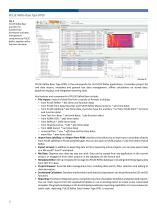
PULSE Reflex Base Type 8700 Fig. 1 PULSE Reflex Base provides the fundamental framework and data management components of PULSE Reflex, together with a function calculator PULSE Reflex Base Type 8700, is the prerequisite for all PULSE Reflex applications. It provides project file and data import, metadata and general test data management, offline calculations on stored data, graphical displays, and integrated reporting tools. Key features and components of PULSE Reflex Base include: • File Import: Import of data files from a variety of formats including: – from PULSE Reflex: *.bkc (time and function...
Open the catalog to page 2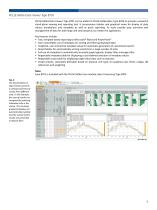
PULSE Reflex Data Viewer Type 8701 PULSE Reflex Data Viewer Type 8701 can be added to PULSE Reflex Base Type 8700 to provide a powerful stand-alone viewing and reporting tool. It incorporates tabular and graphical views for display of data values, annotations and metadata as well as quick reporting. Its tools provide easy overview and management of data for both large and small projects no matter the application. Key features include: • Fast, template-based reporting to Microsoft® Word and PowerPoint® • User-controllable use of metadata for sorting and filtering displayed data • Graphical, user-interactive...
Open the catalog to page 3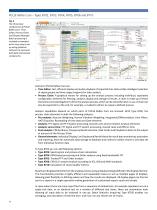
PULSE Reflex Core – Types 8702, 8703, 8704, 8705, 8706 and 8710 Fig. 3 The three basic components of PULSE Reflex Core: Time Editor, Process Chain, and Display Manager. Batch processing is included as standard and is very easy to set up using graphical elements to represent both data and analysis components Central to PULSE Reflex Core are: • Time Editor: Fast, efficient display and audio playback of imported time data enable intelligent selection of signal groups and time ranges (regions) for later analysis • Process Chain: A graphical means for setting up the analysis process including individual,...
Open the catalog to page 4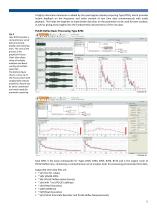
A highly interactive dimension is added by the spectrogram display (requiring Type 8703), which provides instant feedback on the frequency and order content of raw time data simultaneously with audio playback. This helps the engineer to make better decisions on the parameters to be used for later analysis, as well as giving early insights into the fundamental characteristics of the raw data. Fig. 4 Type 8702 provides a comprehensive set of data processing, display and reporting tools. The core of the process is the graphical Process Chain that allows setup of multiple analyses and batch running...
Open the catalog to page 5All Hottinger Brüel & Kjær A/S catalogs and technical brochures
 Artificial Mastoid Type 4930
6 Pages
 Power Amplifier Type 2718
2 Pages
 DISCOM Mobile
6 Pages
 DISCOM NVH Analysis Systems
4 Pages
 TEDS Microphones
8 Pages
 LDS V8
4 Pages
 LDS Comet USB
4 Pages
 LDS Laser USB
16 Pages
 2690-A
16 Pages
 4374
43742 Pages
 4326-A-001
8 Pages
 4152
41524 Pages
 4191
41912 Pages
 2719
27192 Pages
 LDS V8900
4 Pages
 BKS 10
8 Pages
 1704-A-001
4 Pages
 4939
49392 Pages
 4138
41384 Pages
 4101-B and 4965-B
4 Pages
 Sonoscout NVH Recorder
8 Pages
 LDS Power Amplifiers
8 Pages
 Type 2720
2 Pages
 Type 2721
2 Pages
 TYPE 3668
4 Pages
 3656-A
4 Pages
 TYPE 2270-S
28 Pages
 LDS V994
2 Pages
 BZ-7848-A
40 Pages
 TYPE 9718-A:bp0317
12 Pages
 TYPE 4720:bp1974
12 Pages
 TYPE 4824:bp1936
4 Pages
 SOUND LEVEL METER:bp 2025
28 Pages
 Transducers and conditioning
188 Pages
 Noise Sentinel Overview
3 Pages
 Analyzer Catalogue
39 Pages
 Noise Logger Type 3659
1 Page
 Sound level meters
17 Pages




Archived catalogs
 B&K 2245 Sound Level Meter
8 Pages
 HBK 2255 Sound Level Meter
10 Pages
 Data Analysis Software
6 Pages
- Power supply unit
- DC power supply
- AC/DC power supply
- Brüel & Kjaer calibrator
- Brüel & Kjaer accelerometer
- Single-output power supply
- Digital indicator
- Analog I/O
- Portable analyzer
- Communication gateway
- Measurement software
- Turntable
- Piezoelectric accelerometer
- Tilt sensor
- Brüel & Kjaer signal amplifier
- Real-time analyzer
- Tabletop power supply
- Laboratory analyzer
- Ethernet gateway
- Electric rotary table