
- Catalogs
- Hottinger Brüel & Kjær A/S
- LDS Laser USB


LDS Laser USB

LDS Laser USB
LASERUSB is a high-performance controller designed for test labs, offering precision, flexibility, and safety. It supports both 32 and 64-bit Windows operating systems and is equipped for vibration control and data reduction across multiple channels.
- Supports 32 and 64-bit Windows OS.
- Handles 4 to 16 channels for multi-point control.
- 24-bit resolution for a wide dynamic range.
- Fast loop time of 100 ms for efficient control.
- Seamless integration with lab equipment through amplifier and thermal chamber interfaces.
- USB connectivity for easy installation.
- Automatic safety checks and fatigue monitoring.
- Vibration testing in R&D and production environments.
- Simulation of vehicle and transportation vibrations.
- Fatigue tests and driving switching power amplifiers.
Inputs
- Analogue channels: 4 standard, expandable to 16.
- Frequency range: Up to 42 kHz.
- Voltage ranges: ±10, 1, 0.1 V.
- Resolution: 24-bit with a dynamic range of 120 dBfs.
Outputs
- Analogue channels with drive and shock trigger outputs.
- Frequency range: Up to 22 kHz.
- Voltage range: ±10 Vpeak.
Hardware
- AC Power: 100 to 240V, 50/60 Hz.
- Dimensions: Height 8.9 cm, Width 41.9 cm, Depth 36.3 cm.
- Weight: 6 kg.
Software
- Distributed processing architecture.
- Applications include random, sine-on-random, and shock response spectrum testing.
- Features online help and test management tools.
Control Loop
- Random dynamic range: 95 dB.
- Loop time: 100 ms typical.
Regulatory Compliance
- CE marking, Safety EN/IEC 60950–1, EMC compliance.
Premier Random Vibration Control
- Frequency range: 0 to 10 kHz.
- Dynamic range: Up to 95 dB.
- Control strategy includes single or multiple input channels.
Safety Features
- Automatic detection of input overload and loss of control signal.
- Email support for automatic abort notifications.
Test Execution
- Pre-test checks and automatic mode execution.
- Manual mode for user control.
Signal Displays
- Unlimited display windows with customizable formats.
Post-test Documentation
- Single-click generation of data plots and test reports.
The document details various vibration control systems, including Premier Classical Shock Transient Control, Resonance Search, Track and Dwell (RSTD) Vibration Control, Sine-on-Random (SoR) Vibration Control, and Random-on-Random (RoR) Vibration Control. Each section outlines control parameters, test setup, management, and special features.
Details control parameters such as frequency range (0 to 22 kHz), frame size, transfer function, averaging, filtering, and pulse delay. Describes pulse types, duration, compensation methods, abort limits, validation tools, and test schedule management. Safety features include automatic detection of input overload and graceful shutdown procedures.
Includes features from the Swept Sine Vibration Control software. Allows users to define search and dwell events, with automated and interactive test modes. Explains resonance search criteria, dwell modes, and drift criteria. Highlights special displays and post-test documentation features.
Describes setup and control of SoR tests, including broadband control techniques and sine tone control techniques. Highlights validation tools, RMS limits, and special data displays. Covers test management, including automatic and manual modes.
Outlines setup and control of RoR tests, focusing on broadband and narrowband control techniques. Discusses special displays and safety features, emphasizing automated and interactive test modes.
Includes Sine-and-Random-on-Random (SRoR), Shock Response Spectrum (SRS) Transient Control, Transient Time History (TTH) Control, and Long Time History (LTH) Waveform Replication Control. Each section outlines capabilities, setup, and management, emphasizing application in simulating complex vibration environments.
Displays and validates waveforms against shaker parameters, allowing for automatic or manual aborts during testing. Continuous point-abort checking enables aborts during a test rather than at the end of an entire output data frame.
After determining the initial transfer function, tests can start immediately with a drive signal that is continuously adjusted. An overlapped convolution algorithm ensures smooth transitions between output frames.
The transfer function is updated continuously during the test to adjust for non-linear effects and changing load dynamics, ensuring high accuracy without multiple pre-test iterations.
Pre-programmed schedules include test levels, output repetitions, and result saving.
Single-click generation of data plots and test reports, including setup parameters, test logs, and formatted signal plots in Microsoft Word.
The software supports random, swept sine, and classical shock testing, with options for upgrading from Value to Premier packages without additional hardware. Key features include a wide frequency range, high dynamic range, and various control strategies.
Both Value and Premier packages offer similar setup features, test execution modes, and safety features. However, Premier packages provide additional capabilities such as multiple channel control, non-acceleration control, and advanced signal displays.
Lists hardware and software bundles, including optional hardware and software for enhanced functionality. Calibration services are also available.
Includes a disclaimer about the accuracy and completeness of the information, noting that content is subject to change without notice.
Catalog excerpts
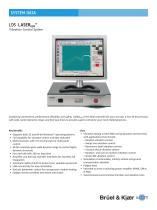
SYSTEM DATA Vibration Control System Combining convenience, performance, flexiblity, and safety, LASERUSB is the ideal controller for your test lab. It has 24-bit precision with wide control dynamic range, and fast loop times to provide superb control for your most challenging tests. Key Benefits • Supports both 32 and 64-bit Windows® operating systems • Full capability for vibration control and data reduction • Multi-channels, with 4 to 16 channels for multi-point control • 24-bit resolution gives wide dynamic range to control highly dynamic structures • Fast and safe with 100 ms loop time • Amplifier and thermal chamber interfaces for seamless lab integration • Automatic safety checks to protect your valuable equipment • USB connectivity for easy installation • Kurtosis parameter control for non-gaussian random testing • Fatigue monitor protects test article and shaker Uses • Vibration testing in both R&D and production environments with applications that include: – Random vibration control – Swept sine vibration control – Resonance dwell vibration control – Classical shock vibration control – Random- and sine-on-random vibration control – Shock SRS vibration control • Simulation of automobile, military vehicle and ground transportation vibration • Fatigue tests • Intended to drive a switching power amplifier (HPAK, SPA-K, D-PAK) • Synchronised envi
Open the catalog to page 1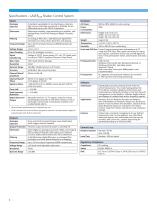
Specifications - LASERUSB Shaker Control System Inputs Analogue Channels Electronics Filtering Frequency Range Voltage Ranges Input Coupling Signal Conditioning Max. Input Resolution Dynamic Range Accuracy Channel Match† Amplitude Channel Match† Phase Signal-to-Noise Cross-talk Total Harmonic Distortion Digital Input and Output Hardware 4 standard, expandable to 16 simultaneous channels. Each can be controlled, monitored or disabled. All are differential inputs with 220 kΩ impedance. Differential amplifier, programmable gain amplifier, antialiasing filters, and 24-bit Analog-to-Digital Converter...
Open the catalog to page 2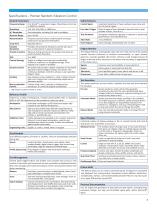
Specifications - Premier Random Vibration Control Control Parameters Safety Features Frequency Range Control Signal Resolution Δ F Resolution Dynamic Range Randomization Loop Time Variable Resolution Transfer Function DOF Control Strategy Kurtosis Control Limiting Non-acceleration Control 0 to 10 kHz* in seventeen ranges. Closed loop control up to 4000 Hz standard. 110, 225, 450, 900, or 1800 lines User-selectable, including 5Hz and its multiples. Up to 95 dB Frequency domain phase randomization technique produces a true gaussian distribution. Typically 100 ms Provides enhanced low frequency...
Open the catalog to page 3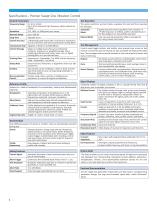
Specifications - Premier Swept Sine Vibration Control Control Parameters Test Execution Frequency Range The system performs pre-test checks, equalises the load and then executes the schedule. Automatic System executes events specified in the schedule. If a Profile Sequence is defined, profile-schedule blocks in Mode the flow diagram are sequentially executed. Manual Mode User can override automatic mode to manage the test using manual commands. Resolution Dynamic Range Loop Time Control Accuracy Compression Rate Control Strategy Tracking Filter Sweep Rate Limiting Non-acceleration Control 0.1...
Open the catalog to page 4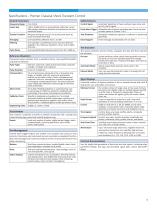
Specifications - Premier Classical Shock Transient Control Control Parameters Safety Features Frequency Range Frame Size Control Signal Transfer Function Averaging Filtering Pulse Delay 0 to 22 kHz 128 to 16384 points or automatically optimised. Linear filter design minimises distortion and preserves the true waveform shape. Measure during pre-test or, for quickest test start-up, recall a function from disk. User-specified coefficient from 1 to 500 User specifies cut-off frequency for low-pass filtering applied to the reference waveform, drive, and all input channels. User-specified delay between...
Open the catalog to page 5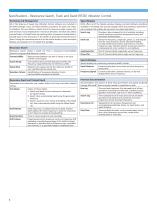
Specifications - Resonance Search, Track and Dwell (RSTD) Vibration Control Test Setup and Management Signal Displays All of the features of Swept Sine Vibration Control software are included in the RSTD package. Users can follow familiar procedures for quick test setup. In Schedule, the user defines a Search Event by frequency range, sweep rate, and minimum Q and amplitude for resonance detection. Schedule also allows easy definition of a Dwell Event by selecting either a frequency locked dwell or tracked dwell at the resonances in the Dwell List generated during the Search Event. During the...
Open the catalog to page 6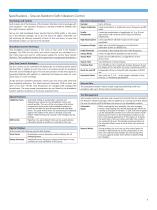
Specifications - Sine-on-Random (SoR) Vibration Control Test Setup and Control Sine Tone Characteristics SoR includes all of the features of the Random Vibration Control package with one exception – the maximum frequency is limited to 4000 Hz (5500Hz with the High Frequency option). Number Target Amplitude Set up of a SoR broadband Power Spectral Density (PSD) profile is the same as in the Random package. Up to 20 sine tones are added. Automatic on/ off switching (at arbitrary intervals) of each of the sine tones, or even the broadband random, can be set in the schedule. Profile Breakpoints Broadband...
Open the catalog to page 7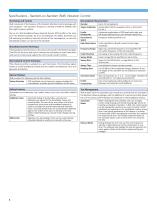
Specifications - Random-on-Random (RoR) Vibration Control Test Setup and Control Narrowband Characteristics RoR includes all of the features of the Random Vibration Control package with one exception – the maximum frequency is limited to 4000 Hz (5500Hz with the High Frequency option). Number Target Amplitude Set up of a RoR broadband Power Spectral Density (PSD) profile is the same as in the Random package. Up to 12 narrowbands are added. Automatic on/ off switching (at arbitrary intervals) of each of the narrowbands, or even the broadband random, can be set in the schedule. Profile Breakpoints...
Open the catalog to page 8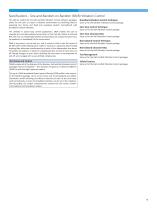
Specifications - Sine-and-Random-on-Random (SRoR) Vibration Control This add-on module for the SoR and RoR Vibration Control software packages, allows for the user to create a vibration environment by combining fixed or sweeping sine tones, and fixed and sweeping random narrowbands with broadband random vibration. The ultimate in closed loop control applications, SRoR enables the user to simulate the most demanding environments in their test lab. Similar to SoR and RoR, the user can individually activate and deactivate any component (sine tone, narrowband, or broadband) of the environment. SRoR...
Open the catalog to page 9All Hottinger Brüel & Kjær A/S catalogs and technical brochures
 Artificial Mastoid Type 4930
6 Pages
 Power Amplifier Type 2718
2 Pages
 DISCOM Mobile
6 Pages
 DISCOM NVH Analysis Systems
4 Pages
 TEDS Microphones
8 Pages
 LDS V8
4 Pages
 LDS Comet USB
4 Pages
 2690-A
16 Pages
 4374
43742 Pages
 4326-A-001
8 Pages
 4152
41524 Pages
 4191
41912 Pages
 2719
27192 Pages
 LDS V8900
4 Pages
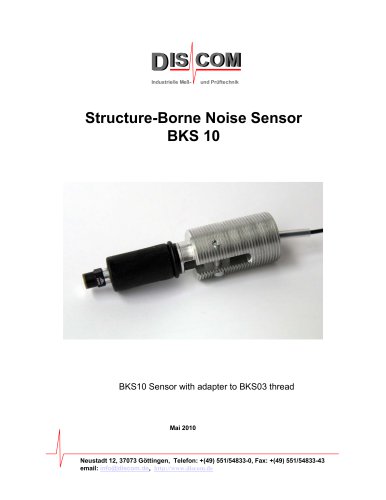 BKS 10
8 Pages
 1704-A-001
4 Pages
 4939
49392 Pages
 4138
41384 Pages
 4101-B and 4965-B
4 Pages
 Sonoscout NVH Recorder
8 Pages
 LDS Power Amplifiers
8 Pages
 Type 2720
2 Pages
 Type 2721
2 Pages
 TYPE 3668
4 Pages
 3656-A
4 Pages
 TYPE 2270-S
28 Pages
 LDS V994
2 Pages
 TYPE 8702
16 Pages
 BZ-7848-A
40 Pages
 TYPE 9718-A:bp0317
12 Pages
 TYPE 4720:bp1974
12 Pages
 TYPE 4824:bp1936
4 Pages
 SOUND LEVEL METER:bp 2025
28 Pages
 Transducers and conditioning
188 Pages
 Noise Sentinel Overview
3 Pages
 Analyzer Catalogue
39 Pages
 Noise Logger Type 3659
1 Page
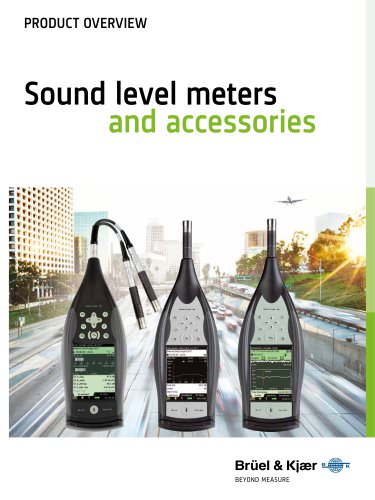 Sound level meters
17 Pages




Archived catalogs
 B&K 2245 Sound Level Meter
8 Pages
 HBK 2255 Sound Level Meter
10 Pages
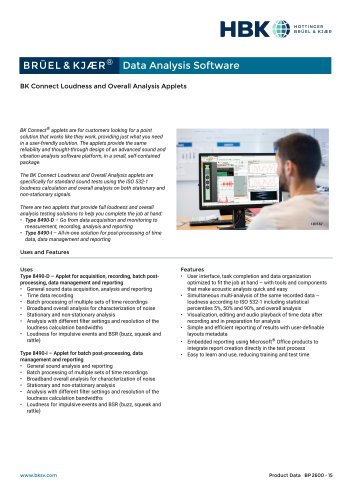 Data Analysis Software
6 Pages
- Power supply unit
- DC power supply
- AC/DC power supply
- Brüel & Kjaer calibrator
- Brüel & Kjaer accelerometer
- Single-output power supply
- Digital indicator
- Analog I/O
- Portable analyzer
- Communication gateway
- Measurement software
- Turntable
- Piezoelectric accelerometer
- Tilt sensor
- Brüel & Kjaer signal amplifier
- Real-time analyzer
- Tabletop power supply
- Ethernet gateway
- Laboratory analyzer
- Electric rotary table