


2690-A
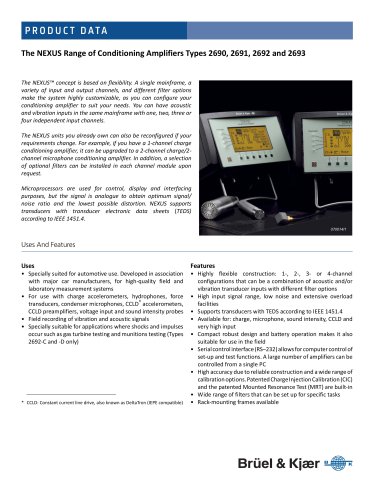
2690-A
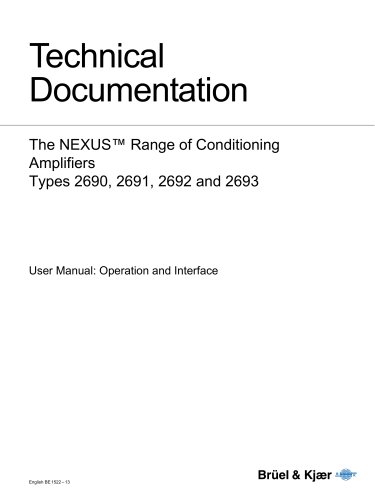
The NEXUS range of conditioning amplifiers, including Types 2690, 2691, 2692, and 2693, is designed for flexibility and customization. These amplifiers can be configured with various input and output channels and filter options to meet specific needs. They support both acoustic and vibration inputs and can be reconfigured as requirements change.
- Developed for automotive use and suitable for field and laboratory measurements.
- Compatible with various transducers, including charge accelerometers, hydrophones, and condenser microphones.
- Robust design for field use, with battery operation and computer control via RS-232 interface.
- High accuracy with built-in calibration options and a wide range of filters.
NEXUS amplifiers meet strict European EMC immunity requirements and are mechanically robust, adhering to MIL–STD–810C and IEC 60068–2–6 standards. They are designed for outdoor use, withstanding temperatures from –10 to +55 °C.
The amplifiers use a modular design with interchangeable modules for channel configuration, allowing for cost-effective updates and maintenance.
Standard versions cover common configurations, while custom versions can be tailored for specific channel combinations. Changes in configuration require returning the unit to Brüel & Kjær for updates.
- Charge Channel: Up to four channels with high- and low-pass filtering, supporting single and double integration modes.
- Microphone Channel: Up to four channels with floating inputs for EMI protection and various filter options.
- Sound Intensity Channel: Supports one or two probes with phase- and gain-match specifications.
- CCLD Channel: Up to four input modules for CCLD-based accelerometers and microphones.
NEXUS offers a range of built-in and optional filters, including low-pass, high-pass, and A-weighting filters. User-defined filters can be requested.
Extremely accurate gain control with automatic gain adjustment ensures linearity better than 0.02 dB. Gain is calculated based on output and transducer sensitivity.
All functions can be controlled via RS-232 interface, allowing for daisy-chaining of up to 99 channels. The NEXUS Setup and Control Software Type 7749 facilitates setup and control.
Setup is managed through six pushkeys, allowing for configuration of filters, gain, transducer settings, and more.
The rechargeable battery is intelligent, with no memory effect, and can be charged in approximately four hours.
Overload detection and other testing features ensure reliable operation and setup accuracy.
- Overload Detection: Comprehensive overload detection for various transducers and signals, with indications on the front panel LEDs and via RS-232 interface.
- Calibration Techniques: Includes Charge Injection Calibration (CIC) and Mounted Resonance Test (MRT) for verifying measurement setup and accelerometer mounting.
- Transducer Support: Supports transducers with TEDS according to IEEE 1451.4, allowing automatic reading of sensitivity and mode fields.
- Compliance with Standards: Complies with safety and EMC standards, including CE marking, RCM, China RoHS, and WEEE. Meets safety requirements under EN/IEC 61010-1 and ANSI/UL 61010-1.
- Environmental Specifications: Operates within a temperature range of -10 to +55 °C and is tested for humidity, vibration, and shock resistance according to relevant IEC standards.
- Input Specifications: Detailed specifications for charge, microphone, intensity, and CCLD inputs, including connector types, grounding, input impedance, and protection levels.
- Power Supply: Powered by an internal rechargeable battery or external DC power input, with specifications for charging and operational duration.
- Digital Control Interface: RS-232 interface supports various baud rates and communication protocols, with detailed timing and execution specifications for command transmission and setup configuration.
Features a 64 × 128 pixel graphical display with an option to toggle back-lighting on or off.
Dynamic range from -30 to +10 dBV (peak) with a resolution of 1 dB.
Output connector is BNC, with options for single-ended or floating grounding. Output impedance is 50 Ω || 500 pF. Maximum differential voltage output is 3.16 V peak (6.32 V peak to peak), with a maximum DC offset of ±25 mV, typically less than 2 mV. Output protection includes a differential voltage of ≤50 V(peak) and a common mode voltage of ≤15 V (peak). Common mode rejection is greater than 50 dB for common mode voltage ≤2 V peak. Output drive capacity supports 100 m of cable length to 20 kHz and 1000 m to 2 kHz. Channel separation is better than -100 dB at 1 kHz.
Measures 90 mm in height, 144 mm in width, and 230 mm in depth, with an approximate weight of 3 kg for a 4-channel unit including the battery.
Comes with a Manufacturer’s Certificate of Conformance. Initial calibration is optional, with specific models available for initial calibration and recalibration.
Includes accessories such as a mains adaptor, ferrite cable clamp, CD-ROM for setup and control software, and an RS-232 interface cable. Optional accessories include various adaptors, cables, a TEDS editor, rechargeable battery, rack shelf, fast charger kit, and more.
States that while reasonable care has been taken to ensure accuracy, no warranty is implied regarding its accuracy, currency, or completeness. Content is subject to change without notice.
Catalog excerpts

P R O D U C T D ATA The NEXUS Range of Conditioning Amplifiers Types 2690, 2691, 2692 and 2693 The NEXUS™ concept is based on flexibility. A single mainframe, a variety of input and output channels, and different filter options make the system highly customizable, as you can configure your conditioning amplifier to suit your needs. You can have acoustic and vibration inputs in the same mainframe with one, two, three or four independent input channels. The NEXUS units you already own can also be reconfigured if your requirements change. For example, if you have a 1-channel charge conditioning amplifier, it can be upgraded to a 2-channel charge/2channel microphone conditioning amplifier. In addition, a selection of optional filters can be installed in each channel module upon request. Microprocessors are used for control, display and interfacing purposes, but the signal is analogue to obtain optimum signal/ noise ratio and the lowest possible distortion. NEXUS supports transducers with transducer electronic data sheets (TEDS) according to IEEE 1451.4. Uses And Features Uses • Specially suited for automotive use. Developed in association with major car manufacturers, for high-quality field and laboratory measurement systems • For use with charge accelerometers, hydrophones, force transducers, condenser microphones, CCLD* accelerometers, CCLD preamplifiers, voltage input and sound intensity probes • Field recording of vibration and acoustic signals • Specially suitable for applications where shocks and impulses occur such as gas turbine testing and munitions testing (Types 2692-C and -D only) • Highly flexible construction: 1-, 2-, 3- or 4-channel configurations that can be a combination of acoustic and/or vibration transducer inputs with different filter options • High input signal range, low noise and extensive overload facilities • Supports transducers with TEDS according to IEEE 1451.4 • Available for: charge, microphone, sound intensity, CCLD and very high input • Compact robust design and battery operation makes it also suitable for use in the field • Serial control interface (RS–232) allows for computer control of set-up and test functions. A large number of amplifiers can be controlled from a single PC • High accuracy due to reliable construction and a wide range of calibration options. Patented Charge Injection Calibration (CIC) and the patented Mounted Resonance Test (MRT) are built-in • Wide range of filters that can be set up for specific tasks • Rack-mounting frames available * CCLD: Constant current line drive, also known as
Open the catalog to page 1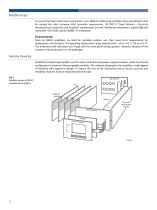
Reliable Design To survive the harsh electrical environment in cars, NEXUS conditioning amplifiers have specifications that far exceed the strict European EMC immunity requirements. ISO 7637-1 “Road Vehicles – Electrical disturbance by conduction and coupling” requirements are met. Mechanical robustness is equally high and meets MIL–STD–810C and IEC 60068–2–6 standards. Environmental Since all NEXUS amplifiers are built for portable outdoor use, they meet strict requirements for temperature and humidity. The operating temperature range extends from –10 to +55 °C (14 to 131 °F). The instrument...
Open the catalog to page 2
Standard Versions A number of standard versions are available that cover the most commonly used configurations. However, if you require a combination not found below, we can provide a custom-made version. NEXUS Standard Version Type/Order Number 2-channel Microphone Conditioning Amplifier with A, B, C and D Filters 4-channel Microphone Conditioning Amplifier with A, B, C and D Filters 1-channel Microphone Conditioning Amplifier 2-channel Microphone Conditioning Amplifier 4-channel Microphone Conditioning Amplifier 2-channel (Single Probe) Intensity Conditioning Amplifier 1-channel Charge Conditioning...
Open the catalog to page 3
Channel Description A conditioning amplifier can contain up to four modular channels. Each channel consists of a common module, an input module, an optional module and an output module. The common module contains filters, gain settings and calibration functions. The input and output modules have additional gain settings and include high-pass filters. Fig. 2 Back panel of a 4channel NEXUS Conditioning Amplifier Type 2690-A-OS4. Each input module has a 7-pin LEMO connector for connecting Brüel & Kjær’s Falcon range microphones and a BNC output channel Charge Channel A conditioning amplifier can...
Open the catalog to page 4
Sound Intensity Channel One or two sound intensity probes can be connected with 7-pin LEMO connectors in a single conditioning amplifier containing two or four intensity channels. The features of the sound intensity channel are very similar to the microphone channel, but it has IEC 61043 standard Class 1 and ANSI S1.9–1996 Class 1 phase- and gain-match specifications using the special intensity 20 Hz high-pass filter. CCLD Channel Up to four CCLD input modules can be fitted for conditioning of input signals from CCLD based accelerometers, microphone preamplifiers or direct voltage input. The...
Open the catalog to page 5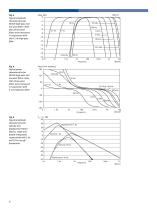
Fig. 3 Typical amplitude characteristics for NEXUS high-pass and low-pass filters. Note that all low-pass filters were measured in conjunction with the 0.1 Hz high-pass filter Fig. 4 Typical phase characteristics for NEXUS high-pass and low-pass filters. Note that all low-pass filters were measured in conjunction with 0.1 Hz high-pass filter Phase Shift (degrees) 180 10 Hz Intensity Fig. 5 Typical amplitude characteristics for velocity and displacement filters (that is, single and double integration, respectively) with 1 Hz and 10 Hz cut-off frequencies
Open the catalog to page 6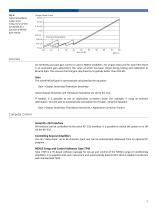
Fig. 6 Typical broadband output noise measured in 22 kHz bandwidth as a function of NEXUS gain setting Output Noise (Vrms) 30mV 10 mV 3.16 mV 1 mV 316 μV CCLD and Preamplifier 100 μV 31.6 μV 10 μV –20 Accuracy An extremely accurate gain control is used in NEXUS amplifiers. For all gain steps and for each filter there is an automatic gain adjustment, the value of which has been stored during testing and calibration at Brüel & Kjær. This ensures that the gain step linearity is typically better than 0.02 dB. Gain The overall NEXUS gain is automatically calculated by the equation: Gain = Output Sensitivity/Transducer...
Open the catalog to page 7All Hottinger Brüel & Kjær A/S catalogs and technical brochures
 Artificial Mastoid Type 4930
6 Pages
 Power Amplifier Type 2718
2 Pages
 DISCOM Mobile
6 Pages
 DISCOM NVH Analysis Systems
4 Pages
 TEDS Microphones
8 Pages
 LDS V8
4 Pages
 LDS Comet USB
4 Pages
 LDS Laser USB
16 Pages
 4374
43742 Pages
 4326-A-001
8 Pages
 4152
41524 Pages
 4191
41912 Pages
 2719
27192 Pages
 LDS V8900
4 Pages
 BKS 10
8 Pages
 1704-A-001
4 Pages
 4939
49392 Pages
 4138
41384 Pages
 4101-B and 4965-B
4 Pages
 Sonoscout NVH Recorder
8 Pages
 LDS Power Amplifiers
8 Pages
 Type 2720
2 Pages
 Type 2721
2 Pages
 TYPE 3668
4 Pages
 3656-A
4 Pages
 TYPE 2270-S
28 Pages
 LDS V994
2 Pages
 TYPE 8702
16 Pages
 BZ-7848-A
40 Pages
 TYPE 9718-A:bp0317
12 Pages
 TYPE 4720:bp1974
12 Pages
 TYPE 4824:bp1936
4 Pages
 SOUND LEVEL METER:bp 2025
28 Pages
 Transducers and conditioning
188 Pages
 Noise Sentinel Overview
3 Pages
 Analyzer Catalogue
39 Pages
 Noise Logger Type 3659
1 Page
 Sound level meters
17 Pages




Archived catalogs
 B&K 2245 Sound Level Meter
8 Pages
 HBK 2255 Sound Level Meter
10 Pages
 Data Analysis Software
6 Pages
- DC power supply
- AC/DC power supply
- Brüel & Kjaer calibrator
- Single-output power supply
- Digital indicator
- Analog I/O
- Portable analyzer
- Communication gateway
- Measurement software
- Turntable
- Piezoelectric accelerometer
- Tilt sensor
- Brüel & Kjaer signal amplifier
- Real-time analyzer
- Tabletop power supply
- Ethernet gateway
- Laboratory analyzer
- Electric rotary table