

PA-1000
PA-1000
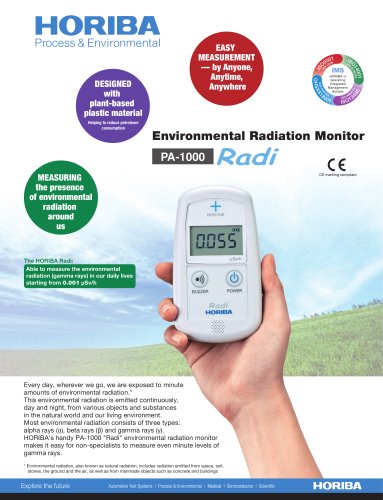
The document introduces the HORIBA PA-1000 "Radi" environmental radiation monitor, designed to measure environmental radiation, specifically gamma rays, using plant-based plastic materials. It aims to reduce petroleum consumption and offers easy measurement capabilities for non-specialists.
Specifications
The PA-1000 Radi is capable of measuring gamma rays starting from 0.001 µSv/h. It features a splash-resistant construction (IPX4), is compact and lightweight, and operates on two AA batteries with a life of 50 hours or more. The device uses a CsI (Tl) scintillator for high-performance detection and can measure radiation levels from normal to 100-200 times natural intensity.
Measurement Capabilities
The monitor displays radiation measurements in microsieverts per hour (µSv/h) on a large LCD. It includes an automatic power-off function after 3 hours and an audible beep when radiation is detected. The device is designed to measure radiation quantity at a location but does not assess safety.
Radiation Types and Units
The document explains the types of radiation: alpha rays (α), beta rays (β), and gamma rays (γ), with gamma rays being the most penetrating. It also describes radiation units: Becquerel (Bq) for radioactivity, Gray (Gy) for radioactive energy received, and Sievert (Sv) for the effect on humans.
Technical Specifications
The detection method is scintillation, measuring gamma rays with a minimum sensitivity of 1000 counts per minute for 1 µSv/h. The relative error of indication is ±10%, with a maximum coefficient of variation of 0.1. The energy range is more than 150 keV, with an effective measurement range of 0.001 - 9.999 µSv/h. The device dimensions are 68 (W) × 28 (D) × 121 (H) mm, weighing a maximum of 175 g without batteries. Accessories include an instruction manual, two AA batteries, and a neck strap.
Recommendations
The International Commission on Radiological Protection (ICRP) recommends a maximum exposure of 1 mSv per year to manmade radiation for the general public, excluding medical checkups.
Catalog excerpts

DESIGNED with plant-based plastic material Helping to reduce petroleum consumption EASY MEASUREMENT — by Anyone, Anytime, Anywhere Environmental Radiation Monitor PA-1000 MEASURING the presence of environmental radiation around us The HORIBA Radi: Able to measure the environmental radiation (gamma rays) in our daily lives starting from 0.001 µSv/h Every day, wherever we go, we are exposed to minute amounts of environmental radiation.* This environmental radiation is emitted continuously, day and night, from various objects and substances in the natural world and our living environment. Most environmental radiation consists of three types: alpha rays (α), beta rays (β) and gamma rays (γ). HORIBA's handy PA-1000 "Radi" environmental radiation monitor makes it easy for non-specialists to measure even minute levels of gamma rays. * Environmental radiation, also known as natural radiation, includes radiation emitted from space, soil, stones, the ground and the air, as well as from manmade objects such as concrete and buildings
Open the catalog to page 1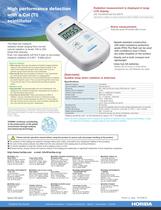
High performance detection radiation levels ranging from normal natural radiation to levels 100 to 200 times that intensity. Even non-specialists will find it easy to accurately measure radiation of 0.001 - 9.999 uSv/h. • Alpha rays (a): Alpha rays are streams of positively charged particles made up of two neutrons and two protons (helium nucleus). In the natural world, alpha rays are given off by radium 226. In air, the particles cannot travel more than a few centimeters. • Beta rays (P): Beta rays are streams of electrons. In air, the particles can travel several dozen centimeters in a zigzag...
Open the catalog to page 2All HORIBA Process & Environmental catalogs and technical brochures
 SLFA-60.6000 catalog
4 Pages
 EMIA Series catalog
6 Pages
 EMIA-STEP catalog
2 Pages
 EMGA-921 catalog
4 Pages
 Ultima Expert LT
4 Pages
 LA-350
4 Pages
 LA-960
10 Pages
 HT-110_TOC
2 Pages
 XGT-7200 catalog
8 Pages
 LAQUAtwin
6 Pages
 LAQUA series
20 Pages
 CODA-500
1 Page
 51 series
2 Pages
 VA-5000 Analyzer
1 Page
 B-340 series
2 Pages
 SEC-Z500X series
13 Pages
 Water quality analyzer
12 Pages
 Compact Water Quality Meter
11 Pages
 IG Series
4 Pages
 TW-100
4 Pages
 INM-700
4 Pages
 ENDA-4000
2 Pages
 GA-360E Series
2 Pages
 IG-410
2 Pages
 Infrared Thermometers
8 Pages
 Conductivity/Resistivity Meters
16 Pages
 U-50 Series
8 Pages
 VA-3000 Series
10 Pages
 XE multi-gas CEMS
2 Pages
 AP-370 Series
12 Pages


Archived catalogs
 B-700series
5 Pages
- Measuring device
- Gas analyzer
- Concentration analyzer
- Monitoring analyzer
- Liquids analyzer
- Automatic analyser
- Benchtop analyser
- Solids analyser
- Spectrometer
- Process analyzer
- Portable analyzer
- Industrial thermometer
- Continuous analyzer
- Water analyzer
- Integration analyzer
- Oxygen analyzer
- IR pyrometer
- Compact analyzer
- Digital analyzer
- Digital gauge