
- Catalogs
- Höcherl & Hackl
- PRODUCT & SOLUTIONS Mainn Catalog | 2019


PRODUCT & SOLUTIONS Mainn Catalog | 2019

PRODUCT & SOLUTIONS Mainn Catalog | 2019
Höcherl & Hackl GmbH, established in 1986 and restructured in 1990, is a prominent developer and manufacturer of electronic loads and systems for testing power supplies, energy storage systems, and fuel cells. The company is recognized for its 'Made in Germany' quality and has a strong presence in both German and international markets.
The company offers a wide range of electronic loads, including:
- PLA Series: Low power DC loads (200-1,200 W)
- PLI Series: Medium and high power DC loads (600-28,800 W)
- ZS Series: Multi-range DC loads (500 W)
- ERI Series: Energy recycling DC loads (3,600-10,800 W)
- PMLA Series: Multi-channel DC loads (150-600 W/channel)
- NL Series: Source-sink loads (100-3,200 W, unipolar and bipolar)
- SE Series: 19" power distribution
- ACL Series: DC/AC/3-phase loads (500-21,000 W)
H&H is certified under DIN EN ISO 9001, integrating quality management with environmental stewardship, emphasizing sustainability and responsible resource use.
The company supports innovation in renewable energies and electric mobility, collaborating with research and educational institutions on projects like the WARR Hyperloop and Solar Team Twente.
H&H has representatives in numerous countries, including Austria, Belgium, China, and the USA, ensuring a broad international reach.
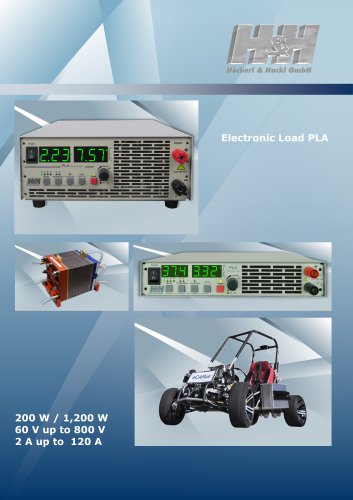
The PLA series offers various operating modes (CC, CV, CR, CP) and features like dynamic loads, MPP tracking, and multiple data interfaces (Ethernet, USB, RS-232, CAN, GPIB). These devices are designed for flexibility and reliability, with options for front and rear load inputs and silent cooling.
H&H prioritizes high labor and social standards, aligning with human rights and ILO core labor standards, providing regular training to ensure compliance and promote a supportive work environment.
The document provides detailed specifications for various models in the PLI Series, focusing on power capabilities ranging from 14,000 W to 28,800 W. Key specifications include maximum and minimum input voltages, maximum current, continuous and short-time power, voltage and current settings, resistance settings, rise and fall times, load terminals, power consumption, noise levels, weight, and dimensions.
Models are designed for 19” rack installations, with heights ranging from 2 U to 20 U. Noise levels are measured at a maximum of 80 dB(A), with power consumption varying by model.
Maximum Power Point Tracking (MPPT) is available, consisting of sweeping and tracking sub-functions. Internal resistance measurement is supported, following standards like DIN EN 61951 and DIN EN 61960. The Charger Starter Interface (CSI) tests intelligent chargers by simulating energy storage devices.
The PLI software tool provides a graphical interface for controlling the electronic loads, with features like a list editor for dynamic load profiles and a data viewer for exporting measurement data. LabVIEW drivers are available for download.
The document outlines the technical specifications for the PLI and ZS series electronic loads. Key specifications include voltage and current measurement accuracy of ±1%, dynamic function capabilities with up to 300 load levels, and data acquisition options via USB and internal memory. The devices support various operating modes such as constant current (CC), constant voltage (CV), constant resistance (CR), and constant power (CP).
Data can be acquired at sampling rates from 0.5 to 30 seconds with a resolution of 0.1 seconds. The devices support multiple interfaces including RS-232, USB, LAN, GPIB, and CAN, with options for galvanically isolated I/O ports.
The devices feature overcurrent, overpower, overtemperature, and undervoltage protection. Monitoring includes overvoltage and reverse polarity indications.
The devices operate within a temperature range of 5 to 40°C and can be stored between -25 to 65°C. They are designed for use up to 2000 meters above sea level with a pollution degree of 2 and overvoltage category II.
Various options are available including data interfaces, hardware extensions, and function enhancements like MPPT tracking. Calibration certificates are provided, and a two-year warranty is included.
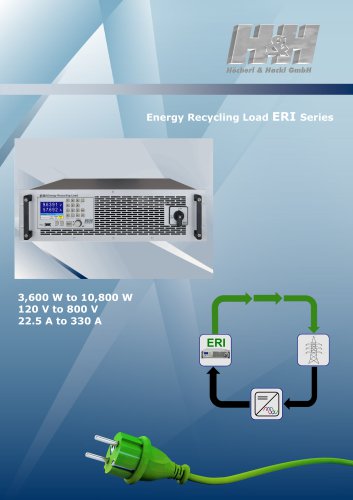
The ERI Series is highlighted for its energy recycling capabilities, reducing electricity costs and minimizing heat waste. It supports various data interfaces, including Ethernet, USB, RS-232, and CAN, with optional GPIB installation. The series is suitable for laboratory operations due to its quiet and efficient performance.
The document outlines the available interfaces for both series, including RS-232, USB, LAN, GPIB, and CAN, with options for galvanically isolated I/O ports to prevent ground loops and support bipolar voltage loading.
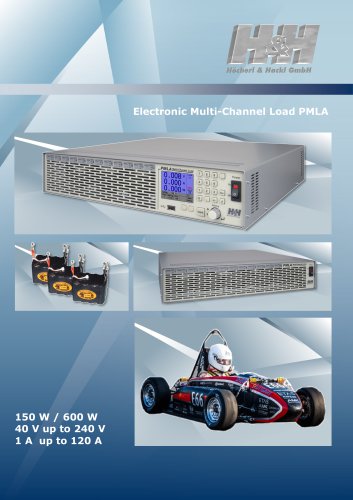
The PMLA Series is a multi-channel electronic DC load system designed for power regeneration applications. It supports up to 12 load channels/modules in a compact 19" housing, with each channel being galvanically isolated. The system can be expanded with Slave devices, allowing for a maximum of 72 channels per system.
The PMLA Series offers modules in four voltage classes (40 V, 60 V, 120 V, 240 V) and four power classes (150 W, 300 W, 450 W, 600 W). The total power capacity is 1,800 W, with currents ranging from 1 A to 120 A. It supports various operating modes including constant current (CC), constant voltage (CV), constant resistance (CR), and constant power (CP).
The system includes multiple data interfaces such as RS-232, USB, LAN, GPIB, and CAN. It features a graphical user interface for operation and supports SCPI programming. The system also includes a watchdog function to protect against communication issues.
The PMLA Series is equipped with overcurrent, undervoltage, overpower, and overtemperature protection. It also includes analog control inputs and monitor outputs for voltage and current.
The system is suitable for a variety of applications including burn-in testing, battery and accumulator testing, DC/DC converter testing, and more. It is also equipped with a discharge function for energy storage device testing.
A Factory Calibration Certificate is provided, ensuring traceability to national standards. The system is calibrated according to DIN EN ISO 9001 standards, with a recommended calibration interval of two years.
The PMLA Tool software allows for control of up to 72 channels, with features such as a List Editor for setting values and a Data Viewer for graphical display of measured values. The software supports data logging and storage in CSV format.
Various modules are available with different power and voltage specifications. Accessories include cooling units, interface options, and calibration certificates.
The document outlines the specifications for a series of electronic loads, detailing input levels, accuracy, load capacity, and operating conditions. Key specifications include:
- Input level: 3 to 30 V
- Accuracy for analog signals: Voltage ±0.1%, Current ±0.2%
- Maximum load capacity: 2 kΩ
- Operating temperature: 5 to 40 °C
- Protection against overcurrent, overpower, overtemperature, and reverse polarity
The document describes various operating modes such as constant current, resistance, power, and voltage modes (CC, CR, CP, CV). It highlights:
- Synchronization options for input voltage, line/mains voltage, or external signals
- Protection features including overcurrent and overvoltage indications
- Analog and digital interfaces for control and monitoring
The ACL series supports both AC and DC loads with features like:
- Frequency range up to 1,000 Hz
- Single and three-phase models
- 4.3" touchscreen interface for easy operation
- Automatic amplitude correction and phase shift capabilities
The document mentions a factory calibration certificate provided with the devices, ensuring traceability to national standards. A second calibration is offered free within two years of delivery. The recommended calibration interval is two years under laboratory conditions.
The devices are designed for stability and ease of use, with features such as:
- 19" rack-mountable design
- Temperature-controlled air cooling to minimize noise
- Protection class 1 and IP20 rating
- Compliance with various safety and EMC standards
The document lists optional interfaces and accessories, including:
- GPIB interface
- Galvanically isolated I/O port
- Heavy-load castors for larger devices
The document provides a detailed technical specification for various models of the ACLS and ACLT series, which are single-phase and three-phase power systems, respectively. These systems are designed for both AC and DC input modes, with varying capacities and features tailored to different power requirements.
- Voltage and Current: The maximum AC input voltage is 280 V or 500 V, and the maximum DC input voltage is 400 V or 700 V, depending on the model. The maximum current ranges from 2 A to 120 A, with peak currents reaching up to 480 A.
- Power and Resistance: Power output varies from 500 W to 21,000 W, with resistance values adjusted accordingly to suit different load requirements.
- Frequency Range: All models support a frequency range from DC to 1,000 Hz.
- Input Capacity: Capacities for AC and DC modes are specified, with values increasing with model power capabilities.
- Noise Levels: Noise levels range from 70 dB(A) to 83 dB(A), measured at a distance of 1 meter.
- Dimensions and Weight: The dimensions and weight of the units vary significantly, with larger models being heavier and occupying more rack space.
- Installation: The installation depth is specified without wiring, and detailed dimensions can be accessed via 3D models on the manufacturer's website.
- Load Terminals: Different terminal types are available, with descriptions beginning on page 109 of the document.
- Housing: The units are housed in standard 19" racks, with height measured in U (1 U = 44.45 mm).
- Ensure compatibility with the specified mains voltage and frequency for optimal performance.
- Consider noise levels and installation space when selecting a model for specific environments.
The document provides detailed specifications for various models of the ACLT and NL series devices. Key specifications include power consumption, mains voltage, noise levels, weight, dimensions, housing, and installation depth. The ACLT series models have a frequency range of DC to 1,000 Hz, with maximum AC and DC input voltages of 500 V and 700 V respectively. The NL series offers 2-quadrant and 4-quadrant versions with source-sink functions and rapid regulation times.
The document outlines the accuracy of voltage, current, resistance, and power settings across different frequency ranges. It highlights the total harmonic distortion and the accuracy of measurements and displays. The devices feature a resolution of 14 bits for voltage and current measurements.
The ACLT series supports various operating modes including constant current (CC) and constant voltage (CV) modes. The NL series can operate in source-sink mode, with rapid switching between source and sink functions. The devices offer programmable waveforms and SCPI programming for measurement functions.
The document details protective devices such as overcurrent, overpower, and overtemperature protection. Monitoring features include overvoltage and undervoltage protection, with specified operating conditions like temperature and humidity limits.
The devices come with standard interfaces such as USB, RS-232, and optional interfaces like GPIB and LAN. The document describes various hardware expansions, including galvanically isolated I/O ports and data acquisition tools.
The document mentions a factory calibration certificate provided with the devices, with a recommendation for a calibration interval of two years. A two-year warranty is also offered.
The document provides detailed technical specifications and operational guidelines for the NL Series of devices, which are used for testing and data logging in electrical applications. It includes information on software tools, model specifications, options, accessories, and technical data.
The NL Series devices offer a range of voltage and current capabilities, with models available in both bipolar and unipolar configurations. Key specifications include voltage and current ranges, power ratings, rise/fall times, load terminals, power consumption, and dimensions. The devices are designed for use with a 115/230 V AC mains supply and are housed in standard 19" racks.
The document mentions several software tools, including the Control Tool (Universal Control Program), Battery Test Tool, and Dynamic List and Data Acquisition Tool. These tools facilitate intelligent profile generation, waveform display, and data logging.
The devices support fast synchronous data logging with the NL13 option, allowing for detailed measurement and analysis. Logged data includes voltage, current, time, capacity, status, test conditions, and switch-off criteria.
The document provides a comprehensive list of models, detailing their voltage and current ranges, power ratings, rise/fall times, load terminals, power consumption, dimensions, weight, and housing specifications. Models are available for both low and high power applications, with options for customization.
A variety of options and accessories are available, including RS-232 cables, GPIB interface extensions, Ethernet converters, galvanically isolated I/O ports, power I/O boards, heavy-load castors, and factory calibration certificates.
The document outlines the technical data for the NL Series, including setting accuracy, display accuracy, measurement accuracy, sampling rates, and I/O port specifications. It also covers operating conditions, protection and monitoring features, and permissible potentials.
The devices are designed to operate within a temperature range of 5 to 40 °C, with a maximum operating height of 2,000 meters above sea level. They are suitable for environments with a pollution degree of 1 and a maximum humidity of 80% at 31 °C.
The document outlines the specifications for H&H power distribution units, including cooling methods, noise levels, supply voltage options (115/230 V~ ±10 %, 50 ... 60 Hz and 230/400 V AC, 16 A CEE), and power consumption details. The units are designed with specific dimensions and weight, and are colored in RAL7032 (pebble grey) and RAL7037 (dusty grey).
The units comply with safety standards such as DIN EN 61010-1 and EMC standards like DIN EN 61326-1. They are classified under protection class 1 and IP20, with a measuring category of O (CAT I according to EN 61010:2004).
The units come with a factory calibration certificate and a two-year warranty.
The SE Series power distribution units feature a central mains switch, emergency stop function, and individual circuit fuses. Some models include a residual current circuit breaker and a built-in DC power supply.
Various models are listed, such as SE-1PH, SE-3PH-16, and SE-3PH-32, each with specific voltage, current, and connection details. The models are designed for integration into rack systems and feature different configurations of emergency stop switches and DC power supplies.
The document describes different types of terminals, including binding posts, bolts, and copper bars, with specifications for current capacity and installation examples.
Accessories include high current cables, super flexible cables, low-inductance cables, and rack systems. The document provides details on cable specifications, such as cross-section, current, voltage, and assembly options.
Special racks are available for the installation of electronic loads, designed with large air vents for efficient air outlet and equipped with socket strips for mains connection.
The document includes the General Standard Terms and Conditions of Business for Höcherl & Hackl GmbH, covering aspects like offer acceptance, delivery periods, prices, and terms of payment.
Catalog excerpts

PRODUCTS SOLUTIONS SUPPORT TRADE Main Catalog | 2019 POWER DISTRIBUTION ELECTRONIC AC LOAD RAIL INDUSTRY HIGH TECH MULTI-CHANNEL LOAD RENEWABLE ENERGIES MEDICINE ENERGY RECYCLING SOURCE-SINK AEROSPACE
Open the catalog to page 1
Höcherl & Hackl GmbH Industriestr. 13 94357 Konzell GERMANY
Open the catalog to page 2
Johann Hackl (left), Helmut Höcherl WELCOME AT HÖCHERL & HACKL In this catalog we present our entire product and service portfolio. Sometimes, however, a brochure cannot replace personal contact. Therefore we always have an open ear for your questions and wishes. We look forward to talking to you. Höcherl & Hackl GmbH was founded as a partner ship in 1986 and changed its name to the present GmbH in 1990. For over 30 years Höcherl & Hackl has been developing and manufacturing electronic loads and systems for testing power supplies, energy storage systems and fuel cells. We can look back on 30...
Open the catalog to page 3
1986 - Foundation of the company 1990 - Conversion to a GmbH Our down-to-earth company has a home: The entire development and production process of H&H products takes place in Konzell in Lower Bavaria on an area of 1200m². The development of our location reflects our growth history: The production hall was built in 1995 and expanded to double the production area in 2001. The ground-breaking ceremony for an extension building took place in 2014. Today, 40 employees in Konzell develop and produce solutions for users of electronic loads worldwide. 1992 - Employment of the first trainee 1995 - New...
Open the catalog to page 6
Apprenticeship In our company we focus on passing on our knowledge and train our junior staff ourselves. The first trainee was hired as early as 1992. Today Hocherl & Hackl offers two apprenticeship professions: "Electronics Technician for Devices and Systems" and "Office Management Assistant". Our apprenticeship positions are always filled by young employees. Training and further education are firmly anchored in our company. It is important to us to involve our trainees in the teamwork right from the start and to entrust them with challenging work. Flat hierarchies and interesting tasks ensure...
Open the catalog to page 7
Environment "Protecting the environment" - that means that we think of our children. In a time of fast-moving globalization and rapid technological change, it becomes clearer every day how limited the resources on this planet are. Resources that recently seemed to be available in unlimited quantities - such as water and air - are now considered limited or threatened in their purity. The responsible use of nature's valuable raw materials is therefore a fundamental part of H&H's corporate philosophy. Only the consistent observation of ecological findings can ensure the long-term success of our...
Open the catalog to page 8
H&H worldwide You will find H&H representatives in the following countries: • Austria • Belgium • China • Croatia • Czech Republik • Denmark • Finland • France • Germany • Great Britain • India • Israel • Italy • Liechtenstein • Luxemburg • Netherlands • Norway • Poland • Portugal • Romania • Slovakia • Slovenia • South Korea • Spain • Sweden • Switzerland Labor and Social Standards Our company effectively ensures compliance with high labor and social standards. At Hocherl & Hackl, the protection of human rights and compliance with applicable laws and standards are not a lip service but a top...
Open the catalog to page 9
WARR Hyperloop An extremely fascinating project is "WARR Hyperloop", in which Hocherl & Hackl also participates and supports the project development by providing electronic loads. Hyperloop is the concept of a high-speed transport system in which a magnetic levitation train is transported in a vacuum tube. The Hyperloop is similar to the Transrapid, except that no evacuated tubes are used. According to the old principle of the pneumatic tube system, electrically driven transport pods with travel speeds of up to about 1125 km/h are to be transported on air cushions using solar energy, and thus...
Open the catalog to page 10
Solar Team Twente The Solar Team Twente (part of TU Twente) designs and builds a solar car every other year to participate in the World Solar Challenge in Australia. In 2017, this team took part with the RED SHIFT, a solar car in which the so-called Solar Balancing technique called "SABINE" was applied. SABINE stands for Solar Array Balancing Interface Not Expected. It ensures that losses caused by the differences between the revenues of solar cells, also called Grouping Loss, are marginalized. SABINE "removes" energy from high-performance cell groups and gives it to poorly-performing groups....
Open the catalog to page 11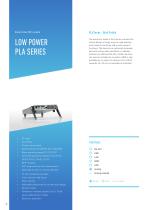
PLA Series - Brief Profile The electronic loads of PLA series combine the classic design of large, easy-to-read displays with modern interfaces and a wide range of functions. The devices can optionally be equipped with various data interfaces. In addition to Ethernet, USB and RS-232, a CAN interface can also be installed as an option. GPIB is also available as an option for devices from 400 W upwards. An I/O port is available as standard. • Optional Ethernet/USB/RS-232, CAN, GPIB • Basic operating modes CC, CV CR, CP • Combined operating modes CC+CV CP+CV, CR+CV CP+CC, CR+CC,CV+CC • MPP Tracking...
Open the catalog to page 12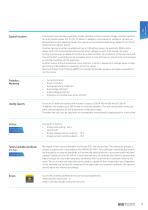
Scope of Functions The devices have the basic operating modes constant current, constant voltage, constant resistan ce, and constant power (CC, CV, CR, CP Mode). In addition, a limit value for voltage or current can be specified in each operating mode. This results in the combined operating modes CC+CV, CP+CV, CR+CV CP+CC, CR+CC, CV+CC. Dynamic functions can be simulated with up to 100 setting values. An automatic DAQ function allows up to 100 measurement data records (time, voltage, current) to be stored internally. Further functions are available for control via a data interface: For protection...
Open the catalog to page 13
Overcurrent and Undervoltage Protection An overcurrent or undervoltage protection may be activated and varied. The active protection works in all operating modes. Undervoltage protection works in two different modes: • regulating transition at slow regulation speed (e.g. battery discharge) • switching transition at fast regulation sped (short dead time, e.g. when switching the input voltage ) Load Profiles (List Function) In all operating modes PLA series loads can generate dynamic load profiles. Up to 100 settings with variable dwell and ramp time are possible. Load profile with LIST function...
Open the catalog to page 14All Höcherl & Hackl catalogs and technical brochures
 PMLA Series
10 Pages
 Brochure ERI Series
12 Pages
 ZS Series
12 Pages
 Brochure PMLA
14 Pages
 PLA Series Brochure
16 Pages
 ZS/ZSLC/ZSLV Series
23 Pages
 PMLI Series
6 Pages
 PL Series
5 Pages
 Main catalogue
76 Pages
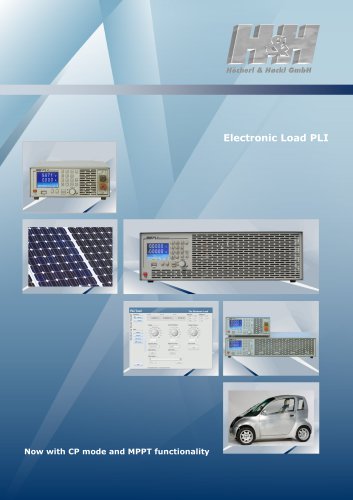 Electronic Loads, PLI Series
5 Pages
 PMLI Multiload
4 Pages
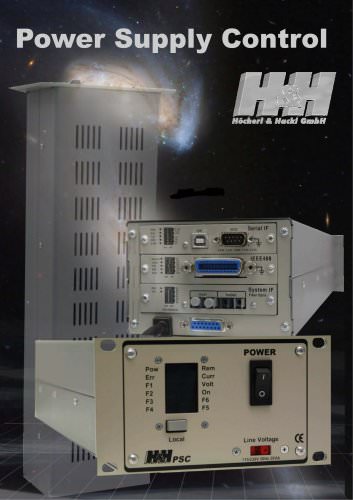 Power Supply Control
4 Pages
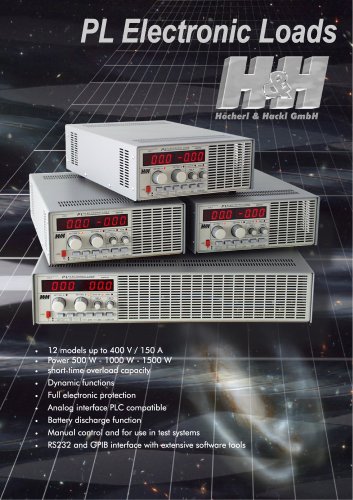 PL Electronic Loads
4 Pages
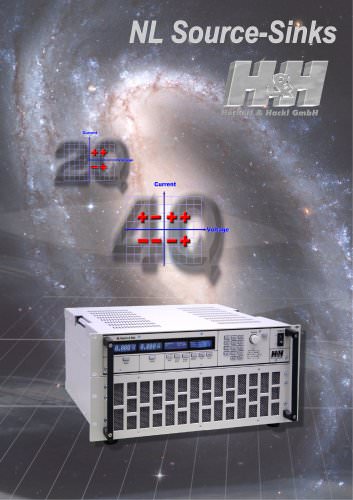 NL Source-Sink
12 Pages
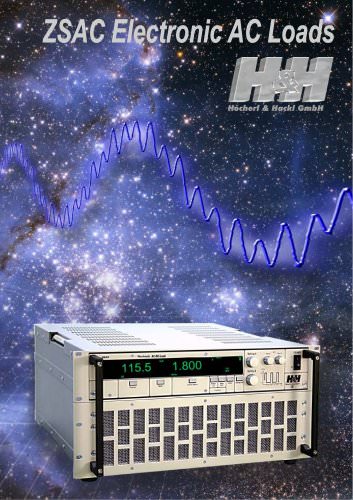 ZSAC Electronic AC Loads
12 Pages
 H&H Product Overview
4 Pages
Archived catalogs
 NL Series
11 Pages
 NL SERIES_2013
11 Pages