
- Catalogs
- Hitachi Zosen Inova AG
- Semi-Dry System

Semi-Dry System

Semi-Dry System
- Proven technology with a successful track record.
- Efficient process with minimal investment requirements.
- Compact equipment design allows for easy retrofitting.
- Low maintenance due to minimal moving components.
- High system availability due to generous design margins.
- Low reagent consumption and residue levels.
- High separation efficiency and low emissions.
- No wastewater discharge and upgradable system.
Catalog excerpts

Hitachi Zosen I nova AG Hitachi Zosen Semi-dry System Flue gas purification no period Hitachi Zosen Semi-dry System Flue gas purification no period
Open the catalog to page 1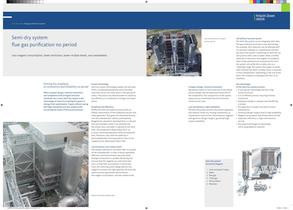
Semi-dry System Flue gas purication no period Semi-dry system ue gas purication no period Two Line Semi Dry FGT System erection period Less reagent consumption, lower emissions, lower residue levels, zero wastewater. Putting the emphasis on economics and reliability no period When compact design, minimal investment, and compliance with stringent emission standards are crucial, Semi-dry system is the technology of choice for treating ue gases at energy-from-waste plants. It goes without saying that high availability and low residue levels are among the assets of this proven process. Proven technology...
Open the catalog to page 2All Hitachi Zosen Inova AG catalogs and technical brochures
 Energy-from-Biosolids plant
4 Pages
 ThermoRe by HZI
4 Pages
 XEROSORP+
4 Pages
 The Inova fluid bed
4 Pages
 Dynor SNCR Process
4 Pages
 Grate Combustion Technology
4 Pages
 Online Boiler Rapper Monitor
4 Pages
 Oxi-Air - Wet Scrubbing
4 Pages

- Drying system
- Continuous drying system
- Screen
- Steam generator
- Recuperator
- Fluidized bed dryer
- Stainless steel grate
- Scrubber System
- Energy recovery system
- Wet gas scrubber
- Digestion system
- Chemical gas scrubber
- Screw press
- Gas steam generator
- Rotary screen
- Electrostatic precipitator
- Coarse screening screen
- Combined heat and power plant
- High-efficiency gas scrubber
- Dry gas scrubber