
- Catalogs
- Hitachi Zosen Inova AG
- Dynor SNCR Process

Dynor SNCR Process

Dynor SNCR Process
The DyNOR™ process is an advanced Selective Non-Catalytic Reduction (SNCR) technology developed by Hitachi Zosen Inova. It is designed to meet Europe's stringent nitrogen oxide (NOx) standards by converting harmful NOx emissions into nitrogen and water. This process offers a cost-effective alternative to the more expensive Selective Catalytic Reduction (SCR) process, achieving low NOx levels with minimal ammonia slip.
- Low NOx Levels: DyNOR™ effectively reduces NOx emissions with minimal ammonia slip, confirmed through successful deployment in energy-from-waste plants.
- Cost Reduction: The process requires lower investment and energy consumption compared to SCR, making it economically advantageous.
- Energy Efficiency: DyNOR™ maximizes steam production by minimizing atomizing media consumption and eliminating the need for additional dilution water.
- Minimized Maintenance: The use of undiluted reagents prevents nozzle fouling, reducing maintenance needs.
- Simple Design and Installation: The modular design facilitates easy integration into new or existing plants, enhancing system dependability and cost-effectiveness.
The DyNOR™ system includes a distributor, nozzles, IR pyrometers, and air/steam injection components. It operates by virtually segmenting the combustion zones and independently measuring temperatures to optimize reagent injection. This ensures precise functionality even with temperature fluctuations, maintaining efficient NOx reduction.
DyNOR™ divides the steam generator's first pass into vertical segments, each equipped with a module containing a distributor and injection points. This setup allows for accurate reagent metering and temperature-responsive control, ensuring effective NOx reduction across varying conditions.
The DyNOR™ process is a reliable and cost-effective solution for meeting the world's strictest NOx standards. Its simple installation and modular technology make it suitable for both retrofits and new plant integrations, providing a practical answer to Europe's tightened nitrogen oxide limits.
Catalog excerpts

Hitachi Zosen The SNCR process that fulfils Europe's strict nitrogen oxide standards
Open the catalog to page 1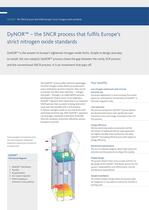
DyNOR™ The SNCR process that fulfils Europe’s strict nitrogen oxide standards DyNOR™ – the SNCR process that fulfils Europe’s strict nitrogen oxide standards DyNOR™ is the answer to Europe’s tightened nitrogen oxide limits. Simple in design and easy to install, the non-catalytic DyNOR™ process closes the gap between the costly SCR process and the conventional SNCR process. It is an investment that pays off. The DyNOR™ process offers decisive advantages. Harmful nitrogen oxides (NOx) are produced in every combustion process; however, they can be converted into their basic elements – nitrogen ...
Open the catalog to page 2
Efficiency thanks to precisely interacting systems In the SNCR process, the reactant must be injected into the secondary combustion chamber within the optimised temperature range of 850° C to 950° C. Although modern combustion systems react to different waste qualities, it is not possible to totally prevent short-term temperature fluctuations and asymmetries. The key advantage of DyNOR™ is that reagents are always injected at the precise right location. The answer to Europe’s tightened nitrogen oxide limits Due to the independent segments and continuous level selection, the full potential of...
Open the catalog to page 3
Hitachi Zosen Inova AG Phone +41 44 277 n n Hitachi Zosen DyNOR ™ The SNCR process that fulfils Europe's strict nitrogen oxide standards
Open the catalog to page 4All Hitachi Zosen Inova AG catalogs and technical brochures
 Energy-from-Biosolids plant
4 Pages
 ThermoRe by HZI
4 Pages
 XEROSORP+
4 Pages
 The Inova fluid bed
4 Pages
 Grate Combustion Technology
4 Pages
 Online Boiler Rapper Monitor
4 Pages
 Semi-Dry System
2 Pages
 Oxi-Air - Wet Scrubbing
4 Pages

- Drying system
- Continuous drying system
- Screen
- Recuperator
- Fluidized bed dryer
- Stainless steel grate
- Scrubber System
- Energy recovery system
- Wet gas scrubber
- Digestion system
- Chemical gas scrubber
- Screw press
- Gas steam generator
- Rotary screen
- Electrostatic precipitator
- Coarse screening screen
- Combined heat and power plant
- High-efficiency gas scrubber
- Dry gas scrubber