
- Catalogs
- Hitachi High-Tech Europe GmbH
- FlexSEMII Product Guide


- Company
- Products
- Catalogs
- News & Trends
- Exhibitions
FlexSEMII Product Guide
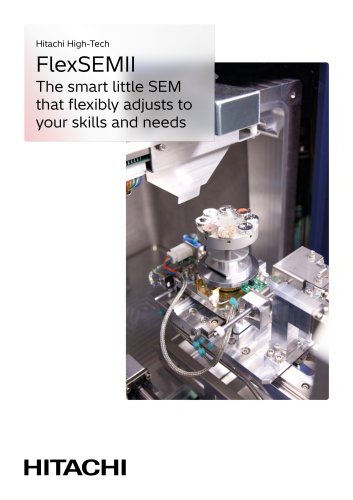
FlexSEMII Product Guide
The Hitachi FlexSEMII is a compact scanning electron microscope (SEM) designed to deliver high performance akin to full-scale SEMs while maintaining a small footprint. It is ideal for users needing advanced imaging capabilities beyond optical microscopy without the space or budget for traditional large SEMs.
Specifications
The FlexSEMII is compact, with a width of 45cm and a weight of 165kg, making it highly mobile. It features a tungsten-source electron optics system with up to 20kV accelerating voltage, achieving a high-resolution SE image of 4nm in high vacuum. It supports both high-vacuum and low-vacuum modes for observing non-conductive and moist specimens.
Electron Optics
The electron optics system operates from 300V to 20kV, featuring a dynamic gun bias system for consistent brightness and a double-condenser-optics system for fine spot imaging. It uses tungsten hairpin filaments, which are easy to replace and maintain.
Detection System
The SEM includes an Everhart-Thornley detector for high-resolution SE imaging and five high-sensitivity backscattered electron detectors for both vacuum modes. The BSE detector system supports various imaging modes, including material contrast, topographical, and 3D imaging. An optional low-vacuum SE detector (UVD) is available.
Usability and Flexibility
The FlexSEMII is user-friendly, with customizable software and automated functions. It includes a color specimen camera for navigation and a 5-axis sample stage for easy handling. The system adapts to different user skill levels, ensuring safe and efficient operation.
Operability and User Interface
The FlexSEMII offers a customizable user interface with features like a graphical user interface, recipe memory, and customizable quick access buttons. It supports operation via PC mouse, touch screen, and optional trackball or knob panel.
Beginner-Friendly Features
For novice users, the FlexSEMII provides pre-defined application purposes with optimal working conditions for tasks like surface composition and EDX analysis, enabling high-quality imaging with minimal experience.
Maintenance and Cost
The FlexSEMII allows easy maintenance with options for professional service or DIY. Key components are designed for easy replacement and cleaning, with annual maintenance costs below €1,000.
Advanced Analytical Capabilities
The FlexSEMII supports advanced applications like EDX analysis with integrated detectors and 3D metrology using Hitachi Map3D software, allowing high count rates and 3D surface modeling compliant with ISO standards.
Conclusion
The Hitachi FlexSEMII is a versatile and cost-effective SEM offering capabilities comparable to full-scale variable pressure SEMs. It suits a wide range of applications and user skill levels, making it a compelling choice for laboratories seeking advanced microscopy solutions.
Contact Information
For further assistance or product inquiries, contact Hitachi High-Tech via their website or email.
Catalog excerpts
Hitachi High-Tech The smart little SEM that flexibly adjusts to your skills and needs
Open the catalog to page 1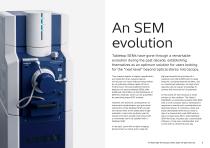
An SEM evolution Tabletop SEMs have gone through a remarkable evolution during the past decade, establishing themselves as an optimum solution for users looking for the “next level” beyond optical stereo microscopy. They inspect objects at higher magnification and resolution than classical optical microscopy can reach without being limited by an extremely shallow depth of focus. Furthermore, the backscattered electron detectors of typical tabletop SEMs offer additional information on the distribution of different materials, which can be quantified by executing proper EDX analysis. However, the...
Open the catalog to page 2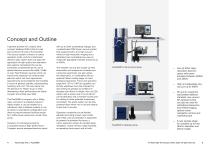
Concept and Outline A general problem for a typical ultracompact tabletop SEM is that its small size comes at the cost of functionality: The vacuum system is fixed to a certain operation mode, and the miniaturized electron optic system does not allow the application of high-quality low-aberration lens systems. Sometimes this can be somewhat compensated by the use of special electron sources like LaB6 / CeB6 or even Field Emission sources which can improve the resolution of compromised electron optics, but such approaches typically bring more problems than benefits in terms of general usability,...
Open the catalog to page 3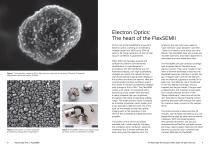
Electron Optics: The heart of the FlexSEMII At the core of the FlexSEMII is a powerful electron optics, covering an accelerating voltage range from 300V up to 20kV at which a SE image resolution of 4nm at high vacuum conditions is guaranteed. Figure 1. Toner particle, imaged at 5kV in high-vacuum mode with the Everhart-Thornley-SE detector. Magnification (polaroid base) is 20.000x. Figure 2. Gold grains on carbon substrate. Accelerating voltage 20kV, magnification Hitachi High-Tech | FLEXSEMII Figure 3. FlexSEMII’s electron gun flipped open for direct access to the filament cartridge. While 20kV...
Open the catalog to page 4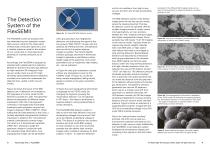
unit for all conditions, from high to low vacuum and from low to high accelerating voltages. The Detection System of the FlexSEMII The FlexSEMII comes as standard with two dedicated vacuum operation modes: High-vacuum mode for the observation of electrically conductive specimens, and a variable-pressure mode for the analysis of non-conductive or moist specimens, allowing for chamber pressures up to 100Pa. Accordingly, the FlexSEMII is equipped as standard with suitable electron detectors. Besides an Everhart-Thornley type detector for high-resolution SE imaging in highvacuum mode, there is a...
Open the catalog to page 5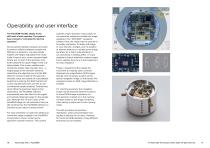
The FlexSEMII flexibly adapts to the skill level of each operator. The system's base concept is “convenient & risk-free operation”. During sample loading, measures are taken to prevent collisions between sample and SEM lens or detectors: Cup-like sample holders with height-adjustable inner stubs make it easy to set a correct sample height. Simply put, no part of the specimen may extend beyond the upper edges of the cup-shape holder. This is even verified when closing the drawer-type chamber door - a height gauge at the chamber entrance, resembling the objective lens and the BSE detector contours...
Open the catalog to page 6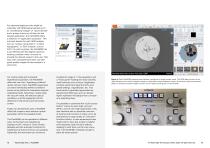
For absolute beginners who might be unfamiliar with SEM-typical phrases such as “accelerating voltage” or “spot intensity” and a proper choice out of them for the desired application, the FlexSEMII offers a selection of “application purposes”. This are basic desires for each SEM analysis, such as “surface composition”, “surface topography”, or “EDX analysis”, and so forth. For each purpose, the FlexSEMII has a pre-defined and self-aligned optimum working condition which is known to provide the desired output to the user. That way, even unexperienced users can take good-quality images of their...
Open the catalog to page 7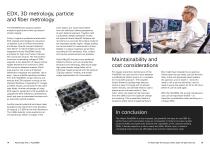
The FlexSEMII also supports special analytical applications which go beyond simple imaging. Firstly, it supports professional elemental EDX analysis technologies by renowned companies such as Oxford Instruments and Bruker. Special compact detectors with 30mm2 or 60mm2 SDD can be fully integrated into the FlexSEMII's body and allow for high count rates of several kilo-counts per second. The instrument's maximum accelerating voltage of 20kV supports K-line detection of heavier atomic weight elements and conforms to DIN/ ISO norms for asbestos analysis. Point/ area spectra, line scans and element...
Open the catalog to page 8
More information Contact us If you need help choosing the best product for your needs or seeking expert guidance to optimise your microscopy, our experts are here to help. Contact us today to discover how Hitachi High-Tech can enhance your lab’s capabilities. Visit: www.hitachi-hightech.com Email: [email protected] This publication is the copyright of Hitachi High-Tech Europe GmbH and provides outline information only, which (unless agreed by the company in writing) may not be used, applied or reproduced for any purpose or form part of any order or contract or regarded as the representation...
Open the catalog to page 9All Hitachi High-Tech Europe GmbH catalogs and technical brochures
 ZoneSEMII & ZoneTEMII
3 Pages
 HT7800 Series | TEM
2 Pages
 TM4000 Series
2 Pages
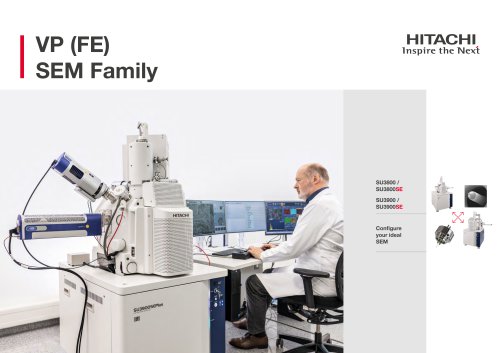 VP (FE) SEM Family
4 Pages
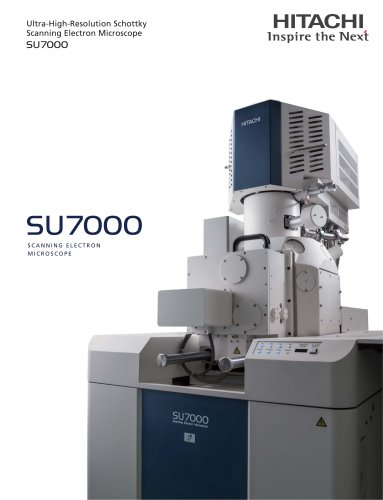
Archived catalogs

- Automation software solution
- Hitachi laboratory microscope
- Inspection microscope
- Desktop microscope
- Digital camera microscope
- Measuring microscope
- Hitachi analysis microscope
- Industrial microscope
- Hitachi automated microscope
- Hitachi high-resolution microscope
- Bright field microscope
- Compact microscope
- Materials research microscope
- Metallurgical microscope
- Quality control microscope
- Research microscope
- Dark field microscope
- Ergonomic microscope
- Sample preparation system