
- Catalogs
- Hitachi Europe GmbH
- Datasheet: Vision System

Datasheet: Vision System

Datasheet: Vision System
- Compatibility with various printer brands and types, including inkjet, laser, thermal, and stamp printers.
- Character matching, presence, and area verification methods.
- Support for up to 16 characters per verification area and a maximum of 6 verification areas.
- High-speed inspection capabilities with color cameras inspecting up to 500 pieces per minute and monochrome cameras up to 1,000 pieces per minute.
- Support for a wide range of characters, including alphabetic, numeric, general symbols, and external characters.
- Advanced correction functions for reference position, rotation, and shading.
- Camera interface options include color VGA or monochrome VGA cameras.
- Lighting options include white LED strobe lighting with dedicated light controllers.
- Touch panel display interface with a 15.0-inch TFT LCD and resistive touch panel.
- External storage options include USB memory, USB HDD, and NAS.
- Comprehensive I/O signals for input and output, including status indicators and inspection results.
- Communication capabilities via serial and Ethernet, supporting Modbus and FTP communication.
- Conveyor specifications include encoder, tracking, object sensor filter, and sampling ejection.
- Power supply requirements are AC100-120/200-240V±10%, 50/60Hz±1%.
- Operating environment conditions include a temperature range of 0-40˚C and humidity of 30-80%RH.
Catalog excerpts
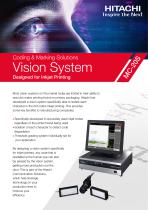
Designed for Inkjet Printing Most vision systems on the market today are limited in their ability to read dot matrix printing found on primary packaging. Hitachi has developed a vision system specifically able to isolate each character in the dot matrix inkjet printing. This provides some key benefits to manufacturing companies: ■ Specifically developed to accurately read inkjet codes regardless of the printer brand being used ■ Isolation of each character to detect code degradation ■ Threshold grading system individually set for your application By designing a vision system specifically for inkjet printers, any code that is readable by the human eye can also be passed by the vision system, getting more production out the door. This is part of the Hitachi Communication Solutions, which help leverage technology on your production lines to improve your efficiency. Vision System Coding & Marking Soluti
Open the catalog to page 1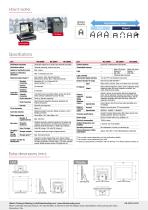
How it works Modeling Character Vision System Specifications Item Verification characters Characters marked by IJ printer, laser, thermal and stamp Camera interface Color VGA, or Monochrome VGA camera Verification method Character matching, presence and area Connectable cameras Number of verification areas Number of verification characters Light controller Touch panel display interface External storage for Image Color camera : Max. 500 pieces/minute Monochrome camera: Max. 1,000 pieces/minute Alphabetic [A-Z, a-z], Numeral [0-9], General symbol [. –’ / :+] Maximum Inspect Speed *¹ Inspection...
Open the catalog to page 2All Hitachi Europe GmbH catalogs and technical brochures
 Software Suite
4 Pages
 HX Series
15 Pages
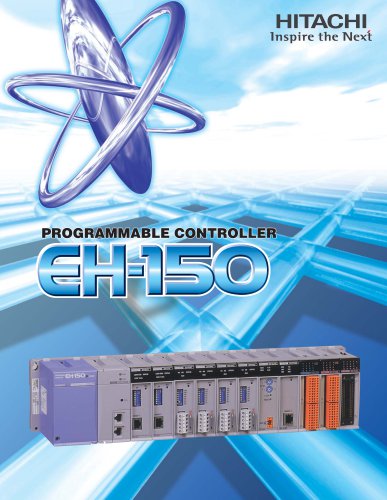 EH-150
27 Pages
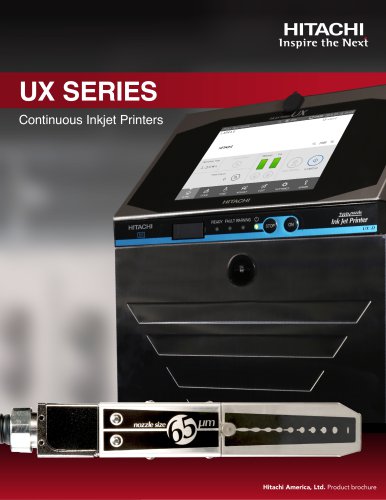 Continuous Inkjet Printers
12 Pages
 CO2 Laser Coder LM Series
12 Pages
 Brochure: S1 Series (Inverter)
12 Pages


Archived catalogs
 Brochure: EHV+ Series (PLC)
4 Pages


- Compressor stage
- Air compressor
- Stationary compressor
- Positive-displacement compressor
- Industrial compressor
- Electrically-powered compressor
- Digital I/O
- Reciprocating piston compressor
- IO module
- Oil-free compressor
- Analog I/O
- Digital IO module
- Compact compressor
- Hoist
- Low-noise compressor
- HMI
- Fieldbus I/O module
- Programmable logic controller
- HMI with touch screen
- Analog IO module