


OSHA 1926.1153, Section X and VII

OSHA 1926.1153, Section X and VII
Catalog excerpts

HILTI SUBMITTAL PACKAGE OSHA 1926.1153 TABLE 1, SECTION x AND SECTION vii Section x: J ackhammers and handheld powered chipping tools Section vii: H andheld and stand-mounted drills (including impact and rotary hammer drills) Current Hilti SDS-max rotary hammers that use a DRS-Y shroud: TE 50-AVR TE 60-AVR TE 60-ATC/AVR TE 70-AVR TE 70-ATC/AVR TE 80-ATC/AVR or instructions on how to assemble F these systems, please refer to the Hilti North America Youtube page DRS-Y
Open the catalog to page 1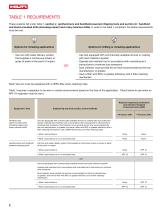
Options for chiseling applications Options for drilling or chiseling applications Use tool with water delivery system • Use tool equipped with commercially available shroud or cowling that supplies a continuous stream or with dust collection system spray of water at the point of impact • Operate and maintain tool in accordance with manufacturers Or instructions to minimize dust emissions • Dust collector must provide the air flow recommended by the tool manufacturer, or greater • Have a filter with 99% or greater efficiency and a filter-cleaning mechanism Note: Vacuum must be equipped with a...
Open the catalog to page 2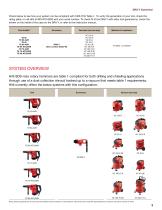
DRS-Y Submittal Check below to see how your system can be compliant with 1926.1153 Table 1. To verify the generation of your tool, check the rating plate, or call Hilti at 800-879-8000 with your serial number. To check fit of the DRS-Y with older tool generations, check the sticker on the inside of the case on the DRS-Y, or refer to the instruction manual. Tool models* DRS-Y (Item number 2055718) SYSTEM OVERVIEW Hilti SDS-max rotary hammers are table 1 compliant for both drilling and chiseling applications through use of a dust collection shroud hooked up to a vacuum that meets table 1 requirements....
Open the catalog to page 3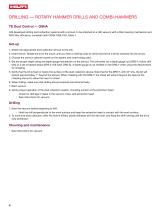
Hilti developed drilling dust collection systems with a shroud, to be attached to a Hilti vacuum with a filter cleaning mechanism and 99% filter efficiency, compliant with OSHA 1926.1153, Table 1. 1. Attach the appropriate dust collection shroud to the drill. 2. Insert the bit. Rotate the bit in the chuck until you hear a clicking noise to verify that the bit is firmly inserted into the chuck. 3. Choose the correct collector based on the system and insert being used. 4. Set the proper depth using the depth gauge mechanism on the shroud. This will either be a depth gauge rod (DRS-Y, hollow drill...
Open the catalog to page 4All HILTI catalogs and technical brochures
 OSHA 1926.1153, Section X
3 Pages
 OSHA 1926.1153, Section VII
5 Pages

- Electric vacuum cleaner
- Dry vacuum cleaner
- Metal sawing line
- Mobile vacuum cleaner
- Drilling tool
- Circular sawing machine
- Screw
- Solid drill bit
- Band sawing line
- Saw blade
- Sanding machine
- Compact vacuum cleaner
- Wood sawing line
- Electric screwdriver
- Multi-purpose drilling tool
- Metal stand
- Tube sawing machine
- Crimping applicator
- Profile saw