


IF Technical Manual Global Portfolio 2022
IF Technical Manual Global Portfolio 2022
The manual provides comprehensive specifications for various types of screws used in interior finishing. These include screws for drywall, fiber, hard, cement, acoustic, and wood boards, applicable to both metal and wood substructures. It also covers applications in metal framing, wire lath, and door framing.
Screws are categorized by head shapes, drive types, thread types, and screw points. Key head shapes include oval, pan, countersunk, bugle, and wafer heads. Drive types include Phillips, Pozidrive, and Torx. Threads are designed for different materials, with fine, coarse, and HI-LO options. Screw points include S point, nail point, drill point, and wing tip, each suited for specific fastening needs.
Hilti offers corrosion protection solutions such as galvanic zinc plating, duplex-coated carbon steel, and A2 grade stainless steel. The manual discusses factors affecting corrosion, including humidity, temperature, salt, and industrial pollution. It outlines the salt spray test used to evaluate corrosion resistance, with different coatings providing varying levels of protection.
Applications are classified into indoor and outdoor environments, considering pollution levels, proximity to the sea, and industrial areas. Special applications include high corrosive conditions like road tunnels and swimming pools. The final decision on corrosion protection suitability is left to the customer, based on typical atmospheric conditions.
- Single Screws: Available in lengths of 30mm, 41mm, and 57mm with a diameter of 3.8mm, a drilling capacity of 0.63 - 2.25mm, and a minimum failure torque of ≥ 2.8 Nm.
- Collated Screws for SMD 57: Similar to single screws but packaged for specific tools.
- Collated Screws for SD-M 1 and SD-M 2: Available in lengths of 32mm and 41mm with a diameter of 3.9mm, a drilling capacity of 0.63 - 2.25mm, and a minimum failure torque of ≥ 3.8 Nm.
- Wood boards to metal substructure ≤ 2.25 mm.
- Cement boards to metal substructure ≤ 2.25 mm.
- Exterior sheathing boards to metal substructure ≥ 0.75 mm ≤ 2.25 mm.
- Screw Design: Drill point, wings, fine thread, countersunk head.
- Material: Carbon steel with zinc plating or electro-coating.
- Recommended Rotation Speed: 1800 - 2500 rpm.
- Pull-out Load: ≥ 300 N.
- Standard: EN 14566.
- Cordless and corded drywall screwdrivers (SD 5000-A22, SD 5000-22, SD 5000 230V, SD 6000 230V, SD 2500 230V) with various packaging options.
- Screw magazines (SD-M 1, SD-M 2, SMD 57) and related components like nose pieces, feeding mechanisms, and springs.
- Bit holders and driver bits for different screw types and applications.
Catalog excerpts
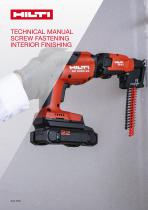
TECHNICAL MANUAL SCREW FASTENING INTERIOR FINISHING
Open the catalog to page 1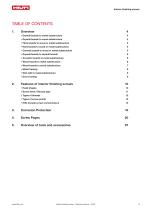
Interior finishing screws • Drywall boards to metal substructure 4 • Drywall boards to wood substructure 4 • Fibre boards to wood or metal substructure 5 • Hard boards to wood or metal substructure 5 • Cement boards to wood or metal substructure 5 • Drywall boards to drywall boards 6 • Acoustic boards to metal substructure 6 • Wood boards to metal substructure 6 • Wood boards to wood substructure 7 • Wire lath to metal substructure 9 2. Features of interior finishing screws 10 • Screw drive / Recess type 11 • Types of screw points 13 • Hilti drywall screw nomenclature 14 5. Overview of tools...
Open the catalog to page 3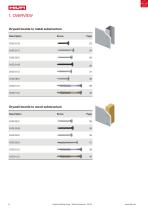
1. OVERVIEW Drywall boards to metal substructure Description Drywall boards to wood substructure Description Interior finishing screw – Technical manual – 04/22
Open the catalog to page 4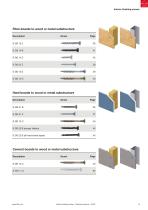
Interior finishing screws Fibre boards to wood or metal substructure Description Hard boards to wood or metal substructure Description S-DS 22 B (all hard board types) Cement boards to wood or metal substructure Description Interior finishing screw – Technical manual – 04/22
Open the catalog to page 5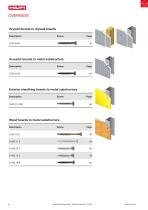
OVERVIEW Drywall boards to drywall boards Description Acoustic boards to metal substructure Description Exterior sheathing boards to metal substructure Description Wood boards to metal substructure Description Interior finishing screw – Technical manual – 04/22
Open the catalog to page 6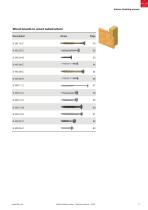
Interior finishing screws Wood boards to wood substructure Description Interior finishing screw – Technical manual – 04/22
Open the catalog to page 7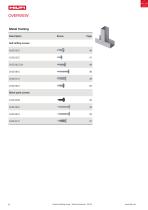
OVERVIEW Metal framing Description Stitch point screws S-DS 05 B Interior finishing screw – Technical manual – 04/22
Open the catalog to page 8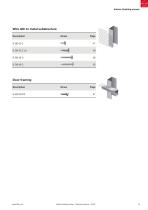
Interior finishing screws Wire lath to metal substructure Description S-DD 03 Z Door framing Description S-MD 03 PZ Interior finishing screw – Technical manual – 04/22
Open the catalog to page 9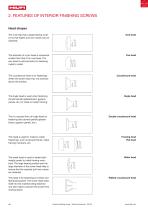
Screw fastening: Basic information 4 4.8FEATURES Head shapes 2. OF INTERIOR FINISHING SCREWS 4.8.1 Drywall screws for interior finishing The oval head has a large bearing surface so that higher pull-over values can be obtained. Oval head The diameter of a pan head is somewhat smaller than that of an oval head. The pan head is used primarily for fastening metal to metal. The countersunk head is for fastenings where the screw head may not protrude above the surface. Countersunk head The bugle head is used when fastening drywall panels (plasterboard, gypsum panels, etc.) to metal or timber framing....
Open the catalog to page 10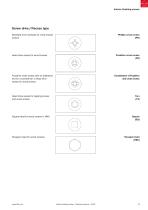
Screw fastening: Basic information 4 Interior finishing screws 4.9 Types of head drives 4.9.1 Drywall screws for interior finishing Screw drive / Recess type Phillips cross recess (PH) Standard drive recesses for most drywall screws Pozidrive cross recess (PZ) Head drive recess for wood screws Combination of Pozidrive and cross recess Pozidrive cross recess with an additional slot for a screwdriver; a head drive recess for wood screws Head drive recess for tapping screws and wood screws Square head for wood screws in HNA Interior finishing screw – Technical manual – 04/22 Hexagon head for wood...
Open the catalog to page 11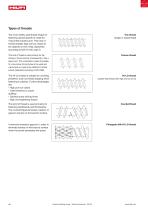
Types of threads fine thread (single or double lead) The most widely used thread shape for fastening drywall panels to metal framing metal substructure. This kind of thread enables high pull-out values to be obtained in thin metal. (Specified according to DIN 18 182, part 2) Coarse thread This kind of thread is used primarily for fastenings in timber (wood). Consequently, it has a taper point. This combination makes it possible for a low screw driving torque to be used and a good pull-out value to be obtained in timber (wood). (Specified according to DIN 7998) HI-LO thread The HI-LO thread is...
Open the catalog to page 12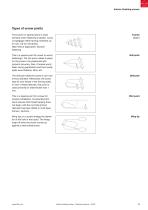
Screw fastening: Basic information 4 4.11.1 Drywall screws for interior finishing Interior finishing screws 4.11 Types of screw points Types of screw points 4.11.1 Drywall screws for interior finishing The S point or tapered point is used primarily when fastening in plastic, wood or lightgage metal framing members up to max. 0.8 mm thickness. Main field of application: Drywall fastening This is a special point for wood-to-wood fastenings. The nail point makes it easier for the screw to be positioned with pinpoint accuracy. Also, it breaks wood fibers during penetration and thus hardly splits...
Open the catalog to page 13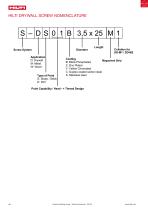
Screw System Length Diameter D: Drywall M: Metal W: Wood S: Sharp / Stitch D: Drill B: Black Phosphated Magazine Strip C: Duplex coated carbon steel 14 Interior finishing screw - Technical manual - 04/22 www.hilti.com
Open the catalog to page 14
Interior finishing screws Interior finishing screw – Technical manual – 04/22
Open the catalog to page 15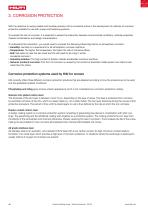
3. CORROSION PROTECTION With the objective to supply reliable and durable products, Hilti is constantly active in the development of methods of corrosion protection suitable for use with screws and fastening systems. To evaluate the risk of corrosion, it is essential to assess the interaction between environmental conditions, material properties, material combinations and design characteristics. To understand this interaction, you would need to consider the following influencing factors to atmospheric corrosion: • Humidity: Humidity is a requirement for all atmospheric corrosion reactions. •...
Open the catalog to page 16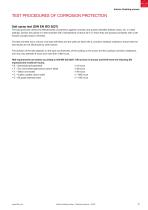
Interior finishing screws The salt spray test checks the effectiveness of protection against corrosion and quickly identifies defects, flaws, etc. in metal platings. Screws are placed in a test chamber with a temperature of about 35°C in which they are sprayed constantly with a salt solution (usually sodium chloride). The test chamber has a volume of at least 400 liters and the walls are lined with a corrosion-resistant material to ensure that the test results are not influenced by other factors. The duration of the test depends on the type and thickness of the coating on the screw and the coating’s...
Open the catalog to page 17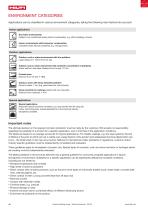
ENVIRONMENT CATEGORIES Applications can be classified in various environment categories, taking the following main factors into account: Indoor applications Dry indoor environments (heated or air-conditioned areas) without condensation, e.g. office buildings, schools Indoor environments with temporary condensation (unheated areas without pollutants), e.g. storage sheds Outdoor applications Outdoor, rural or urban environment with low pollution Large distance (> 10 km) from the sea Outdoor, rural or urban environment with moderate concentration of pollutants and/or salt from sea water. Distance...
Open the catalog to page 18All HILTI catalogs and technical brochures
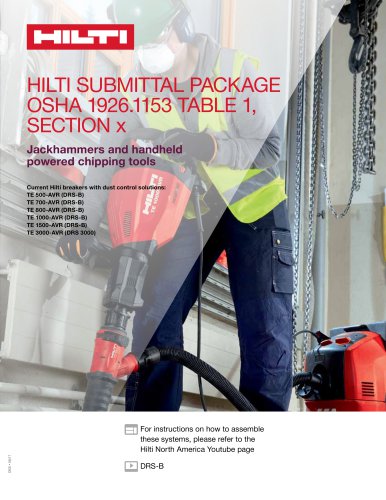 OSHA 1926.1153, Section X
3 Pages
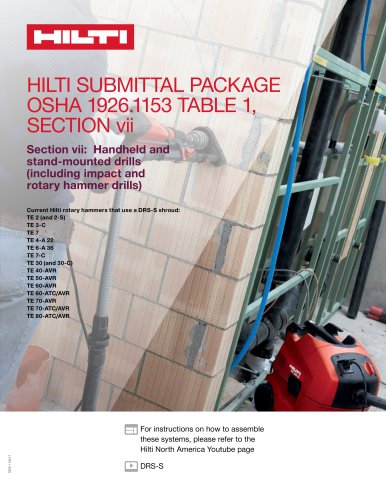 OSHA 1926.1153, Section VII
5 Pages
- Electric vacuum cleaner
- Dry vacuum cleaner
- Metal sawing line
- Mobile vacuum cleaner
- Circular sawing machine
- Drilling tool
- Solid drill bit
- Band sawing line
- Saw blade
- Sanding machine
- Compact vacuum cleaner
- Wood sawing line
- Electric screwdriver
- Multi-purpose drilling tool
- Metal stand
- Tube sawing machine
- Crimping applicator
- Profile saw