- Catalogs
- The Hilliard Corporation
- Anti-Static Filter Elements to Prevent Varnish


Anti-Static Filter Elements to Prevent Varnish
1 /2Pages
Anti-Static Filter Elements to Prevent Varnish
1 /2Pages
Catalog excerpts
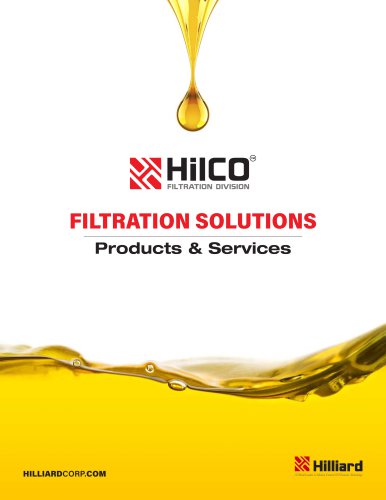
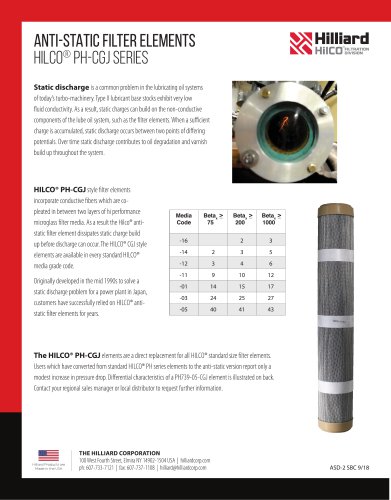
ANTI-STATIC FILTER ELEMENTSHILCO® PH-CGJ SERIES Static discharge is a common problem in the lubricating oil systems of today's turbo-machinery. Type II lubricant base stocks exhibit very low fluid conductivity. As a result, static charges can build on the non-conductive components of the lube oil system, such as the filter elements. When a sufficient charge is accumulated, static discharge occurs between two points of differing potentials. Over time static discharge contributes to oil degradation and varnish build up throughout the system. HILCO® PH-CGJ style filter elements incorporate conductive fibers which are copleated in between two layers of hi performance microglass filter media. As a result the Hilco® antistatic filter element dissipates static charge build up before discharge can occur.The HILCO® CGJ style elements are available in every standard HILCO® media grade code. Originally developed in the mid 1990s to solve a static discharge problem for a power plant in Japan, customers have successfully relied on HILCO® antistatic filter elements for years. The HILCO® PH-CGJ elements are a direct replacement for all HILCO® standard size filter elements. Users which have converted from standard HILCO® PH series elements to the anti-static version report only a modest increase in pressure drop. Differential characteristics of a PH739-05-CGJ element is illustrated on back. Contact your regional sales manager or local distributor to request further information. 100 West Fourth Street, Elmira NY 14902-1504 USA | hilliardcorp.com ph: 607-733-7121 | fax:607-737-1108 | [email protected]
Open the catalog to page 1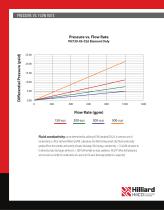
Differential Pressure (psid) Pressure vs. Flow Rate PH739-05-CGJ Element Only Fluid conductivity can be determined by utilizing ASTM standard D2624. A common unit of conductivity is a Peco Siemens/Meter (pS/M). Laboratory and field testing reveals that fluid conductivity greatly effects the number and severity of static discharge. Oils having a conductivity < 35 pS/M are prone to hi intensity static discharges while oils > 200 Ps/M exhibit no static problems. HILCO® offers full laboratory services and can verify the conductivity of a user's oil if a static discharge problem is suspected.
Open the catalog to page 2All The Hilliard Corporation catalogs and technical brochures
 Hilliard Brake Systems
20 Pages
 Seal Gas Filter Housings
4 Pages
 Oil Mist Eliminators
6 Pages
 HILCO Spin On Duplex Filters
6 Pages
 HILCO Lab Services
4 Pages
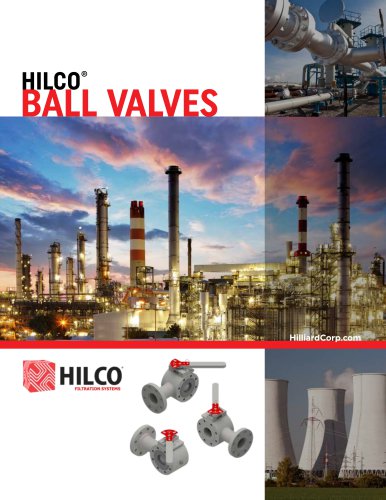 HILCO Ball Valves
4 Pages
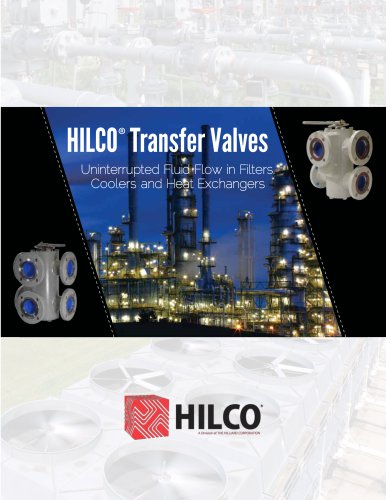 HILCO Transfer Valves
4 Pages
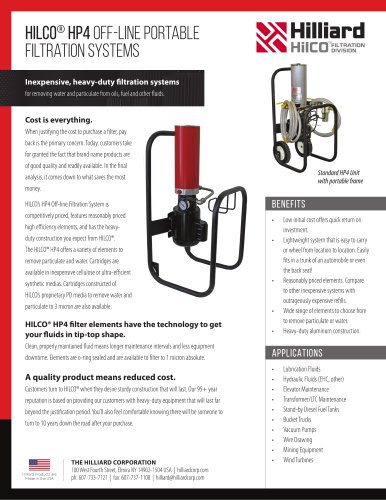 Portable Filtration Systems
2 Pages
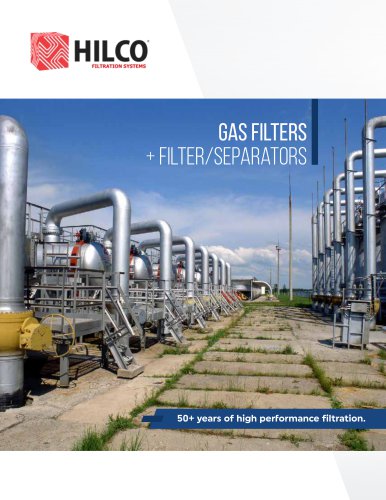 Gas Filters and Separators
4 Pages
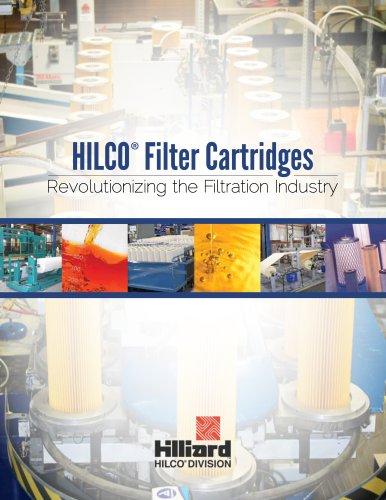 HILCO Filter Cartridges
12 Pages
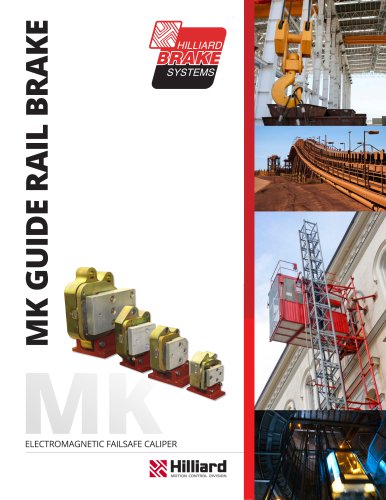 Hilliard Electric Brakes
8 Pages
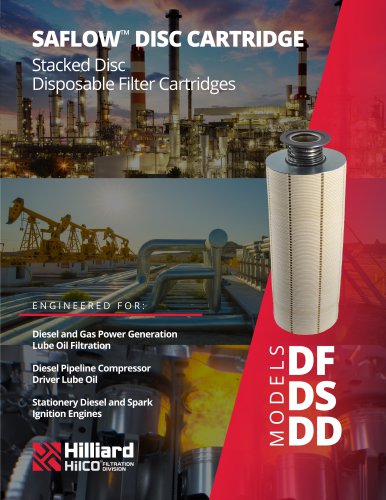 SAFLOW Disc Cartridge
4 Pages
 Friction Torque Limiter
1 Page
 CENTRIFUGAL CLUTCHES
4 Pages
 Hilco Bag Filter Cartridges
2 Pages