
- Catalogs
- Hiller GmbH
- purée and smoothies


- Company
- Products
- Catalogs
- News & Trends
- Exhibitions
purée and smoothies

purée and smoothies
The document discusses the use of decanter centrifuges and plants for solid/liquid separation in the food sector, particularly focusing on the production of purées, juices, and smoothies. The technology ensures gentle and hygienic processing, enhancing the aroma and flavor of the end products.
Specifications and Benefits
- High-quality purées with intense aroma and improved flavor.
- Reduced operating costs due to savings on water and personnel.
- Minimal cleaning required, approximately 2 hours, thanks to automatic CIP cleaning.
- Simple and rapid product changeover.
- Closed system ensures maximum hygiene and low product load due to oxygen exclusion.
- Lower space requirements and a continuous, rapid process.
Continuous Production of Purée and Smoothies
The HILLER decanter technology is highlighted for its efficiency in producing purées and smoothies. The process is continuous and ensures high yields while saving energy and water.
Applications
Purées are used in the food industry for various applications, including baby food and smoothies. Fruits like apricot, plum, and pear are ideal for purée production. The HILLER conditioner allows for the processing of leaf and stalk vegetables as well.
Process Description for Apricot Purée
- Inward delivery of apricots.
- Raw material preparation, including washing, sorting, and de-stoning.
- Heating of fruit pieces in the reaction tank or via direct steam in the HILLER conditioner.
- Pumping the mash to the decanter.
- Purée production in the HILLER decanter with separation of larger components (pomace).
- Fruit purée is ready for further use in products like baby food, smoothies, and nectar.
Conclusion
The document emphasizes the advantages of using HILLER decanter technology in the food processing industry, highlighting its efficiency, cost-effectiveness, and ability to maintain high product quality.
Catalog excerpts
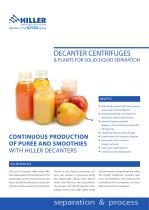
DECANTER CENTRIFUGES & PLANTS FOR SOLID/LIQUID SEPARATION ■ high quality purées with more intense aroma and improved flavour ■ reduced operating costs thanks to savings on water and personnel ■ minimal cleaning required (approx. 2 hours) thanks to automatic CIP cleaning CONTINUOUS PRODUCTION OF PURÉE AND SMOOTHIES WITH HILLER DECANTERS ■ simple and rapid product change ■ closed system for maximum hygiene ■ low product load thanks to oxygen exclusion ■ lower space requirements ■ continuous and rapid process HILLER PROCESS The use of a decanter offers many different usage options in the food sector. This technology can be used not just to produce naturally cloudy juices or juice concentrate, but also purées and smoothies. Thanks to the closed, continuous systems, the product is processed gently and hygienically, giving more intense aroma and flavour in the end product. The process with HILLER decanter technology ensures very high yields whilst simultaneously saving energy and water. The HILLER conditioner provides optimum cell breakdown. This improves the consistency of the end product and valuable constituents are released.
Open the catalog to page 1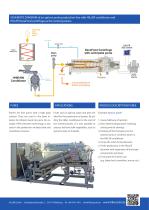
SCHEMATIC DIAGRAM of an apricot purée production line with HILLER conditioner and HILLER DecaFood centrifuge as the central process PUREE Purées are fruit juices with a high pulp content. They are used in the food industry for dilution back into juice, for example. Hiller decanter technology is also used in the production of baby food and smoothies, however. APPLICATIONS Fruits such as apricot, plum and pear are ideal for the production of purées. By adding the Hiller conditioner to the start of the overall process, it is also possible to process leaf and stalk vegetables, such as spinach, leeks...
Open the catalog to page 2All Hiller GmbH catalogs and technical brochures
 Image brochure
24 Pages
 Service brochure
12 Pages
 Tunnel building
2 Pages
 Biodiesel
2 Pages
 Hiller Centrate Monitoring
2 Pages
 Hiller DecaPress
4 Pages
 Decanter vs. Screw Press
2 Pages
 Compact Unit DecaSmart DP31
2 Pages
 Compact unit DecaSmart DP45n
2 Pages
 Turnkey Decanter Plants
2 Pages
 ECO-Jet Weir Plates
2 Pages
 3-Phases TricaPress
2 Pages
 Hiller SEE-Control pro
2 Pages
 Wine
Wine2 Pages
 Extracting vegetable oils
2 Pages
 Fruit Juice
2 Pages
 Hiller Conditioner
2 Pages
 Fish Industry
2 Pages
 Root Vegetables
2 Pages
 Palm Oil
2 Pages
 Hiller Remote Monitoring
2 Pages


- Horizontal decanter
- Industrial decanter
- Decanter for the food industry
- 2-phase decanter
- 3-phase decanter
- Wastewater decanter
- Sludge dewatering decanter
- Olive oil decanter
- Dehydration decanter
- Vertical decanter
- Decanter for the chemical industry
- High-volume decanter
- Sludge thickening decanter
- Containerized decanter
- Decanter for the beverage industry