
- Catalogs
- Hiller GmbH
- Biodiesel


- Company
- Products
- Catalogs
- News & Trends
- Exhibitions
Biodiesel

Biodiesel
Decanter centrifuges and plants are essential for solid/liquid separation in biodiesel extraction from organic resources. The increasing importance of alternative fuels, such as biodiesel, is driven by rising crude oil prices and advancements in renewable resource technologies, alongside a focus on climate protection.
Applications of HILLER Decanters
- Clarifying fresh and used oil for biodiesel production.
- Separating glycerine, fatty acids, and salts during glycerine processing in biodiesel production.
- Separating methanol and washed salts from the glycerine process.
- Yeast separation in biodiesel production.
- Dewatering slurry after distillation in bioethanol production.
- Dewatering fermentation substrate in biogas production.
- Solid matter separation from filtrate during the pressing process.
Raw Materials for Biodiesel
Traditionally, biodiesel raw materials include fresh plants, old cooking fat, and animal fats. Regional preferences vary, with rapeseed oil in Northern Europe, soya oil in the USA, and palm oil in tropical countries.
HILLER DecaOil Centrifuge Technology
The HILLER DecaOil centrifuge is a high-performance, solid-bowl scroll centrifuge designed for efficient solid matter separation and simultaneous separation of fluid phases. The process involves feeding the mixture into a rotating bowl, where centrifugal force separates the fluid and solid matter. Solid particles adhere to the bowl wall and are expelled by a screw, while fluids are collected and discharged based on the centrifuge design.
Advantages of HILLER Centrifuges
- Space-saving design.
- Capability for 2- or 3-phase operation.
- Fully automatic operation with HILLER control system.
- Modern scroll drive operation system.
- Use of special, non-corrosive materials.
- Explosion protection features.
- Adjustable centripetal pump for lighter phase.
- Flexible use as a 3-phase machine, also operable in 2-phase mode.
Catalog excerpts
DECANTER CENTRIFUGES & PLANTS FOR SOLID/LIQUID SEPARATION CENTRIFUGE TECHNOLOGY FOR BIODIESEL EXTRACTION - FROM ORGANIC RESOURCES Alternative fuels will be increasingly important in the future. Along with bioethanol, the production of biodiesel is constantly increasing. This development has its basis not only in the rising price of crude oil on the world market, but also in the development of new technologies which enable the production of new fuels from renewable resources. Additionally, there is an increased focus on climate protection in both national and international politics. Typical uses for the HILLER decanters are: ■ clarifying fresh and used oil, for use in biodiesel production ■ separation of glycerine, fatty acids and salts in the glycerine processing during the production of biodiesel ■ separation of methanol and washed ■ dewatering of the slurry after distillation (Bioethanol) ■ dewatering of fermentation substrate produced in the production of biogas ■ solid matter separation from the filtrate during the pressing process salts from the glycerine process ■ yeast separation in the biodiesel production
Open the catalog to page 1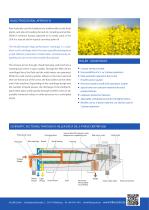
BASIC PROCEDURAL APPROACH Raw materials used for biodiesel are traditionally mostly fresh plants, and also old cooking fat and oil, including animal fats. While in northern Europe rapeseed oil is mostly used, in the USA it is soya oil and in tropical countries palm oil. The HILLER DecaOil high performance centrifuge is a solidbowl scroll centrifuge which has been specially developed as a high-efficiency separator of solid matter, simultaneously separating via one or two (not mixable) fluid phases. HILLER - ADVANTAGES The mixture arrives through a fixed inlet pipe, and is fed into a rotating bowl...
Open the catalog to page 2All Hiller GmbH catalogs and technical brochures
 Image brochure
24 Pages
 Service brochure
12 Pages
 Tunnel building
2 Pages
 Hiller Centrate Monitoring
2 Pages
 Hiller DecaPress
4 Pages
 Decanter vs. Screw Press
2 Pages
 Compact Unit DecaSmart DP31
2 Pages
 Compact unit DecaSmart DP45n
2 Pages
 Turnkey Decanter Plants
2 Pages
 ECO-Jet Weir Plates
2 Pages
 3-Phases TricaPress
2 Pages
 Hiller SEE-Control pro
2 Pages
 Wine
Wine2 Pages
 Extracting vegetable oils
2 Pages
 Fruit Juice
2 Pages
 purée and smoothies
2 Pages
 Hiller Conditioner
2 Pages
 Fish Industry
2 Pages
 Root Vegetables
2 Pages
 Palm Oil
2 Pages
 Hiller Remote Monitoring
2 Pages


- Horizontal decanter
- Industrial decanter
- Decanter for the food industry
- 2-phase decanter
- 3-phase decanter
- Wastewater decanter
- Sludge dewatering decanter
- Olive oil decanter
- Dehydration decanter
- Vertical decanter
- Decanter for the chemical industry
- High-volume decanter
- Sludge thickening decanter
- Containerized decanter
- Decanter for the beverage industry