
- Catalogs
- Hiller GmbH
- 3-Phases TricaPress


- Company
- Products
- Catalogs
- News & Trends
- Exhibitions
3-Phases TricaPress

3-Phases TricaPress
The document discusses the HILLER Tricapress Decanters, which are used for solid/liquid separation in industrial processes. These decanters utilize the density differences between two immiscible liquid phases to separate them from a solid phase in a single process step.
Separation Process
The separation process leverages sedimentation and density differences to achieve high purity of liquid phases, minimize residual solid moisture, and ensure low power consumption. The process requires significant expertise to optimize product quality and manage impurities.
Design and Operation
Key design considerations include the choice of outlet systems for liquid phases, the design of the working area, and the management of particle streams. These factors are crucial for the successful operation of the HILLER Tricapress Decanter. Additional features may include hygienic and safety measures, such as explosion protection.
Applications
The decanters are used in various applications, including the production of cooking oils (e.g., olive oil, avocado), cleaning of core/seed oils, oil recycling from sludge, production of animal fats, and processing of used cooking oils for alternative fuels. They are also used in biodiesel production and oil separation from industrial processes.
Functionality
The decanter operates by using centrifugal force to settle solid particles on the bowl wall, which are then moved to discharge ports by a scroll conveyor. The clarified liquid flows towards the discharge zone, where centrifugal force separates the light and heavy liquid phases, allowing for their separate extraction.
Conclusion
The HILLER Tricapress Decanter offers economic efficiency and high-quality separation results, relying on decades of experience in the field.
Catalog excerpts

DECANTER CENTRIFUGES & PLANTS FOR SOLID/LIQUID SEPARATION SEPARATION OF 3 PHASES - WITH THE HILLER TRICAPRESS In addition to the known effect of separation of solids by sedimentation in 2 phase decanters the HILLER Tricapress Decanters make use of the density differences of both liquids to separate them from each other in only one process step. Here two liquid phases with different densities – which cannot be mixed – are separated from a solids phase. In addition to the well-known effect of separating solids by sedimentation, the density differences of the two liquids are used to separate them from each other. RELY ON DECADES OF EXPERIENCE The separation process itself is quite simple, but its optimization requires a huge know-how and long-lasting experience. This does not apply only for achieving the best possible product qualities, but also for managing impurities and for avoiding interfering effects to ensure a stable operation of the machine. ECONOMIC EFFICIENCY AND QUALITY ■ highest purity of the liquid phase maximise the value of the product ■ lowest residual solid moisture for minimum disposal costs or maximum yield ■ low power and operating material consumption ■ various wear protection systems for long service life ■ simple operation and high degree of automation
Open the catalog to page 1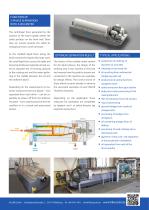
FUNCTION OF 3-PHASE SEPARATION WITH A DECANTER The centrifugal force generated by the rotation of the bowl rapidly settles the solids particles on the bowl wall. There they are moved towards the solids discharge ports by a scroll conveyor. As the clarified liquid flows along the bowl towards the liquids discharge zone, the centrifugal force causes the light and heavy liquid phases (typically oil and water) to separate; the oil moving upwards to the rotating axis and the water gathering in the middle between the oil and the sediment layers. Depending on the requirements of customer and process...
Open the catalog to page 2All Hiller GmbH catalogs and technical brochures
 Image brochure
24 Pages
 Service brochure
12 Pages
 Tunnel building
2 Pages
 Biodiesel
2 Pages
 Hiller Centrate Monitoring
2 Pages
 Hiller DecaPress
4 Pages
 Decanter vs. Screw Press
2 Pages
 Compact Unit DecaSmart DP31
2 Pages
 Compact unit DecaSmart DP45n
2 Pages
 Turnkey Decanter Plants
2 Pages
 ECO-Jet Weir Plates
2 Pages
 Hiller SEE-Control pro
2 Pages
 Wine
Wine2 Pages
 Extracting vegetable oils
2 Pages
 Fruit Juice
2 Pages
 purée and smoothies
2 Pages
 Hiller Conditioner
2 Pages
 Fish Industry
2 Pages
 Root Vegetables
2 Pages
 Palm Oil
2 Pages
 Hiller Remote Monitoring
2 Pages


- Horizontal decanter
- Industrial decanter
- Decanter for the food industry
- 2-phase decanter
- 3-phase decanter
- Wastewater decanter
- Sludge dewatering decanter
- Olive oil decanter
- Dehydration decanter
- Vertical decanter
- Decanter for the chemical industry
- High-volume decanter
- Sludge thickening decanter
- Containerized decanter
- Decanter for the beverage industry