


H.265+ Encoding Technology

H.265+ Encoding Technology
Hikvision developed H.265+ encoding technology to address the high bandwidth and storage demands of ultra HD surveillance cameras. This technology is based on the H.265/HEVC standard and is optimized for surveillance video characteristics, such as stable backgrounds and infrequent moving objects. H.265+ significantly reduces video bitrate, thereby lowering bandwidth and storage costs.
- Prediction Encoding: Utilizes both inter-frame and intra-frame prediction to enhance compression. P-frames use reference frames to encode differences, while I-frames are encoded independently.
- Noise Suppression: Differentiates between background and moving objects, applying high compression to the background to reduce noise and bitrate.
- Long-Term Bitrate Control: Manages bitrate over extended periods, allocating more bitrate during busy hours and less during idle times, optimizing storage and transmission.
Tests comparing H.264, H.265, and Hikvision H.265+ show significant bitrate reductions. For instance, in a café scene with many moving objects, H.265+ reduced the bitrate by 81.3% compared to H.264 and 64.7% compared to H.265. The average reduction rate for H.265+ was 83.7% over H.264 and 67.6% over H.265.
In a café setting, H.265+ reduced the 24-hour file size by 83% compared to H.264 and 67.3% compared to H.265. For intersection monitoring, the reductions were 79.4% and 64.5%, respectively. These reductions highlight the storage cost savings achieved with H.265+.
Hikvision H.265+ is an advanced encoding technology that maintains video quality while significantly reducing bandwidth and storage requirements. It is compatible with H.265/HEVC standards and supports the widespread adoption of ultra HD video surveillance.
Catalog excerpts

HIKVISION H.265+ Encoding Technology Halve Your Bandwidth and Storage Enjoy the Ultra HD and Fluency
Open the catalog to page 1
1. BACKGROUND Several years ago, the ultra HD surveillance camera was developed. However it has not been widely applied so far because it requires wide transmission bandwidth and massive storage capacity. Thus, how to limit the bitrate of the ultra HD video stream becomes a critical problem that decides the ultra-HD camera popularity. H.265+ technology is an intelligent algorithm developed by Hikvision. It is a remarkable encoding technology based on the H.265/HEVC (High Efficiency Video Coding) standard and is optimized while fully considering the following features of the surveillance video....
Open the catalog to page 3
frame prediction encoding. 2.1.1. P-FRAME ENCODING With inter-prediction, you can lower the bitrate by compressing only the difference between the current frame and the reference frame. Therefore, selecting an appropriate reference frame is the key to improving the stream compression ratio. For a surveillance video, the background information is usually stable. Thus, we can extract a background frame as a reference frame to encode. The background frame should contain as few moving objects as possible. As shown in Figure 1, among the three frames, T0 and T1 are the encoded images. You can take...
Open the catalog to page 4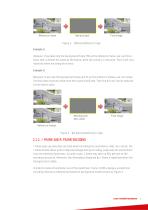
Reference frame Residual part Final image Figure 3 Ordinary Reference Type Example 2: However, if we take only the background frame (T0) as the reference frame, we can find a block that is almost the same as the B area, while the A area is a new area. Then it will cost more bits when encoding the A area. Example 3: Moreover, if we take the background frame and T1 as the reference frames, we can simply find the areas that are similar with the A area and B area. Then the bit cost can be reduced to the lowest value. T0 T2 T1 Residual part (less data) Final image Reference frames Figure 4 Background...
Open the catalog to page 5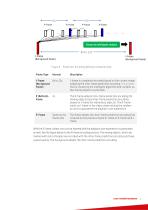
Chosen by intelligent analysis I-Frame (Background frame) I-Frame (Background frame) Figure 5 Prediction Encoding Reference Relationship Frame Type I-Frame (Background Frame) I-frame is completely encoded based on the current image adopting the intra-frame prediction encoding. that is chosen by the intelligent algorithm and contains as few moving objects as possible. The R-frame adopts intra-frame prediction encoding (for moving objects) and inter-frame prediction encoding based on I-frame (for motionless objects). The R-frame works as I-frame in the video stream during the random access to guarantee...
Open the catalog to page 6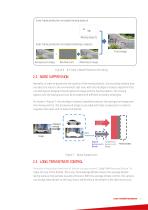
Intra-frame prediction encoded moving objects Moving objects Inter-frame prediction encoded motionless objects Final image Background image Residual part Motionless image Figure 6 R-Frame Mixed Prediction Encoding 2.2. NOISE SUPPRESSION Normally, in order to guarantee the quality of the moving objects, the encoding module also encodes the noise in the environment. But now, with the intelligent analysis algorithm that can distinguish between the background image and the moving objects, the moving objects and the background can be encoded with different encoding strategies. As shown in Figure 7,...
Open the catalog to page 7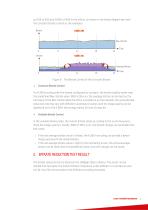
as 0:00 to 9:00 and 20:00 to 24:00 in the office), as shown in the below diagram (we take the constant bitrate control as the example). Bitrate Figure 8 The Bitrate Control of the Constant Bitrate Constant Bitrate Control For H.265 encoding with the bitrate configured as constant, the bitrate slightly varies near the predefined Max. bitrate value. With H.265+ on, the average bitrate can be kept as the half value of the Max. bitrate (take the office surveillance as the example, the actual bitrate reduction rate may vary with different surveillance scenes) and the image quality can be optimized...
Open the catalog to page 8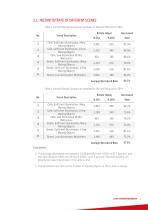
3.1. INSTANT BITRATE OF DIFFERENT SCENES Table 1 Instant Bitrate Comparison between H.264 and Hikvision H.265+ No. Scene Description Cafe, Sufficient Illumination, Many Moving Objects Cafe, Sufficient Illumination, A Few Moving Objects Cafe, Low Illuminated (IR On), Motionless Street, Sufficient Illumination, Many Moving Objects Street, Sufficient Illumination, A Few Moving Objects Street, Low Illuminated, Motionless Bitrate (kbps) Average Decreased Rate Table 2 Instant Bitrate Comparison between H.265 and Hikvision H.265+ No. Scene Description Cafe, Sufficient Illumination, Many Moving Objects...
Open the catalog to page 9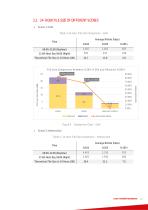
3.2. 24-HOUR FILE SIZE OF DIFFERENT SCENES Scene 1: Café Table 3 24-Hour File Size Comparison - Café Average Bitrate (kbps) Theoretical File Size in 24 Hours (GB) File Size Comparison between H.264, H.265 and Hikvision H.265+ H.264, 83.00% Decreased Rate Hikvision H.265+ Decreased Rate Figure 9 Comparison Chart - Café Scene 2: Intersection Table 4 24-Hour File Size Comparison - Intersection Time Average Bitrate (kbps) H.264 Theoretical File Size in 24 Hours (GB)
Open the catalog to page 10
File Size Comparison between H.264, H.265 and Hikvision H.265+ 40 Decreased Rate Decreased Rate Figure 10 Comparison Chart - Intersection Conclusion: For the café monitoring, the decreased rate of the 24-hour file size between H.264 and Hikvision H.265+ is 83.0 percent, and the rate between H.265 and Hikvision H.265+ is 67.3 percent. For the intersection monitoring, the decreased rate of the 24-hour file size between H.264 and Hikvision H.265+ is 79.4 percent, and the rate between H.265 and Hikvision H.265+ is 64.5 percent. Hikvision H.265+ can greatly decrease the file size in the all-day monitoring...
Open the catalog to page 11All Hikvision catalogs and technical brochures
 DS-2TD2528T-10/Q(C)
7 Pages
 DS-2DE7A432IW-AEB(T5)
8 Pages
 DS-E04HGHI-B
4 Pages
 DS-2CD1043G2-LIUF/SL
5 Pages
 DS-2CD1143G2-I
6 Pages
 DS-2CD2H23G2-IZS
6 Pages
 AX PRO Solution
5 Pages
 Hikvision Tripod Turnstile
2 Pages
 EMERGENCY ALARM SERIES
4 Pages
 CASINO SOLUTION
6 Pages
 SMART CLASSROOMS
6 Pages
 LOGISTICS PARK SOLUTION
12 Pages
 RETAIL SOLUTION
18 Pages
 SAFE CITY SOLUTION
19 Pages
 HOSPITAL SOLUTION
6 Pages
 SMART PORT & MARITIME SOLUTION
16 Pages
 THE SOLUTION FOR CAMPUS SECURITY
12 Pages
 ColorVu Varifocal Cameras
2 Pages
 Hikvision AcuSense Products
8 Pages
 D3T Ultra-low-light Series
2 Pages
 HIKVISION UNDERWATER CAMERA
2 Pages
 Fingerprint Terminal
2 Pages
 AX Wireless System
2 Pages
 VIDEO WALL CONTROLLER
2 Pages
 ColorVu Network Cameras
2 Pages
 WI-FI VIDEO DOORBELL
2 Pages
 DS-KAS261
2 Pages
 ColorVu
2 Pages
 AcuSense DVR
2 Pages
 PIR CAMERAS
2 Pages
 ColorVu Lite series camera
2 Pages
 Radar
Radar2 Pages
 Auto NVR Easy Operation
2 Pages
 AX SERIES Hybrid Alarm Kit
2 Pages
 IP VIDEO INTERCOM KIT
2 Pages
 Powerful PoE Switch
2 Pages
 Hilook Product Family Tree
2 Pages
 Hikvision LED Displays
40 Pages
 Blazer Express
6 Pages
 HikCentral Professional
23 Pages
 Hikvision Access Control
12 Pages
 Explosion Proof Product
8 Pages
 Intrusion Series
28 Pages
 AXHUB
AXHUB2 Pages
 AXPRO Solution
3 Pages
 WIRED SECURITY CONTROL PANEL
8 Pages
 TURBO HD 5.0 SOLUTION
8 Pages
 HIKVISION Monitors
6 Pages
 HIKVISION NVR
16 Pages
 TURBO HD 4.0 SOLUTION
24 Pages
 HikCentral Professional
24 Pages
 TURBO HD 3.0
24 Pages
 DS-K1T607 Series
2 Pages
 ACCESS AT A GLANCE
2 Pages
 DVR
DVR2 Pages
 Flexible product combination
2 Pages
 HIKVISION 4K SYSTEM
6 Pages
 Hikvision Webcams
16 Pages
 ELLIPSE DETECTOR RANGE
5 Pages
 AX PRO SERIES
27 Pages
 Monitors-In-Command-Center
14 Pages
 Enjoy the Ease of IP
8 Pages
 PRODUCT CATALOG 2021 H1
26 Pages
 Hikvision Commercial Displays
44 Pages
 Turbo HD X
6 Pages


Archived catalogs
 HIKVISION cHANNEL PRODUCTS
3 Pages
 DF SERIES PTZ CAMERAS
11 Pages


- Display module
- Hikvision digital camera
- Visible imager
- LCD display panel
- LCD screen
- Ethernet switch
- Hikvision CMOS camera
- Hikvision industrial camera
- Management software solution
- HDMI monitor
- Hikvision infrared camera
- Full-color camera system
- Panel-mount screen
- Hikvision monitoring camera
- Real-time software
- Single-pole switch
- Color display panel
- Push-button switch
- Managed switch
- Hikvision detection camera