
- Catalogs
- Hexcel Corporation
- HexForce®


HexForce®

HexForce®
Hexcel Corporation is a leader in advanced composites, focusing on lightweight, high-performance structural materials like carbon fibers and composite structures. These materials are used in aerospace, defense, and industrial applications such as wind turbines. Hexcel's vertical integration enhances cost, quality, and delivery control, offering global design flexibility and support.
Key parameters for selecting woven fabrics include yarn weight, thread count, weave pattern, and fabric finish, which determine the fabric's strength, weight, and thickness. Common weave patterns include plain, basket, leno, satin, and twill, each offering different pliability and stability levels.
The conversion process involves stages like warping, slashing, entering, weaving, heat cleaning, and finishing, crucial for preparing yarn and fabric for industrial use, ensuring durability and performance.
Hexcel offers a range of carbon fabrics and specialty reinforcements known for high strength-to-weight ratio, thermal and electrical conductivity, and fatigue resistance, with many certified for aerospace applications.
Hexcel provides specialty reinforcements, including lightning strike fabrics and hybrid composites, designed for specific performance requirements in advanced applications.
Fiber glass fabrics are noted for their physical properties and industrial applications. Hexcel offers a range of fiber glass products with different finishes and processes to enhance performance.
Aramid fabrics are known for strength and durability, with applications across various industries. Hexcel provides detailed information on their physical properties, applications, and finishes.
The handbook includes technical references and specifications for various fabric types, providing essential data for engineers and designers in the composites industry.
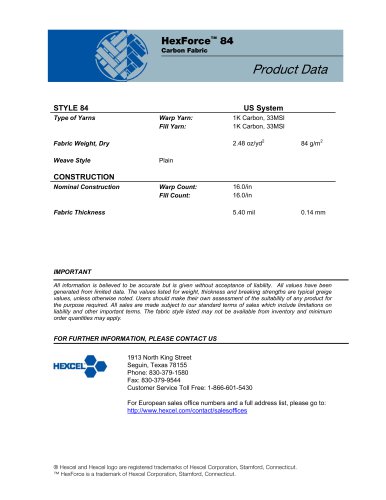
Detailed specifications for yarn and fabric types include weave, yarn count, and fabric weight in oz/yd² and g/m², highlighting styles like SA047, SA060, and KA060 with specific yarn compositions.
Hexcel offers advanced non-crimp and tackified fabrics for non-aerospace applications, featuring multi-axial capabilities and lightning strike fabrics for enhanced structural integrity.
Fiber glass fabrics are used in reinforced plastics, electrical insulation, and thermal insulation, noted for high strength, dimensional stability, moisture, and fire resistance.
Fiber glass fabrics are utilized in reinforced plastics, electrical applications, coated and laminated fabrics, thermal insulation, and construction due to their high strength-to-weight ratio and environmental resistance.
The document explains the nomenclature system for fiber glass yarns, detailing the U.S. and TEX/Metric systems, including glass composition and yarn construction.
HT fabrics like 6781HT and 6220HT offer superior impact resistance and tensile strength, compatible with high-temperature resins.
Hexcel provides finishes and styles for surfboard and recreation markets, including the "CLEAR" finish for clarity and softness, with styles like 1522 and 7533 for various applications.
Fiber glass fabrics come with various finishes and treatments, with recommended Hexcel finishes based on resin compatibility, highlighting performance features.
- Specifications: Lists fiber glass finishes with recommended matrix resins, such as CS-550/Volan compatible with polyester, vinyl ester, and phenolic resins.
- Performance Features: Describes unique performance features like resin compatibility, clarity, and temperature resistance.
- Physical Properties: Includes tables detailing physical properties like weave type, yarn count, weight, thickness, and strength.
- Additional Information: Notes Hexcel's right to use equivalent yarns and provides contact information for technical service representatives.
- Exigencies: Finishes must meet specific qualifications like BMS 9-3 for structural applications.
- Parameters: Specifies recommended matrix resins for each finish, emphasizing appropriate resin selection for optimal performance.
- Limitations: Physical properties listed are typical for untreated fabrics, indicating treated fabrics may differ.
- Best Practices: Advises contacting technical service representatives for additional information and guidance.
- Fiber Properties: Lists fibers like Spectra® and Twaron® with properties such as density, tensile strength, and thermal expansion.
- Specifications: Outlines specifications like AMS 3824 for glass fabrics and ASTM standards for woven glass fabrics.
- Conversions: Provides conversion factors for measurements including areal weight, mass, force, and temperature.
Catalog excerpts

Woven Fabrics Unidirectional Fabrics Glass Carbon Aramid Hybrids Technical Fabrics Handbook HexForce® Reinforcements
Open the catalog to page 1
REINFORCEMENTS FOR COMPOSITES MANUFACTURING, SALES AND CUSTOMER SERVICE Seguin, Texas 1913 N. King St. Seguin, TX 78155 United States Telephone: (830) 379-1580 Fax: (830) 379-9544 Customer Service Toll Free: 1 (866) 601-5430 Technical Service: 1 (830) 401-8180 MANUFACTURING Les Avenieres, France Z.I. Les Nappes 38630 Les Avenieres France For European sales office numbers and a full address list, please go to: www.hexcel.com/contact/salesoffices
Open the catalog to page 3
INDUSTRIAL DISCLAIMER 2 For Industrial Use Only - In determining whether the material is suitable for a particular application, such factors as overall product design and the processing and environmental conditions to which it will be subjected should be considered by the User. The following is made in lieu of all warranties, expressed or implied: Seller’s only obligations shall be to replace such quantity of this product which has proven to not substantially comply with the data presented in this bulletin. In the event of the discovery of a nonconforming product, Seller shall not be liable for...
Open the catalog to page 4
COMPANY PROFILE 4 Hexcel Corporation is a leading advanced composites company. It develops, manufactures and markets lightweight, high-performance structural materials; including carbon fibers, reinforcements, prepregs, honeycomb, matrix systems, adhesives and composite structures, used in commercial aerospace, space and defense and industrial applications such as wind turbines. As the most vertically integrated supplier in the industry, Hexcel is better able to control the cost, quality and delivery of its products. Vertical integration also means that we can offer enhanced design flexibility...
Open the catalog to page 6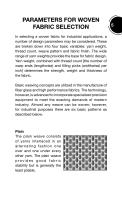
PARAMETERS FOR WOVEN FABRIC SELECTION In selecting a woven fabric for industrial applications, a number of design parameters may be considered. These are broken down into four basic variables: yarn weight, thread count, weave pattern and fabric finish. The wide range of yarn weights provides the base for fabric design. Yarn weight, combined with thread count [the number of warp ends (lengthwise) and filling picks (widthwise) per inch] determines the strength, weight and thickness of the fabric. Basic weaving concepts are utilized in the manufacture of fiber glass and high performance fabrics. The...
Open the catalog to page 7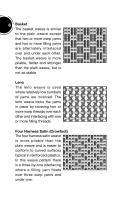
The basket weave is similar to the plain weave except that two or more warp yarns and two or more filling yarns over and under each other. The basket weave is more pliable, flatter and stronger than the plain weave, but is The leno weave is used where relatively low numbers leno weave locks the yarns more warp threads over each other and interlacing with one K or more filling threads. — Four Harness Satin (Crowfoot) The four harness satin weave is more pliable than the plain weave and is easier to conform to curved surfaces typical in reinforced plastics. In this weave pattern there where a filling...
Open the catalog to page 8
Eight Harness Satin The eight harness satin is similar to the four harness satin except that one filling yarn floats over seven warp yarns and under one. This is a very pliable weave and is used for forming over curved surfaces. Twill Weave The twill weave is more pliable than the plain weave and has better drapability while maintaining more fabric stability than a four or eight harness satin weave. The weave pattern is characterized by a diagonal rib created by one warp yarn floating over at least two filling yarns
Open the catalog to page 9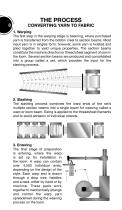
CONVERTING YARN TO FABRIC 1. Warping The first step in the warping stage is beaming, where purchased yarn is transferred from the bobbin creel to section beams. Most input yarn is in singles form; however, some yarn is twisted and plied together to yield unique properties. The section beams constitute the machine direction or thread sheet segment of yarn in the loom. Several section beams are produced and consolidated into a group called a set, which provides the input for the slashing process. 2. Slashing The slashing process combines the warp ends of the set’s multiple section beams into a...
Open the catalog to page 10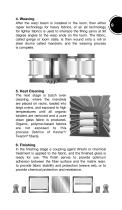
4. Weaving After the warp beam is installed in the loom, then either rapier technology for heavy fabrics, or air jet technology for lighter fabrics is used to interlace the filling yarns at 90 degree angles to the warp ends on the loom. The fabric, called greige or loom state, is then wound onto a roll or steel drums called mandrels, and the weaving process is complete. 5. Heat Cleaning The next stage is batch oven cleaning, where the mandrels are placed on racks, loaded into large ovens, and exposed to high temperatures until all organic binders are removed and a pure clean glass fabric is produced....
Open the catalog to page 11
CARBON FIBER FABRICS
Open the catalog to page 13
CARBON FABRICS Hexcel manufactures the most complete line of carbon fabrics and specialty reinforcements for the composite industry and offers a thorough line of globally certified aerospace products. Carbon fiber reinforcements, when properly engineered into the appropriate matrix, can achieve one of the strongest and most rigid composite structures available with significant weight savings when compared to metals and other materials. In addition to the high strength-to-weight ratio, carbon fiber reinforcements are thermally and electrically conductive, have very low CTE and excellent fatigue...
Open the catalog to page 14
Our Specialty Reinforcements product line includes a number of different technologies that produce an endless variety of carbon-reinforced designs for preform products and your composite needs. (See “Specialty Reinforcements Materials” in this section) Hexcel’s staff, with expertise in the areas of textile development, finishing technology, resin chemistry, composite technology, and applications engineering, is readily available to investigate development requirements for engineered fabrics, coated fabrics, and specialty composite-reinforced structures. Often a process is limited by the use of...
Open the catalog to page 15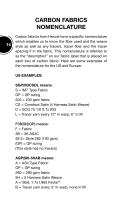
CARBON FABRICS NOMENCLATURE 14 Carbon fabrics from Hexcel have a specific nomenclature which enables us to know the fiber used and the weave style as well as any tracers, tracer fiber and the tracer spacing if in the fabric. This nomenclature is referred to as the “description” on our fabric label that is placed on each box of carbon fabric. Here are some examples of the nomenclature for the US and Europe: US EXAMPLES: SGP203CSDL means: S = IM7 Type Fabric GP = GP sizing 203 = 203 gsm fabric CS = Crowfoot Satin (4 Harness Satin Weave) D = SCG 75 1/0 0.7z 933 L = Tracer yarn every 12” in warp,...
Open the catalog to page 16All Hexcel Corporation catalogs and technical brochures
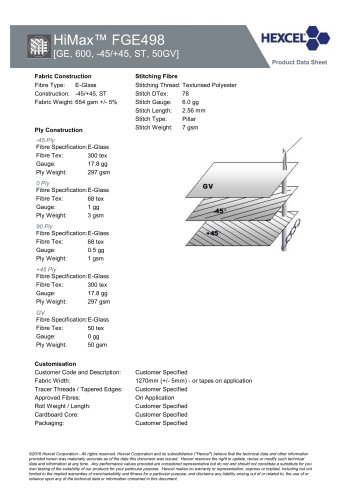
 HiMax™ FGE498
12 Pages
 HiMax™ FGE498
2 Pages
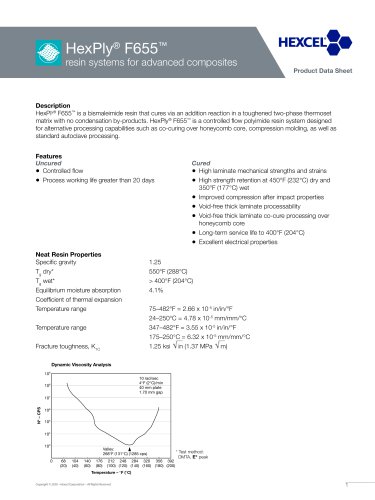 HexPly® F655™
6 Pages
Archived catalogs
 HexWeb® Acousti-Cap®
4 Pages
 Winter Sports
6 Pages
 HexTow® Chopped Fiber
2 Pages
 RTM 6
RTM 64 Pages
 HexTow® AS4
3 Pages
 HexPly® M77
4 Pages
 HexPly® 8552 Epoxy Matrix
6 Pages
 HexTow ® HM63
2 Pages
 HexTow® Carbon Fiber
4 Pages
 HexTow ® AS4A
2 Pages
 HexTow ® IM2A
2 Pages
 HexTow ® AS7
2 Pages
 Modipur® US 583 F
3 Pages
 Modipur® US 569 B
3 Pages
 HexFlow® HT 804
2 Pages
 HexPly® M19.1/M19.6
4 Pages
 Redux® 100 series
4 Pages
 English Winter Sports
6 Pages
 Wind Turbine Blades
12 Pages
 Rail
Rail5 Pages
 HiTape
4 Pages
 HexTow
8 Pages
 Polyspeed
4 Pages
 G-EV 974GI
2 Pages
 G-R98
G-R982 Pages
 HexPly® M78
4 Pages
 Automotive
4 Pages
 HexShield™
2 Pages
 HEXTOOL® M61
4 Pages
 HexMC® User Guide
12 Pages
 HexForce® Reinforcements
99 Pages
 Redux / hexbond
8 Pages
 HiTape® Reinforcements
4 Pages




- Roll sheet
- Epoxy resin
- Adhesive foil
- Glass technical fabric
- Industrial technical fabric
- Roving fiber
- Hexcel reinforcement technical fabric
- Heat-resistant technical fabric
- Continuous fiber
- Two-component resin
- Technical fabric for the automotive industry
- High-performance resin
- Fiberglass technical fabric
- Carbon technical fabric
- Maritime industry technical fabric
- Epoxy resin prepreg
- Chopped fiber
- Bulk fiber
- Carbon fiber prepreg