

Hermes Bonded Abrasives, Basics

Hermes Bonded Abrasives, Basics
Hermes Schleifmittel, founded in 1927, is a prominent manufacturer of precision bonded and coated abrasives, focusing on high-quality production and innovation. The company operates globally, offering local consulting services.
Process and Research
Hermes is dedicated to enhancing grinding processes through continuous improvement, focusing on developing new ceramic bonds and refining abrasive grains to improve product quality and reduce costs.
Abrasives, Variants, and Properties
Bonded abrasives are made from materials like fused aluminum oxide, silicon carbide, cubic boron nitride (CBN), and diamond, each with unique properties suitable for various grinding applications.
Grit Size and Selection
Grit size affects the roughness and performance of the grinding process. Larger grit sizes are coarser, while smaller sizes are finer, with selection based on specific applications.
Hardness and Structure
Abrasive hardness influences toughness and grinding properties, with variants like semi-friable and friable aluminum oxides offering different levels of toughness and cooling properties.
Bonds and Additional Treatments
Hermes develops ceramic bonds to enhance the performance of bonded abrasives, with additional treatments improving grinding results.
Specification and Designation
Bonded abrasives are specified based on composition and intended use, ensuring optimal performance in various applications.
Tools and Applications
Hermes provides tools for gear honing and other applications, including surface grinding and cylindrical grinding.
Environmental and Quality Standards
Hermes adheres to international standards like DIN EN ISO 9001 and 14001, emphasizing environmental protection and quality assurance.
Conclusion
Hermes continues to innovate, focusing on high-quality abrasives and sustainable practices to meet industry demands.
This document outlines factors influencing grinding results, focusing on grit size, hardness, and bond structure, and their impact on performance.
Grit Size and Selection
Grit size, as per DIN ISO 8486-1, affects grinding outcomes, with finer sizes recommended for specific surface roughness and radii.
Hardness and Grinding Force
The hardness of bonded abrasives affects grinding force and temperature, influencing self-sharpening and workpiece tolerances.
Structure and Bond Strength
The structure of bonded abrasives is crucial for adapting to different processes, with bond strength varying between vitrified and resin-bonded abrasives.
Special Treatments and Applications
Special treatments enhance performance, with applications in gear honing reducing noise and improving surface quality.
Advanced Grinding Technologies
Modern technologies use hard materials like synthetic diamond and CBN, offering longer wheel life and reduced processing time.
Conclusion
The document mentions Hermes' online resources for additional information on bonded abrasives.
Information on Microlite-bonded abrasives from Hermes Schleifkörper GmbH is provided, with downloadable product solutions.
Variants
Abrasives are available in different grain types and grit ranges, including Silicon carbide and Regular aluminum oxide.
Specifications
Abrasives come in diameters from 40 mm to 400 mm, with operating speeds between 18 m/s and 35 m/s.
Applications
Suitable for polishing, decorative grinding, deburring, and more, on materials like non-ferrous metals and high-temperature steels.
Contact Information
Hermes Schleifkörper GmbH is located in Dresden, Germany, with contact details provided for further inquiries.
Catalog excerpts

Bonded Abrasives Hermes Bonded Abrasives
Open the catalog to page 1
Grinding processes are subject to continuous change with the objective of constant improvement of workpiece quality and process productivity. this can be achieved by using new and optimized grinding systems and parameters. the core of the process is the bonded abrasive. it’s composition is a key determining factor in the quality and performance values of the process.
Open the catalog to page 2
Hermes – a competent “grinding” partner all over trAdition hAs A Future At herMes Hermes Schleifmittel is a company with roots going back as far as 1927. Hermes does not only hold a key market position in producing precision bonded abrasives, but it is one of the world‘s leading manufacturers of coated abrasives. Hermes owes this market position to its insistence on absolute top quality. We feel obligated to this tradition and it is our primary guiding principle for the future. This is an obligation that is the greatest possible motivation and to which we devote all our energies and commitment....
Open the catalog to page 4
the world sustAininG nAture And environMent Compliance with national and international laws and regulations is one of the key principles of Hermes corporate policy and protection of the environment is a core constituent of our corporate responsibility. As a consequence, as long ago as 1996, Hermes was the fi rst European abrasives factory to be successfully audited on a voluntary basis in line with the EMAS (Eco-Management and Audit Scheme). The management system, currently being implemented, covers all areas of the company. All processes relevant to the environment and also to quality are being...
Open the catalog to page 5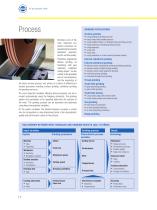
Grinding applications Grinding is one of the most important production processes for generating the required workpiece geometry and its surface quality. Surface grinding • using peripheral grinding process • using creep-feed grinding process • using profiled wheels in a profile/surface grinding process • using continuous-dressing grinding process • using segments • using cups • using rings • using cemented or screw mounted abrasive wheels Production engineering defines grinding as “machining with geometrically undefined cutting edges”. Via the surface to be generated and its characteristics and...
Open the catalog to page 6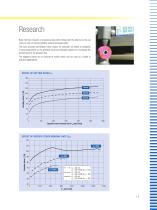
Basic Hermes research is involved among other things with the effects on the out- come of work of varying grinding system and parameters. This work provides information which shows, for example, the effect of variations in input parameters on the grinding result and indicates options for increasing the performance of the abrasive tool. The diagrams below are an excerpt of results which can be used as a guide in practical applications. EFFECT OF SPECIFIC STOCK REMOVAL RATE Q'w
Open the catalog to page 7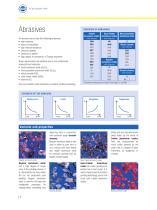
An abrasive has to have the following properties: • high hardness • sharp cutting edges • high thermal resistance • chemical stability • tendency to splinter • high degree of consistency of Charge properties These requirements are satisfied only by the synthetically produced hard materials: • fused aluminium oxide (Al2O3), • microcrystalline aluminium oxide (Al2O3), • silicon carbide (SiC), • cubic boron nitride (CBN), • diamond (D). They are therefore used intensively in modern grinding technology. Friable aluminium oxides with mixtures EKW EKR EKD EKT EWR EWD ERD EWT ERT EDT FP TKR EKE Semi-friable...
Open the catalog to page 8
Cubic boron nitride (CBN) is the second-hardest material after diamond, but has greater thermal resistance and is not subject to chemical wear when cutting steel. With cubic boron nitride, up to one hundred times longer wheel lives can be achieved compared to aluminium oxide abrasive wheels. Cubic boron nitride (CBN) CBN is especially suitable for processing steels which are hard to cut and for the high-performance grinding of high production volume components. Diamond is the hardest material known, but when processing steel, tends to be subject to chemical wear. Its high degree of hardness can...
Open the catalog to page 9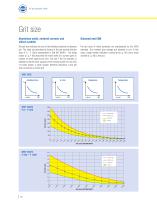
Grit size Aluminium oxide, sintered ceramic and silicon carbide The grit size indicates the size of the individual particles of abrasive grit. The sizes are described by means of the grit particle distributions (F 8 - F 1200) standardized in DIN ISO 8486-1. The designation (e. g. F 60) describes the mesh width of a screen given in number of mesh squares per inch. Grit size F 60, for example, is defined by the 60 mesh squares of the nominal screen for one inch of screen length. A large number therefore describes a fine grit and a small one a coarse grit. The grit sizes of these abrasives are standardized...
Open the catalog to page 10
Grit selection Together with hardness, the selection of grit size has a key influence on the grinding result. Grit size is selected to achieve specified roughnesses and radii. Grit sizes F 46, F 60 and F 80 are most frequently used for precision grinding. Summary of grit sizes Coarse Very fine It is possible and often also advantageous to combine grit sizes. This is stated in the specification of the bonded abrasive. Examples Example 1: When grinding the outside diameter of a shaft, a roughness of R z ≤ 2 µm is required. Three grit sizes come into question: F 60, F 80 or F 100. If the specified...
Open the catalog to page 11
Degree of hardness Extremely soft A, B, C, D Very soft Very hard Extremely hard The nominal hardness quoted in the specification is indicated by the letters “A” (extremely soft) to “Z” (extremely hard). This hardness is a measure of the force required to break a particle of grit out of the bonded abrasive structure. It is controlled by the strength of the links in the bond and by the inherent strength of the bond. Rising nominal hardness in a specification and process management which otherwise remain constant yields a higher G ratio (less wear) but also higher grinding forces and thus higher...
Open the catalog to page 12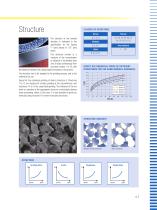
Classes of structure Dense 0, 1, 2, 3 The structure of the bonded abra is indicated in the sive specification by the figures “1” (very dense) to “22” (very open). This structure number is a measure of the concentration of abrasive in the bonded abrasive. It drops continuously from structure number 1 to 22, with the distance between the cutting edges increasing in the process. Effect on tangential force of different structures for the same nominal hardness. The structure has to be adapted to the grinding process and to the material to be cut. Typical for the cylindrical grinding of steel is structure...
Open the catalog to page 13All HERMES catalogs and technical brochures
 BS 118 OP
2 Pages
 Flexible grinding
8 Pages
 FB 637
1 Page
 CERAMIT CR 476 J
1 Page
 BW 114
1 Page
 BW 110
1 Page
 BS 118
1 Page
 Stock list 2015
56 Pages
 Hermes Superabrasives
28 Pages
 Metal working
96 Pages
 Stock list
60 Pages

Archived catalogs
 Stock List
48 Pages
- Power transmission belt
- Industrial strip
- Sanding disc
- Metal abrasive disc
- Flat power transmission belt
- Transparent film
- Grinding abrasive disc
- Flexible power transmission belt
- Sanding sanding disc
- Cleaning abrasive disc
- Flexible foil
- Abrasive belt
- Corundum abrasive disc
- Quick-change abrasive disc
- Abrasive roll
- Aluminum sheet
- Paper film
- Ceramic abrasive disc
- Silicon carbide abrasive disc
- Metal foil