

- Company
- Products
- Catalogs
- News & Trends
- Exhibitions
Encoder Main Catalog

Encoder Main Catalog
Hengstler is a prominent manufacturer of industrial components such as encoders, counters, relays, printers, and cutters. The company is recognized for its innovative products and global reach, with headquarters in Aldingen, Germany, and facilities in Slovakia, the USA, China, Brazil, and Japan.
- Encoders: Hengstler offers incremental, absolute, and motor feedback encoders, available in explosion-proof and stainless steel versions for applications in CNC machines, motors, and medical technology.
- Industrial Counting and Control Components: Includes mini-counters, control counters, multifunction counters, position indicators, timers, and tachometers.
- Printers and Cutters: Solutions for info points, ticket dispensers, and POS systems, with accessories like winders and cutters.
- Relay Technology: A range of safety relays, including bistable, isolation, high-voltage, and mini switching relays.
Hengstler encoders feature advanced technology with high protection against electromagnetic interference, self-monitoring, and fault detection. They come in various configurations, including different flange and shaft sizes, resolutions, and protection classes up to IP 67.
Hengstler emphasizes high-quality materials and processes, with certifications from VDE, UL, CL, and TÜV. The company is DQS-certified to ISO 9001, ensuring reliability and quality in its products.
Hengstler offers extensive customer support through its global network, providing technical assistance, quick response to queries, and a 48-hour repair service. The company also offers flexible manufacturing and short delivery times to meet customer needs.
Hengstler is a reliable partner in industrial components, offering a wide range of products and solutions tailored to customer needs. Their commitment to innovation, quality, and customer service makes them a preferred choice for businesses worldwide.
Incremental encoders generate signals in response to rotary movement and can measure linear movement with mechanical conversion devices. They are used in applications like door closing devices for trains, desktop robots, lens grinding machines, plotters, and testing machines for optical waveguides.
- Supply Voltage: DC 5 V / DC 10 - 30 V
- Current Consumption: 40 mA (DC 5 V), 30 mA (DC 24 V), 60 mA (DC 10 V)
- Frequency Response: 300 kHz (RS 422), 200 kHz (push-pull)
- Protection: Short circuit protection for push-pull outputs
- Temperature Range: -40° to +100°C
- Shaft Diameter: 5 mm, 6 mm, 6.35 mm, 10 mm, 12 mm
- Max Shaft Load: Radial 10 N, Axial 5 N
- Max Speed: 10,000 min-1
- Protection Class: Housing IP 64, Bearings IP 64
- Material: Aluminium housing
- Incremental Signals: A, B, N
- Absolute Accuracy: ±35"
- Repeatability: ±7"
- Max Frequency: 500 kHz
- Harmonic distortion less than 1%
- Self-monitoring and error compensation
- Secure against short-circuit and overload
These encoders are suitable for CNC machines, manipulators, motors, medical technology, textile machines, and other industrial applications requiring high pulse frequencies and protection against environmental factors.
- Available with synchro flange, pilot flange, and various connector options
- Pin assignments and cable specifications provided for different output types
These encoders are designed for precise position measurement in industrial applications, offering high precision and reliability with different interface options.
- Housing diameter: 58 mm or 110 mm
- Protection classes: IP 50 to IP 67
- Flange types: Synchro, clamping, and square flanges
- Shaft diameters: 6 mm to 50 mm
- Max speed: Up to 10,000 min-1 continuous, 12,000 min-1 short-term
- Operating temperatures: -40°C to +85°C
- Supply voltage: DC 10-30 V
- Current consumption: 220 mA to 250 mA
- Interfaces: RS 485, Profibus DP, CANopen, DeviceNet, Interbus
- Resolutions: Up to 29 Bit (17 Bit ST, 12 Bit MT)
- Diagnostic LEDs, compact design, and options for a "tico" display
- Explosion-proof models with ATEX certification
Used in packaging, ship equipment, offshore applications, and more, designed to withstand high vibration and shock resistance.
Hengstler offers a range of motor feedback systems, including modular miniature incremental encoders and absolute encoders for various motor types. These systems are designed for high precision and dynamics, with features like OptoAsic technology and BiSS interface.
- Operating Frequency: Up to 200 kHz for most models, with some supporting up to 500 kHz.
- Resolution: Varies from 512 lines/rev to 10,000 ppr depending on the model.
- Shaft Diameter: Ranges from 1.5 mm to 50 mm, accommodating various motor sizes.
- Max Speed: Typically up to 12,000 min-1, with some models supporting continuous operation at lower speeds.
- Operating Temperature: Generally between -40°C to +120°C, ensuring functionality in diverse environments.
- Protection Class: Varies from IP40 to IP67, indicating different levels of dust and water resistance.
- Mounting: Options include direct mounting, clamping flange, and stator coupling, with mounting depths ranging from 20 mm to 50.5 mm.
- Material: Housings are typically made of aluminum, providing durability and lightweight characteristics.
- Supply Voltage: DC 5 V ±10% or DC 10-30 V, depending on the model.
- Output: Includes RS 422, push-pull, and NPN-O.C. configurations, supporting various signal types like square wave and sinus-cosinus.
- Current Consumption: Ranges from 10 mA to 120 mA without load, with additional specifications for incremental and commutation signals.
- Encoders are designed for easy installation with features like flexible hollow shaft concepts and short mounting depths.
- Some models include integrated diagnostic systems and are compatible with resolver mounting.
- Applications include positioning drives, motors, machine tools, packaging machines, and more.
These encoders are suitable for use in motors, machine tools, packaging machines, robots, and automated SMD equipment, providing precise feedback and control in various industrial applications.
The document provides technical specifications and details for various types of encoders used in motor feedback systems for AC synchronous and BLDC motors. These encoders are designed to offer high performance and reliability in demanding applications such as CNC precision machining and professional printing.
The F18 encoder is designed for stepper and servo motor controls, offering high performance and cost-effective feedback. It features a compact design with a pluggable pin header and a compliant tether for easy mounting. The encoder uses optically-generated signals for higher accuracy and reliability, eliminating hysteresis found in units with hall effect sensors. It supports a range of pulse counts and optional commutation signals.
- Supply Voltage: 5 V ±10%
- Max Current: 150 mA (incremental), 175 mA (incremental + commutation)
- Resolution: Up to 10,000 ppr
- Output Frequency: 250 kHz up to 1,024 ppr, 500 kHz > 1,024 ppr
- Signal Level: TTL differential (RS422)
The AD36 is an absolute encoder with a geared multiturn and optical sensing technology. It features a through hollow shaft and is compatible with resolver size 15. The encoder provides fully digital position data up to 19 Bit (Singleturn) and 12 Bit (Multiturn) over the BiSS interface. It includes an integrated diagnostic system for maximum motor uptime.
- Supply Voltage: DC 5 V or DC 10-30 V
- Resolution: Singleturn up to 19 Bit, Multiturn up to 12 Bit
- Max Speed: 10,000 rpm continuous, 12,000 rpm short term
- Protection Class: IP 40
The AD58 encoder is designed for high-speed, all-digital applications. It offers a geared multiturn and optical sensing technology, suitable for integration into BLDC servo motors. The encoder provides fully digital position data up to 22 Bit (Singleturn) and 12 Bit (Multiturn) over the BiSS interface.
- Supply Voltage: DC 5 V
- Resolution: Singleturn up to 22 Bit, Multiturn up to 12 Bit
- Max Speed: 10,000 rpm continuous, 12,000 rpm short term
- Protection Class: IP 40
The S21 encoder is designed for a wide operating temperature range and offers high signal quality with excellent immunity to interference. It features a sine-wave signal output and is suitable for smaller sized motors.
- Supply Voltage: DC 5 V ±10%
- Max Current: 120 mA
- Number of Pulses: 2,048
- Max Frequency Output: 500 kHz
- Protection Class: IP 40
Type S21 encoders are designed for high positional accuracy with servo axes. They feature a tapered solid shaft with mounting support and are available with a tapered hollow shaft upon request. The encoders provide precise feedback for motor control applications.
Resolvers offer accurate, absolute position feedback and are robust enough to withstand high shock and vibration levels. They operate in extreme temperatures up to 220°C and are maintenance-free. Applications include servo drives, medical technology, robots, and military engineering. Housed resolvers are brushless, maintenance-free, and suitable for harsh environments with high reliability and precision.
The Signo 727 SSI is a position indicator for absolute encoder connections, featuring a large LED display, programmable limit values, and relay outputs. It supports synchronous serial interfaces and is suitable for various applications, including machine position indication and totalizing values. The device is programmable with three operating levels and offers protection against unauthorized programming.
Flexible couplings are used to protect shaft encoders from mechanical stresses due to misalignments. Various types of couplings, including helical, plastic, isolated disk, and bellows couplings, are available, each with specific torque, speed, and misalignment specifications. These couplings are suitable for different encoder types and applications.
Various mounting options and adapters are available for encoders, including synchro flange adapters and clamping eccentrics. Connectors are designed with a numbering system for easy installation and compatibility with different encoder types.
Encoders are devices used to convert mechanical motion into electrical signals. They are categorized based on their mounting and shaft types, including pilot flange, square flange, synchro flange, hollow shaft, and solid shaft encoders. Each type has specific installation methods, such as using fastening threads, angle brackets, or clamping eccentrics. Solid shaft encoders require couplings to compensate for misalignment and axial movements.
Incremental encoders provide output signals that indicate the position of a rotating shaft. They use RS 422 and TTL outputs, with specifications for pulse shape, duty factor, phasing, symmetry, and output frequency. The encoders are equipped with short circuit protection and pole protection, depending on the voltage range. Cable length affects the output frequency, with specific recommendations for different voltage levels.
Push-pull outputs are available in different configurations, including complementary outputs. These outputs are characterized by their pulse shape, duty factor, phasing, symmetry, and maximum output frequency. They offer short circuit protection and pole protection, with cable length affecting the output frequency.
Encoders with alarm outputs have an electronic monitoring system to report malfunctions. The alarm output can be connected to an optical display or control system. Malfunctions are categorized into three types: damaged disks, overtemperature, and voltage range issues. Each category has specific corrective actions.
Sine-wave encoders use OptoAsic technology to provide high-quality signals with low harmonic distortion. They are suitable for applications requiring precision at low speeds without compromising speed. Typical applications include machine tools, printing machines, and gearless elevators.
Absolute encoders provide position information without the need for reference runs. They are available in single-turn and multi-turn versions, with compact designs and high reliability. The ACURO series offers advanced interface technology, including CAN, Suconet K1, and DeviceNet, making them suitable for motor feedback and automation engineering.
The ACURO absolute encoders are designed for high reliability and long service life, utilizing advanced semiconductor technology. They are user-programmable and offer advantages such as easy data processing and mechanical system optimization. These encoders are suitable for determining angular positions in automated systems, eliminating the need for reference runs after power interruptions. They are also highly compatible with electromagnetic environments and offer a good price/performance ratio.
- INTERBUS: Integrated in a compact housing, it offers real-time data transfer with reduced wiring costs and noise sensitivity. It supports up to 256 subscribers and ensures data integrity with a 16-bit CRC.
- SSI (Synchronous-Serial Interface): Designed for environments with mechanical and electrical stresses, it offers data transfer rates up to 1.5 megabits per second with minimal components and cabling.
- BiSS: A bidirectional digital sensor interface that supports up to 8 sensors, offering high-speed data transmission and synchronization precision.
- Profibus DP: Supports programmable encoder profiles.
- INTERBUS supports a maximum cable length of 13 km for remote buses and 10 m for peripheral buses, with a transmission speed of 500 kBit/s.
- SSI offers data transfer with a defined number of clock pulses and supports ring-register mode for repeated polling.
- BiSS protocol allows for clock rates up to 10 Mbit/s and supports various data sections for different sensor applications.
ACURO encoders are versatile, suitable for medical technology, elevators, printing, paper processing, metal-processing machinery, and dynamic drives.
INTERBUS provides a sophisticated diagnostic system with centralized error display and self-acting fault detection. The BiSS interface allows for easy configuration with XML-descriptive files and compensates for line delays to optimize performance.
The document discusses the CAN protocol, highlighting its high transmission reliability with a Hamming distance of 6. The Intel 82527 CAN-Controller used in encoders is compatible with both basic and full-CAN specifications, supporting CAN 2.0 part B with 11-bit and 29-bit identifiers. The AC 58 encoder can record and signal the position of machine parts to control systems via the CAN bus.
CANopen, developed under the Steinbeis Transfer Centre for Automation, is a streamlined version of the CAN Application Layer (CAL) optimized for real-time data transfer. It supports auto-configuration, device synchronization, and both cyclical and event-controlled data processing. CANopen uses four communication objects: Process Data Objects (PDO), Service Data Objects (SDO), Network Management (NMT), and predefined objects for synchronization and emergency messages.
The CANopen profile for encoders defines a manufacturer-independent interface, detailing standard (C1) and extended (C2) categories of functions. The profile allows for an open bus system, with device parameters stored in an object directory.
Data transfer in CANopen is managed through PDOs for real-time data and SDOs for parameter transfer. The priority of messages is determined by the COB identifier, with lower identifiers having higher priority. The 11-bit identifier includes a function code and node number, set via DIP switches.
DeviceNet, developed by Allen-Bradley, is a network protocol for industrial automation, supporting up to 64 nodes per network. It reduces cabling and installation efforts and allows for device configuration over the network. DeviceNet uses a linear bus topology with 24VDC power and supports high-speed I/O and diagnostics.
Profibus-DP is an open field bus standard for quick data exchange in automation, supporting up to 126 devices per bus. It allows for cyclical data transfer and powerful diagnostic functions. The system supports mono- and multimaster configurations, with different device types including DP master classes 1 and 2, and DP slaves.
Profibus-DP supports cyclical user data transfer, dynamic activation of DP slaves, and powerful diagnostic functions. It allows for flexible system configurations with a maximum of 246 bytes of input and output data per DP slave. Diagnostic functions include station-related, module-related, and channel-related diagnostics.
Catalog excerpts
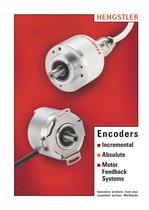
■ Incremental > ■ Absolute > ■ MotorFeedback Systems > Innovative products from yourcompetent partner. Worldwide size="-2">
Open the catalog to page 1
TM ENCODERS COUNTERS INDICATORS RELAYS PRINTERS CUTTERS >
Open the catalog to page 2
■ Variety and competence - HENGSTLER today2 ■ Our service for you5 ■ HENGSTLER produces worldwide6 > Generalaspects ■ Products in this catalogue7 ■ Applications33 ■ Overview of product range37 ■ Industrial encoder types with full shaft45 ■ Industrial encoder types with hollow shaft60 ■ Economy encoders79 ■ Encoder in explosion-proof versions and stainless steel versions90 ■ Sine-wave encoders95 ■ Overview of product range100 ■ ACURO industry 107BiSS/ SSI Field bus systems Parallel ■ Encoder in explosion-proof versions and stainless steel versions150 ■ Overview of product range164 ■ Incremental...
Open the catalog to page 3
2 ENCODERS COUNTERS INDICATORS RELAYS PRINTERS CUTTERS >
Open the catalog to page 4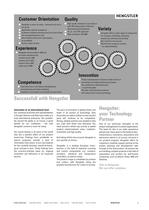
■ > Hengstler is never far away - wherever you are inthe world ■ > High-quality materials in accordancewith VDE (Association of German Electrotechnical Engineers) ■ > Application-specific assistance ■ > Customer-oriented manufacturing (one-piece-flow) ■ > UL, CL- and TV approvals ܢ֠ > Fair price/performance ratio ■ > DQS-certified to ISO 9001 ■ > Hengstler offers a wide range of componentsfor counting, controlling, indicating, measuring, switching and printing ■ > Short delivery times and a high degreeof availability ■ > Get it all from one source! ■ > 48-hour repair service ■ > Benefit from...
Open the catalog to page 5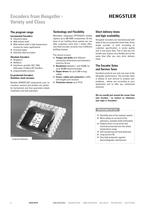
■ Flanges and shafts with differentconnection dimensions and diameters from 6 to 76 mm ■ Resolutions between 1 and 10,000, forup to 40,000 measuring steps > Monolithic integrated OPTOASICS reliably replace up to 200 SMD components. On the base of our building block system we can offer customers more than 1 million diffe- rent shaft encoder versions from 4 different building classes.The choice is yours : ■ Industrial types ■ Output drivers for up to 200 m longcables Hengstler encoders are manufactured with state of the art production know how. Every single encoder is built according to customer...
Open the catalog to page 6
always remains close to you ֖ thanks toour extensive sales & distribution network. Please contact your local Hengstler distri- butor, addresses see chapter ContactӔ (page 288). Talk to Hengstler.We offer solutions. You will always find a friendly contact at Hengstler wherever you are in the world. Our experienced, competent partners are familiar with your branch ֖ just get in touch. Please contact your local Hengstler distri- butor, addresses see chapter ContactӔ (page 288). If you should have any technical questions concerning your product selection or spe- cific application get fast and competent...
Open the catalog to page 7
Germany - Hengstler GmbH Slovakia - Hengstler sro Aldingen Kezmarok China - Danaher ICG China USA - Danaher Controls Gurnee, Illinois Tianjin Japan - Danaher ICG Japan Co. Brasil - Veeder Root do Brasil Sao Paulo Osaka > 6 ENCODERS COUNTERS INDICATORS RELAYS PRINTERS CUTTERS size="-1">
Open the catalog to page 8
Type RI 30 RI 36 RI 58 > Products Special features ■ small encoder for industrial applications ■ small industrial encoder for high numbers of pulses ■ universal industrial encoder ■ up tp 10000 pulses ■ low power consumption ■ high operating safety ■ protection class up to IP 67 ■ high immunity to interference ■ applications, e.g. CNC axles, machine tools, robots, special machinery, high-speed winding machines ■ operating temperature up to 100C Т֠ cable lengths up to 100 m ■ suitable for high pulse frequencies ■ suitable for high shock loads ■ applications e.g. machine tools, CNC axles, packaging...
Open the catalog to page 9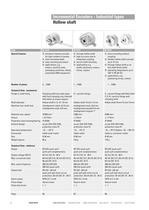
Type RI 36-H RI 58-H RI 58-D Special features ■ miniature industry encoder for high numbers of pulses ■ through hollow shaft ■ direct mounting without coupling ■ high accuracy due to integrated coupling ■ short mounting depth ■ flexible hollow shaft concept up to 14 mm ■ easy mounting procedure ■ secure shaft mounting ■ applications, e.g.motors, machine tools, packaging machines, robots, automated SMD equipment ■ applications e.g.textile machinery, motors, drives, copiers ■ through hollow shaft or as end shaft (blind shaft) ■ operating temperature up to 100 C (RI 58 TD) Т֠ applications, e.g.positioning...
Open the catalog to page 10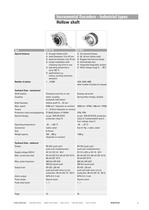
Type RI 76 TD RI 80-E Special features ■ through hollow shaft ■ Incremental Output ■ shaft diameters 15 to 42 mm ■ 30...45 mm hollow shaft ■ external diameter only 76 mm ■ Rugged mechanical design ■ simple installation with clamping ring front or rear ■ Unbreakable disc ■ Integrated diagnostic system ■ operating temperature up to 100 C Т֠ Wide voltage range 5 30 V Ţ֠ applications e.g. motors, printing machines, elevators Number of pulses 1 ... 10000 1024, 2048, 4096 other number of pulses on request Technical Data - mechanical Shaft fixation Clamping ring front or rear Keyway, set screw Coupling...
Open the catalog to page 11
Type PC 9 / PC 9S Special features ■ Provides digital control inputs from operatorss panel Ԣ֠ Bidirectional squarewave signal outputs ■ Up to 512 increments ■ Continuous and reversible rotation ■ Noncontacting ■ Operating temperature-40 ... 100 C Number of pulses 100 ... 512 Technical Data - mechanical Absolute max. shaft load 1/8" Shaft: 4 N axial, 27 N radial 1/4" Shaft: 4 N axial, 4 N radial Moment of inertia 0.20 gcm > 2 Operating temperature -40 ... +100 аC Storage temperature -50 ... +125 C Relative humidity 90 %, non-condensing Connection PC9: 10 pole header, (Accessory: 30 cm ribbon cable...
Open the catalog to page 12
Type RI 32 RI 38 RI 41 Special features > ■ economy encoder for small devices > ■ encoder for universal mounting due to front or rear fixing > ■ economy encoder > ■ high mechanical life > ■ long life due to ball bearings > ■ applications e.g. small motors, graphic machines, desktop robots, wood working machines > ■ low torque > ■ long life due to ball bearings > ■ application e.g. laboratory devices, fitness machines, crimping machines, tampon printing machines, small grinding machines > ■ low torque > ■ applications e.g. small motors, laboratory devices, labelling devices, plotters, length measuring...
Open the catalog to page 13All HENGSTLER catalogs and technical brochures
 TYPE 636-DC
2 Pages
 Types 864-868
2 Pages
 X-56™ Thermal Printer
2 Pages
 ACURO AD36
5 Pages
 ACURO AR63
8 Pages
 ACURO AR62
8 Pages
 ACURO AC36
6 Pages
 ACURO AC58
9 Pages
 Colibri 490
2 Pages
 Datasheet_AC58-CANopen_en
14 Pages
 Datasheet_AC58-Interbus_en
14 Pages
 Datasheet_AC58-Parallel_en
11 Pages
 Datasheet_AC58-SSI-_en
11 Pages
 Datasheet_AC58-EtherCAT_en
8 Pages
 Light Duty types RI 32-O
3 Pages
 Absolute Encoder AD 58
4 Pages
 Counter complete catalog
304 Pages


Archived catalogs
 relay RY en
5 Pages
 relay product range safety
6 Pages
 cutters catalog en
3 Pages
 relay product range
6 Pages
 printer catalog 2006
20 Pages
 Complete thermoprinter catalog
20 Pages
- HENGSTLER rotary encoder
- Proximity switch
- HENGSTLER incremental rotary encoder
- HENGSTLER absolute rotary encoder
- HENGSTLER solid-shaft rotary encoder
- HENGSTLER optical rotary encoder
- HENGSTLER industrial rotary encoder
- HENGSTLER hollow-shaft rotary encoder
- HENGSTLER electromechanical relay
- Magnetic rotary encoder
- HENGSTLER DC electromechanical relay
- IP65 rotary encoder
- HENGSTLER label printer
- HENGSTLER IP67 rotary encoder
- HENGSTLER compact rotary encoder
- HENGSTLER aluminum rotary encoder
- HENGSTLER thermal transfer label printer
- DC rotary encoder