

NKS 13

NKS 13
The document provides technical specifications and installation instructions for the Conductive Level Sensor Type NKS 13, manufactured by Hengesbach GmbH & Co. KG. This sensor is designed for detecting conductive threshold levels in liquids with a minimum conductivity of 5 µS, suitable for industries such as food and pharmaceuticals.
Description
The sensor is designed for easy cleaning and is suitable for CIP (Clean-In-Place) and SIP (Sterilize-In-Place) processes. It is constructed from non-corrosive materials, making it suitable for corrosive media and high-vibration environments. The sensor can be shortened for practical storage, and the electrode is coated with HALAR, allowing it to detect levels in foaming media.
Technical Data
- Cable connection: M16x1.5
- Electrical connection options: M12x1 connection plug
- Protection type: IP 67 according to EN 60529
- Process connection: G ¾ B with union nut and O-ring
- Electrode lengths: 200, 500, 800, 1500 mm (shortenable)
- Operating temperature: max. 140 ºC
- Environmental temperature: -10 to +60 ºC
- Operating pressure: max. 6 bar
- Sensor rod diameter: 11 mm
- Coating: ECTFE (HALAR), FDA approved
Installation Instructions
- The tank or pipe wall must be metal.
- Use the key surface for installation, not the connection head.
- Ensure good electrical contact with the pipe/tank wall; avoid insulating sealing materials.
Ordering Information
Various lengths and coatings are available, with options for terminal output or level modules NM and NC1 for adjustable sensitivity and foam detection.
Additional Notes
The document includes dimensional drawings and emphasizes that the products are subject to modifications due to ongoing development.
Catalog excerpts

- Type NKS 13 - • CONDUCTIVE THRESHOLD LEVEL DETECTION IN LIQUID MEDIA • INSTALLATION VERSION WITH O-RING SEAL FOR THE GEA-TUCHENHAGEN WELDING SOCKET SYSTEM • STAINLESS STEEL HOUSING IP69K • MAINTENANCE-FREE, ELECTRODES CAN BE SHORTENED • OPTION: WITH LEVEL MODULE NM OR NC1 The conductive level sensors are mainly used to detect conductive threshold levels in liquids such as fruit juices, beer, milk, etc. with a minimum conductivity of 5 pS. The design and the corresponding welding socket ensure that the sensor is easy to clean for use in the food and pharmaceutical industry, etc. CIP- and SIP-suitability are guaranteed. The non-corrosive materials used for the rod and the insulation, as well as the diameter of the rod, render the sensor suitable for use in corrosive media and high-vibration environments. The sensor can be shortened, which has a positive and practical effect on storage. The electrode is coated with HALAR, which means that the threshold level detection is also suitable for foaming media. The level modules for installation in the head can be directly connected to the SPS TECHNICAL DATA INSTALLATION INSTRUCTIONS - Please quote separately when ordering -- electrode holder 316L ZEM/NKS131 - level module NM, see separate data sheet_ - level module NC1, see separate data sheet_ - the wall of the tank or pipe must be made of metal - when installing the sensor, only use the key surface, not the connection head - the process connection thread of the sensor must have good electrical contact with the wall of the pipe/tank (do not use any insulating sealing materials!)
Open the catalog to page 1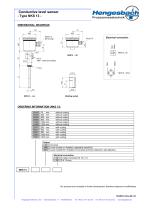
Conductive level sensor- Type NKS 13 -DIMENSIONAL DRAWINGS G3/4 Our products are constantly in further development, therefore subjects to modifications.
Open the catalog to page 2All Hengesbach GmbH & Co. KG catalogs and technical brochures
 TEMA
TEMA1 Page
 VolumMess
1 Page
 Detekt-O-Ring
1 Page
 TURBIMESS NG
1 Page
 TP52
TP524 Pages
 TP62
TP627 Pages
 TP13
TP134 Pages


- Display module
- Flowmeter
- Volume flow monitor
- Liquid flow monitor
- Pressure transmitter
- Analog pressure transmitter
- Waterproof flow meter
- Stainless steel flow monitor
- Liquid level sensor
- Pressure probe
- Waterproof pressure transmitter
- Membrane pressure transmitter
- Stainless steel pressure transmitter
- LED display panel
- Industrial thermometer
- Relative pressure transmitter
- Water flow monitor
- Analog level sensor
- °C thermometer