

- Company
- Products
- Catalogs
- News & Trends
- Exhibitions
DDG
1 /1Page
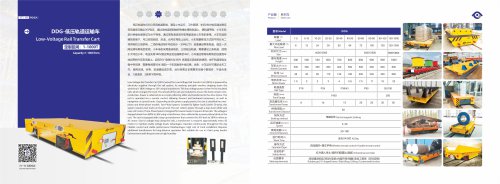
DDG
1 /1Page
Catalog excerpts
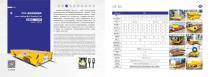
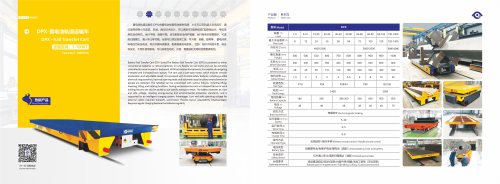
DDG-ffiJISJiiiiiiiS Low-Voltage RailTransfer Cart Sil, t&pie^tlLhJifT. /J'$^P¥JMCflWWfc:= iM£E&fQ=iM£ES, (50D$lilT) tim&Mft&ii. fflist-* tt§?&ftffiS£IlgS±. ^S!36V*$|^380V*;iS^;;WAMffiffl, EtffSflilH&a fl+ffllPf, eSSl'0]PI5O* ±§})D-^^ffi#§»KiJ±Pf. Vt%, ft, s&», siiiisiisjjws, , ^msm Low-Voltage Rail Transfer Cart (DDG Series)The Low-Voltage Rail Transfer Cart (DDG) is powered by electricity supplied through the rail system. Its working principle involves stepping down the workshop's 380V voltage to 36V using a transformer. This low-voltage power is then fed to insulated rails, which energize the track. The wheels of the cart are insulated to ensure the body remains non-conductive. Power is collected via a current-collecting slider and transferred to the drive motor. The cart is operated via a remote control, allowing forward and backward movement, as well as navigation on curved tracks. Depending on the power supply system, the cart is classified into two-phase and three-phase models: Two-Phase System: Suitable for lighter loads (under 50 tons), this system requires two tracks on the ground. The cart collects power through a step-down slider and uses a DC motor. Three-Phase System: Designed for heavier loads, it requires three rails. The voltage is stepped down from 380V to 36V using a transformer, then collected by a power pickup block on the cart. The cart is equipped with a step-up transformer that converts the 36V back to 380V to drive an AC motor. Due to voltage drop along the rails, a transformer is required approximately every 50 meters to maintain stable voltage levels. Advantages: Operates continuously throughout the day Flexible control and stable performance Disadvantages: High cost of track installation Requires additional transformers for long-distance operation Not suitable for use in: Paint spray booths Environments with frequent rain or high humidity Series Cars
Open the catalog to page 1All Henan Peisa Machinery Co., Ltd catalogs and technical brochures
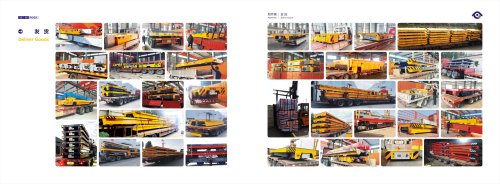 Delivery
1 Page
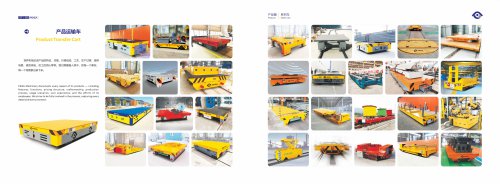 Product Transfer Cart
1 Page
 DWPZ
DWPZ1 Page
 Product Catalog
32 Pages
 AGV
AGV1 Page
 DWP
DWP1 Page
 DPX
DPX1 Page
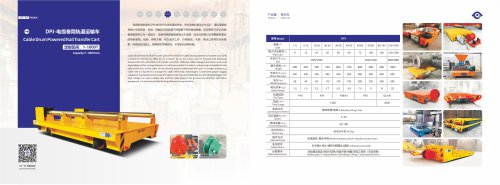 DPJ
DPJ1 Page
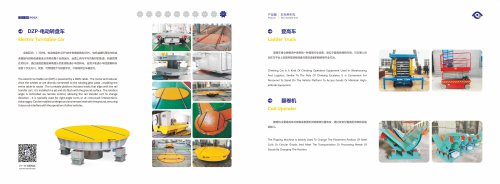 DZP
DZP1 Page
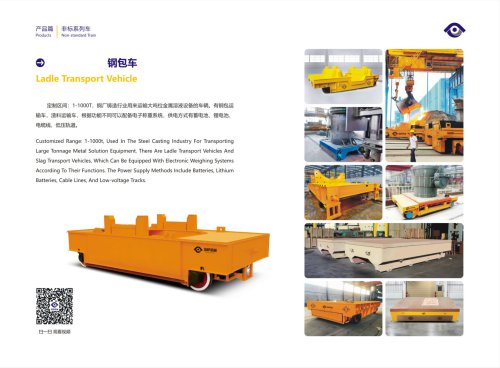 DPX ladle transfer cart
1 Page
- Metal cart
- Lifting table
- Transport trolley
- Scissor lift table
- Lifting system
- Stationary lift table
- Cart with swivel casters
- Turntable
- Handling cart
- Hydraulic lift table
- Electric rotary table
- Shelf trolley
- Wheel with solid tire
- Towed trailer
- Platform cart
- Steel cart
- Horizontal rotary table
- Industrial cart
- Multipurpose cart
- Wheel-mounted tugger cart