
- Catalogs
- Hemisphere GNSS
- Vega 40

Vega 40
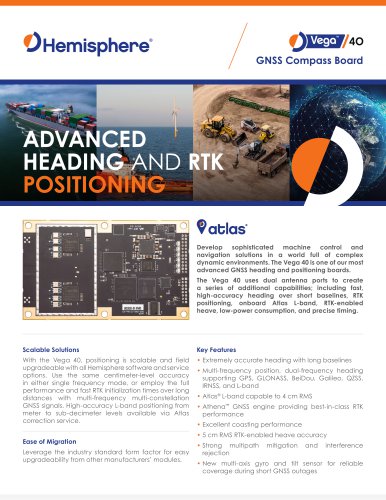
Vega 40
- Extremely accurate heading with long baselines.
- Supports multi-frequency position and dual-frequency heading with GPS, GLONASS, BeiDou, Galileo, QZSS, IRNSS, and L-band.
- Atlas® L-band capable to 4 cm RMS.
- Athena™ GNSS engine for superior RTK performance.
- Excellent coasting performance and 5 cm RMS RTK-enabled heave accuracy.
- Strong multipath mitigation and interference rejection.
- New multi-axis gyro and tilt sensor for reliable coverage during short GNSS outages.
The Vega 40 offers scalable and field upgradeable positioning with Hemisphere software and service options. It provides centimeter-level accuracy in single frequency mode and fast RTK initialization over long distances with multi-frequency multi-constellation GNSS signals. High-accuracy L-band positioning is available from meter to sub-decimeter levels via Atlas correction service.
The Vega 40 uses an industry-standard form factor for easy upgradeability from other manufacturers’ modules. It supports sophisticated machine control and navigation solutions in complex dynamic environments. The board features dual antenna ports for fast, high-accuracy heading over short baselines, RTK positioning, onboard Atlas L-band, RTK-enabled heave, low-power consumption, and precise timing.
- Ports: 3 x full-duplex, 1 x USB Host/Device, 1 x Ethernet 10/100Mbps, 2 x CAN (NMEA2000, ISO 11783), 1 x SPI.
- Interface Level: 3.3V CMOS.
- Baud Rates: 4800 - 115200.
- Correction I/O Protocol: Hemisphere GNSS proprietary ROX format, RTCM v2.3, RTCM v3.2, CMR5, CMR+5.
- Data I/O Protocol: NMEA 0183, Crescent binary.
- Input Voltage: 3.3 VDC +/- 5%.
- Power Consumption: < 2.5 W all signals + L-band.
- Current Consumption: 757 mA all signals + L-band.
- Antenna Voltage: 5 VDC maximum.
- Antenna Short Circuit Protection: Yes.
- Antenna Gain Input Range: 10 to 40 dB.
- Operating Temperature: -40°C to +85°C (-40°F to +185°F).
- Storage Temperature: -40°C to +85°C (-40°F to +185°F).
- Humidity: 95% non-condensing (when in an enclosure).
- Mechanical Shock: EP455 Section 5.14.1 Operational (when mounted in an enclosure with screw mounting holes utilized).
- Vibration: EP455 Section 5.15.1 Random.
- EMC: CE (IEC 60945 Emissions and Immunity), FCC Part 15, Subpart B, CISPR 22.
- Dimensions: 100 L x 60 W x 10 H (mm), 3.9 L x 2.4 W x 0.4 (in).
- Weight: 44 g (1.56 oz).
- Status Indications (LED): Power, Primary and Secondary GNSS lock, Differential lock, DGNSS position, Heading.
- Power/Data Connector: 24-pin male header 2 mm pitch, 16-pin male header 2 mm pitch.
- Antenna Connectors: MMCX, female, straight.
- Gyro: Provides smooth and fast heading reacquisition. During loss of GNSS signals, heading stability is degraded by < 1° per minute for up to 3 minutes.
- Tilt Sensors: Provide pitch, roll data and assist in fast start-up and reacquisition of heading solution.
- Receiver Type: Multi-Frequency GPS, GLONASS, BeiDou, Galileo, QZSS, IRNSS, and Atlas.
- Signals Received: GPS L1CA/L1P/L1C/L2P/L2C/L5, GLONASS G1/G2/G3, P1/P2, BeiDou B1i/B2i/B3i/B10C/B2A/B2B/ACEBOC, GALILEO E1BC/E5a/E5b/E6BC/ALTBOC, QZSS L1CA/L2C/L5/L1C/LEX, IRNSS L5, Atlas.
- Channels: 1,100+.
- GPS Sensitivity: -142 dBm.
- SBAS Tracking: 3-channel, parallel tracking.
- Update Rate: 10 Hz standard, 1 Hz or 20 Hz optional (with activation).
- Timing (1 PPS) Accuracy: 20 ns.
- Rate of Turn: 100°/s maximum.
- Cold Start: 60 s typical (no almanac or RTC).
- Warm Start: 30 s typical (almanac and RTC).
- Hot Start: 10 s typical (almanac, RTC and position).
- Heading Fix: 10 s typical (Hot Start).
- Impedance: 50 Ω.
- Maximum Speed: 1,850 kph (999 kts).
- Maximum Altitude: 18,288 m (60,000 ft).
- Positioning: RMS (67%) 2DRMS (95%) Autonomous, no SA: 1 1.2 m 2.5 m, SBAS: 1 0.3 m 0.6 m, Atlas H10: 1, 3 0.04 m 0.08 m, Atlas H30: 1, 3 0.15 m 0.3 m, Atlas Basic: 1, 3 0.50 m 1.0 m, RTK: 1 8 mm + 1 ppm 15 mm + 2 ppm.
- Heading (RMS): 0.16° rms @ 0.5 m antenna separation, 0.08° rms @ 1.0 m antenna separation, 0.04° rms @ 2.0 m antenna separation, 0.02° rms @ 5.0 m antenna separation.
- Pitch/Roll (RMS): 0.5°.
- Heave (RMS): 1 30 cm rms (DGNSS), 5 cm rms (RTK).
- Receiver Type: Single Channel.
- Channels: 1525 to 1560 MHz.
- Sensitivity: -130 dBm.
- Channel Spacing: 5.0 kHz.
- Satellite Selection: Manual and Automatic.
- Reacquisition Time: 15 seconds (typical).
Catalog excerpts
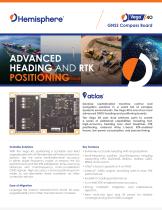
Qg^Mt 40 GNSS Compass Board $ atlas’ Develop sophisticated machine control and navigation solutions in a world full of complex dynamic environments. The Vega 40 is one of our most advanced GNSS heading and positioning boards. The Vega 40 uses dual antenna ports to create a series of additional capabilities; including fast, high-accuracy heading over short baselines, RTK positioning, onboard Atlas L-band, RTK-enabled heave, low-power consumption, and precise timing. With the Vega 40, positioning is scalable and field upgradeable with all Hemisphere software and service options. Use the same centimeter-level accuracy in either single frequency mode, or employ the full performance and fast RTK initialization times over long distances with multi-frequency multi-constellation GNSS signals. High-accuracy L-band positioning from meter to sub-decimeter levels available via Atlas correction service. Leverage the industry standard form factor for easy upgradeability from other manufacturers' modules. • Extremely accurate heading with long baselines • Multi-frequency position, dual-frequency heading supporting GPS, GLONASS, BeiDou, Galileo, QZSS, IRNSS, and L-band • Atlas® L-band capable to 4 cm RMS • Athena™ GNSS engine providing best-in-class RTK performance • Excellent coasting performance • 5 cm RMS RTK-enabled heave accuracy • Strong multipath mitigation and interference rejection • New multi-axis gyro and tilt sensor for reliable coverage during short GNSS outages
Open the catalog to page 1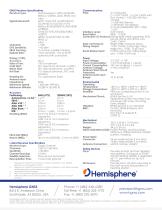
Receiver Type: Multi-Frequency GPS, GLONASS, BeiDou, Galileo, QZSS, IRNSS and Atlas QZSS L1CA/L2C/L5/L1 C/LEX IRNSS L5 Communications Ports: Interface Level: Baud Rates: GPS Sensitivity: SBAS Tracking: Update Rate: Cold Start: Warm Start: Heading Fix: Antenna Input Impedance: Maximum Speed: Maximum Altitude: 3-channel, parallel tracking 10 Hz standard, 1 Hz or 20 Hz optional (with activation) 100°/s maximum 60 s typical (no almanac or RTC) 30 s typical (almanac and RTC) 10 s typical (almanac, RTC and position) Data I/O Protocol: Timing Output: Event Marker Input: (1 x 3.3 V CMOS, 1 x 3.3 V CMOS...
Open the catalog to page 2All Hemisphere GNSS catalogs and technical brochures
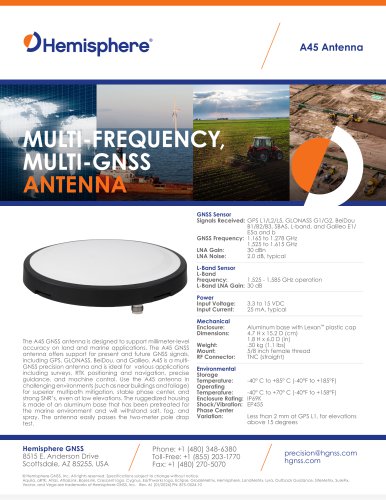 A45 Antenna
1 Page
 A43 Antenna
1 Page
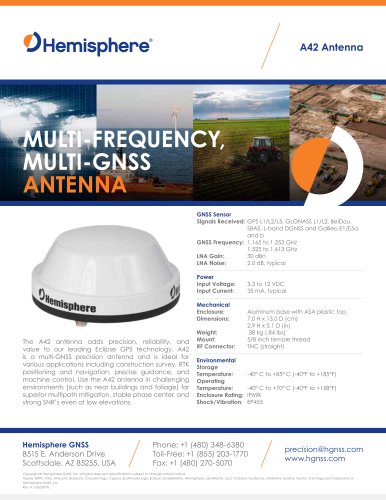 A42 Antenna
1 Page
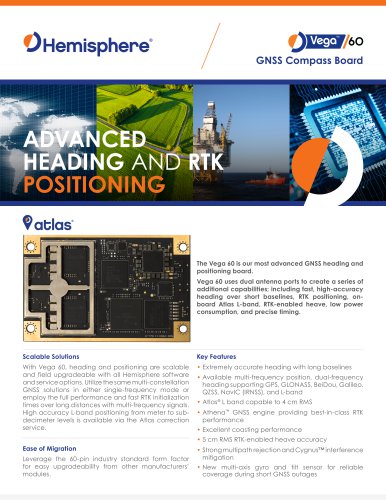 Vega 60
2 Pages
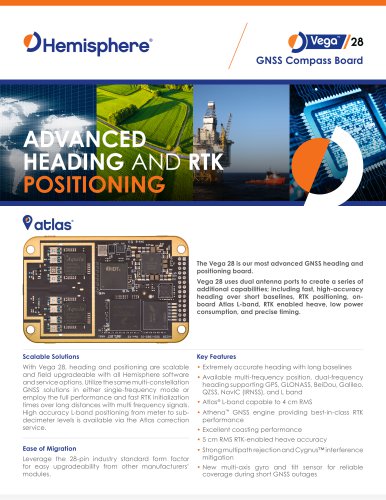 Vega 28
2 Pages
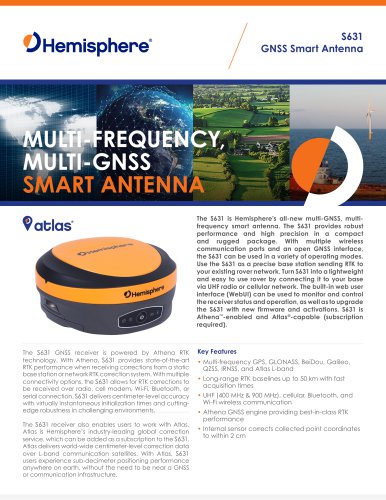 S631 GNSS Smart Antenna
2 Pages
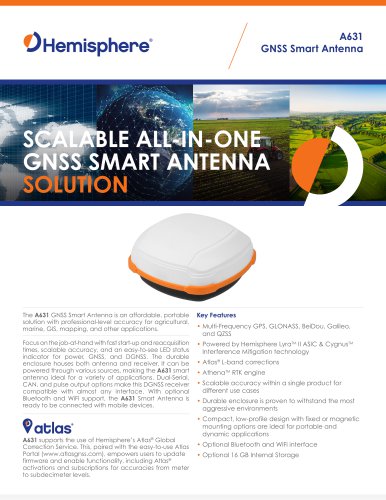 A631 GNSS Smart Antenna
2 Pages
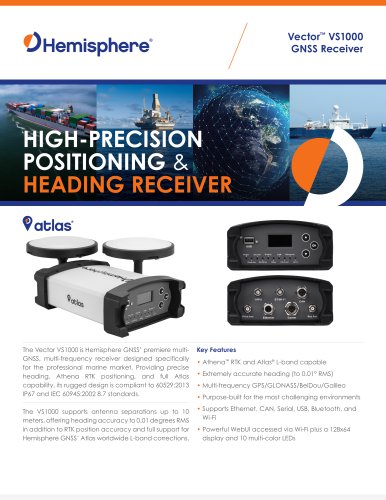 Vector™ VS1000 GNSS Receiver
2 Pages
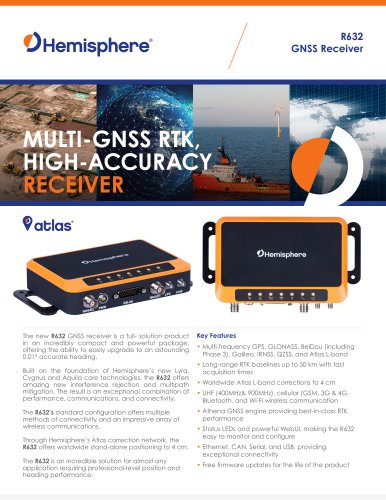 R632 GNSS Receiver
2 Pages
 GRADEMETRIX® EXCAVATOR
6 Pages
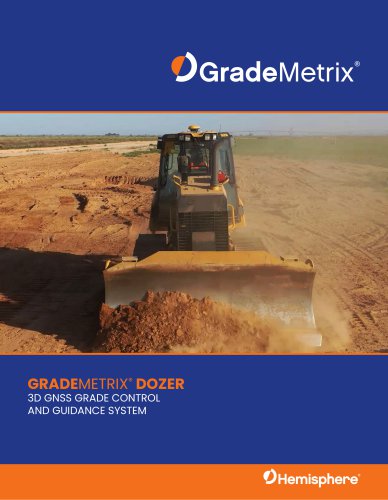 GRADEMETRIX® DOZER
6 Pages
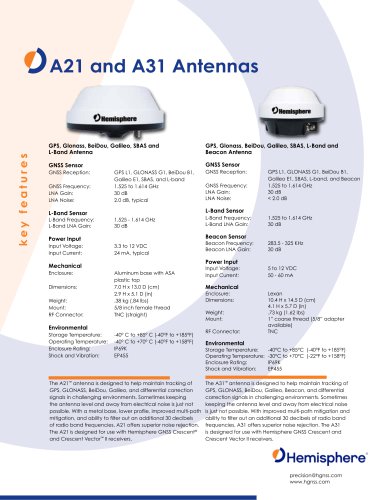 A21 and A31 Antennas
1 Page
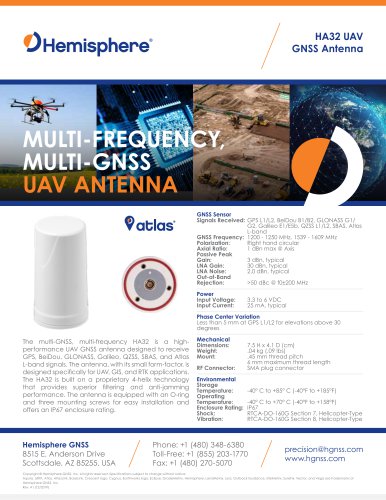 HA32 UAV GNSS Antenna
1 Page
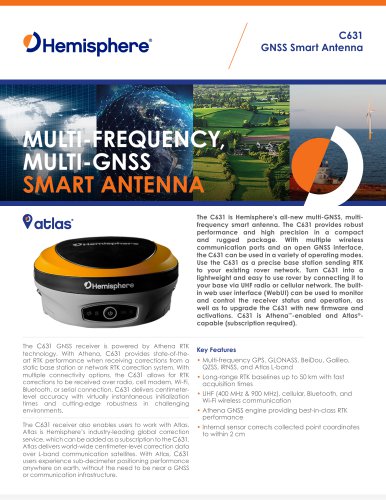 C631 GNSS Smart Antenna
2 Pages
 Vector™ VR1000 GNSS Receiver
2 Pages
 HT20 Rugged Tablet
2 Pages
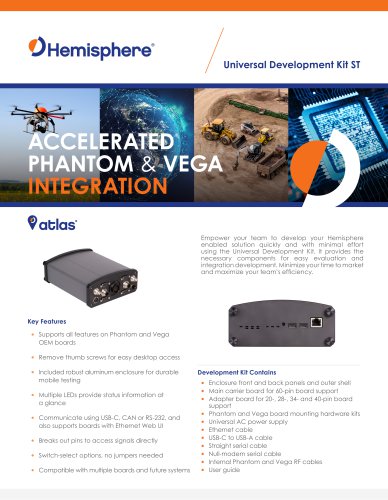 Universal Development Kit ST
2 Pages
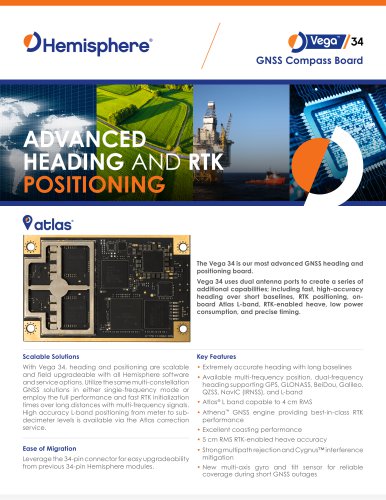 GNSS Compass Board
2 Pages
- Management software solution
- Process software
- Touch screen tablet
- Wireless tablet
- Rugged tablet
- Bluetooth tablet
- WiFi tablet
- Touch screen HMI
- Windows tablet
- Radio antenna
- USB tablet
- Waterproof tablet
- LCD operator terminal
- 8 GB tablet
- Omnidirectional antenna
- Intel® Core™ tablet
- GNSS antenna
- Sunlight-readable tablet
- IP67 antenna