
- Catalogs
- Helmholz GmbH & Co. KG
- CAN-Bridge


- Company
- Products
- Catalogs
- News & Trends
- Exhibitions
CAN-Bridge

1 / 2 PagesView full catalog
CAN-Bridge
Product catalog summary
Overview: The CAN-Bridge is a device designed to connect two CAN bus interfaces, allowing for the enlargement of network scope by connecting different CAN networks with varying transmission rates and protocols. It provides physical disconnection through electrical isolation and reduces bus load on both networks.
Key Features:
- Supports CAN 2.0A & 2.0B, CANopen®, DeviceNet, SAE J1939.
- DIN rail mounting for easy installation.
- Functions as a message repeater to expand network distances and connect different CAN networks.
- Automatic detection of transmission rates with easy configuration mode.
- Flexible filtering logic with up to 256 range filters and 4 bit filters for address filtering.
- Operates in both 11-bit and 29-bit modes with transmission rates from 10 kbps to 1 Mbps.
- Equipped with a powerful microcontroller to handle high data rates and bus loads without message loss.
- 5 LEDs for status indication of the device and connected networks.
Technical Specifications:
- Order number: 700-660-2AA01
- Dimensions: 31 x 74 x 75 mm
- Weight: Approx. 130 g
- CAN Interface: 2 interfaces, ISO/DIN 11898-2 CAN High-speed physical layer
- Connection: SUB-D, 9-pin connector
- Configuration Interface: USB 1.1 with Mini USB socket
- Voltage Supply: 24 V DC, 18–30 V DC
- Current Draw: Typical 35 mA, Maximal 60 mA
- Ambient Temperature: -25 °C to +60°C
- Transport and Storage Temperature: -25 °C to +75 °C
- Protection Rating: IP20
- Certifications: CE, RoHS, REACH compliant
Applications: The CAN-Bridge is suitable for applications requiring network topology flexibility, such as star, tree, and extensive line structures. It can be configured for simple applications using rotary coding switches or for complex applications using supplied parameterization software.
See more
Catalog excerpts

Helmholz COMPATIBLE WITH YOU Pf "IT— ® I Sis,zz:;r ^' ^ ^ CAN2 s sill .1^ ° » Anderungen und Irrtumer vorbehalten. 08-2021 Helmholz GmbH & Co. KG | Hannberger Weg 2 | 91091 Groftenseebach | Germany Phone +49 9135 7380-0 | Fax +49 9135 7380-110 | [email protected] | www.helmholz.de
Open the catalog to page 1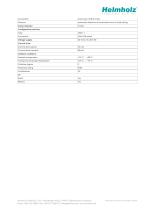
Helmholz COMPATIBLE WITH YOU Helmholz GmbH & Co. KG | Hannberger Weg 2 | 91091 Groftenseebach | Germany Phone +49 9135 7380-0 | Fax +49 9135 7380-110 | [email protected] | www.helmholz.de Anderungen und Irrtumer vorbehalten. 08-2021
Open the catalog to page 2All Helmholz GmbH & Co. KG catalogs and technical brochures
 REX 200, Ethernet Router
2 Pages
 FLEXtra® multiRepeater
6 Pages
 DP/CAN Coupler
31 Pages
 FLEXtra® multiRepeater
2 Pages
 DP/CAN Coupler
1 Page
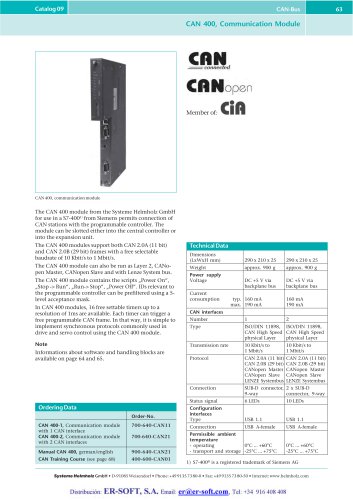
 CAN 300 PRO
2 Pages




Archived catalogs
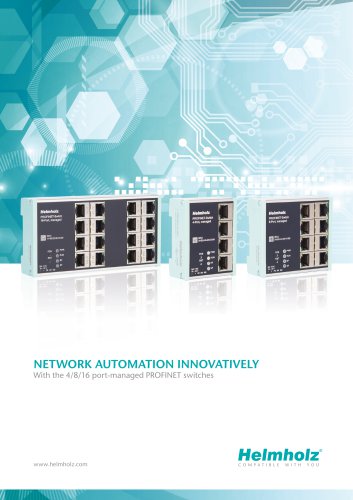
 PROFINET product overview
6 Pages
 PN/PN Coupler
2 Pages
 REX 100 Ethernet router
2 Pages
 FLEXtra® profiPoint
2 Pages
 700-840-16S01
2 Pages
 700-840-8ES01
2 Pages
 700-840-5ES01
2 Pages
 Power module DC 24 V
2 Pages
 PROFINET IO
2 Pages
 PROFIBUS-DP
2 Pages
 CANopen Slave
2 Pages
 DeviceNet Slave
2 Pages
 Modbus/TCP
2 Pages
 EtherNet/IP
2 Pages
 EtherCAT
2 Pages
 DI 2x DC 24 V
2 Pages
 DI 4x DC 24 V
2 Pages
 5-port, unmanaged
2 Pages
 8-port, unmanaged
2 Pages
 4-Port, managed
2 Pages
 8-Port, managed
2 Pages
 16-port, unmanaged
2 Pages


Related Searches
- Ethernet switch
- Industrial network switch
- Managed switch
- Gigabit Ethernet ethernet switch
- DIN rail mounted network switch
- RJ45 network switch
- Waterproof network switch
- Unmanaged switch
- Redundant network switch
- 8 ports network switch
- Standard network switch
- Compact network switch
- Interface module
- Weigh module
- Power module
- 16 ports network switch
- ProfiNet network switch
- Memory card
- Flash memory card
- IP67 network switch
*Prices are pre-tax. They exclude delivery charges and customs duties and do not include additional charges for installation or activation options. Prices are indicative only and may vary by country, with changes to the cost of raw materials and exchange rates.