

TGA

TGA
To minimize noise emissions, it is recommended to install noise sources such as fans away from inhabited areas or use attenuators. Selecting low-noise fans is crucial. Noise levels should be converted from sound power to sound pressure levels for human perception, considering room absorption capacity.
Sound levels should not exceed:
- Industrial: 70 dB(A) day/night
- Residential: 50 dB(A) day, 35 dB(A) night
- Hospitals: 45 dB(A) day, 35 dB(A) night
- Intellectual concentration: 55 dB(A)
- Office work: 70 dB(A)
- Other areas: 85 dB(A)
Examples illustrate how sound pressure levels decrease with distance and how multiple noise sources combine to affect total noise levels.
Key terms include sound, noise, sound power, and sound pressure. Fan noises are influenced by factors like blade shape and airflow, while motor and duct noises arise from mechanical and airflow dynamics.
Fan performance is determined by air flow volume, pressure, and power. Performance curves illustrate the relationship between these factors. System resistance curves are calculated based on duct system pressure losses.
Parallel (P-unit) and two-stage (Z-unit) fan operations are explained, highlighting how they affect airflow and pressure. Performance curves guide fan selection based on working points and system resistance.
Total resistance in ductwork is calculated by summing individual component resistances. Pressure drops in ducts and shaped sections are considered, with equivalent diameters and correction factors for roughness provided.
The document details specifications for AVD and B AVD smoke and heat exhaust fans, which are cylindrical ducts with flanges for direct in-line installation. The casing is made from galvanized sheet steel, and the impellers are high-performance with 5 or 7 blades made from reinforced polymer or aluminum/steel, depending on the series. The operating temperature range is from -30 to +60°C.
Series AVD and HRF feature totally enclosed motors with IP 54 protection, while Series B AVD uses IEC-three phase a.c. motors with IP 55 protection. Motors are maintenance-free and have tropicalized protection of windings.
Fans can be installed in any position, with specific considerations for condensation drainage and vibration isolation. Anti-vibration mounts are recommended to prevent transmission to buildings and ducting.
Sound power levels are provided for different pitch angles, with detailed spectrum figures available on product pages.
The fans are tested to DIN EN 12101-3 and have CE-approval for various temperature classes (F300, F400, F600) with DIBt technical approval.
When ordering, the desired pitch angle of the blades must be specified. Example order data includes type name, impeller diameter, number of poles, motor power, temperature class, and pitch angle.
Various installation configurations are described, including duct installation with anti-vibration mounts, wall installation, and installation with attenuators. Specific accessories like flanged flexible connectors and extension ducts are recommended for optimal performance.
Some models are speed controllable by transformer controller or frequency inverter. Reversed operation is possible with a reversing switch, though it results in a performance loss.
Accessories include anti-vibration mounts, flanged flexible connectors, extension ducts, and attenuators. Specific accessories are available for explosion-proof fans.
Detailed technical data is provided for various fan models, including motor power, air flow volume, current at full load, and maximum pitch angle. Dimensions and sound levels are also specified.
The document details various models of medium pressure axial fans, specifically the B AVD and B AMD series, designed for smoke and heat extraction. These fans are available in different configurations with motor powers ranging from 6.5 kW to 55 kW, and are suitable for air flow temperatures up to 400°C for 120 minutes.
Installation guidelines are provided for both horizontal and vertical setups, emphasizing the use of anti-vibration mounts to prevent transmission of vibrations to the building structure. The document also outlines the importance of using flanged flexible connectors and extension ducts to ensure proper installation and operation.
The fans comply with DIN EN 12101-3 standards for smoke and heat extraction, with CE certification for F300 and F400 temperature classes. Motor protection is ensured through PTC-resistors or motor protection switches, depending on the series.
For optimal performance, the document recommends selecting the appropriate pitch angle for the fan blades and using frequency inverters for speed control. It also advises on the selection of anti-vibration mounts based on the total weight of the fan and accessories.
The document includes performance curves and sound level data for different pitch angles, highlighting the efficiency and pressure rates achieved by the aerodynamically profiled blades. It also provides detailed specifications for various fan models, including motor power, air flow volume, and current at full load.
Key features of the fans include aerodynamically profiled blades made from high-strength aluminum alloy, a casing from sheet steel with surface protection, and universal installation possibilities. The fans are designed for diverse applications, including car park ventilation and smoke protection pressure systems.
The document describes medium pressure axial fans, specifically the AMD and B AMD series, with a diameter of 500 mm and 560 mm. These fans are equipped with surface-mounted, 3-phase motors operating at 400 V and 50 Hz, with protection rated at IP 55. The motors are maintenance-free and come in two series: AMD with insulation class F and B AMD with insulation class H, suitable for smoke extraction.
The fans feature impellers with hubs and blades made from corrosion-resistant aluminum alloy. They have ten aerodynamically profiled blades for high efficiency and pressure rates, dynamically balanced to DIN ISO 1940-1, class 6.3 for low-vibration operation. The pitch angle of the blades is adjustable at standstill and factory set.
Special executions include options with inspection openings and resistors connected to the terminal box for use with frequency inverters or full motor protection switches, available at additional cost.
Various mounting accessories are available, including mounting packages MP-Z for two-stage Z-units and MP-P for parallel P-units, designed to arrange fans in a row or side by side for increased pressure or airflow rates. Other accessories include bell mouths, guards, extension ducts, circular attenuators, and anti-vibration mounts.
The B AMD series fans are tested to DIN EN 12101-3 standards, with DIBt approvals applied. They hold a CE certificate of conformity for F300 and F400 classifications.
The document provides detailed performance data for various models, including motor power, air flow volume, current at full load, and maximum air flow temperature. The fans are suitable for continuous operation at temperatures from -20 °C to +40 °C, with higher temperatures available on request. The B AMD series is also suitable for smoke extraction at temperatures up to 300 °C for 120 minutes or 400 °C for 120 minutes.
The fans require a motor protection switch on site, and for B AMD types, this is to be bridged in case of smoke extraction. Electrical connections are made via a standard terminal box mounted on the outside of the casing.
- Motor Types: The fans are equipped with maintenance-free 3-phase a.c. motors, with protection to IP 55 and insulation class F for AMD series, and class H for B AMD series.
- Impeller Design: The impellers are made from corrosion-resistant aluminium alloy, featuring ten aerodynamically profiled blades for high efficiency and pressure rates.
- Motor Protrusion: Some motor casings project beyond the fan casing, and the protrusion dimension B must be observed according to the type table.
- Air Flow Temperatures: AMD series is suitable for continuous operation from -20°C to +40°C, with higher temperatures available on request. B AMD series can handle smoke extraction at 300°C/120 minutes or 400°C/120 minutes.
- Pitch Angle: The pitch angle of the blades is adjustable at standstill and is factory set. It is mandatory to specify the pitch angle when ordering.
- Motor Protection: Motors should be protected by a motor protection switch on-site. For B AMD types, this protection should be bridged during smoke extraction.
- Electrical Connection: Both series feature a standard terminal box mounted on the outside of the casing, with AMD using polymer and B AMD using aluminium diecasting.
- Mounting Packages: MP-Z for two-stage Z-unit and MP-P for parallel P-unit configurations are available, including necessary extension ducts and assembly kits.
- Anti-Vibration Mounts: Available for both suspension and compression to reduce operational vibrations.
1. The document describes the installation of VAR fans, which can be mounted directly in the ceiling above the void using flanged ends compliant with DIN 24155, Bl.3. Vertical installation involves in-line wall mounting with an attenuator on intake, ensuring easy removal for maintenance.
2. Anti-vibration mounts are crucial for reducing vibrations from rotating components. The selection is based on the total weight of the fan and accessories, with an example calculation provided for a B VAR 900/4 37 kW F300 unit.
1. The B VAR F600 series features a specially designed impeller made from hot-dip galvanized steel, dynamically balanced to DIN 1940- Pt.1, quality grade G 6.3.
2. A centrifugal cooling air fan is necessary for motor cooling, installed outside the fire zone.
1. Two-stage Z-units and parallel P-units are used to meet various technical building equipment requirements, offering high pressure rise and flow rate.
2. Mounting packages MP-Z and MP-P are available for arranging fans in series or parallel, respectively, with detailed scope of delivery for each package.
1. The casing is made from galvanized sheet steel with flanges, featuring fixed guide vanes and motor support.
2. The impeller is a mixed-flow curved design, dynamically balanced and made from aluminum die casting.
3. The motor is direct-driven by an IEC-three phase a.c. motor, with protection to IP 55 and insulation class H.
4. Installation is flexible, suitable for both within and outside the fire zone, with a temperature-resistant terminal box for electrical connections.
5. Sound levels are provided in performance curves, with additional acoustic information available.
The smoke and heat exhaust fans B VAR are tested to DIN EN 12101-3 and have CE-approval and DIBt technical approval.
The document provides a detailed technical description of high-pressure smoke exhaust fans, specifically the B VAR F600 series. These fans are designed for smoke and heat extraction and are tested to comply with DIN EN 12101-3 standards. They are CE-approved and have DIBt technical approval for various temperature categories, including F300, F400, and F600, which cater to different project requirements such as high fire loads and low ceiling heights.
The fans are manufactured with flanges on both sides according to DIN 24155, Pt. 3, and feature a welded construction that is hot dip-galvanized. The impeller is a specially developed mixed-flow curved design, dynamically balanced and made from hot dip-galvanized steel. The motor is a direct-driven IEC three-phase AC motor with protection to IP 55 and insulation class H. The fans can be installed in any position, suitable for both inside and outside the fire zone.
Effective motor protection is ensured by using a motor protection switch on-site, which must be bridged during smoke extraction. The electrical connection is facilitated by a terminal box (IP 55) for installations outside the fire zone. The installation must guarantee protection for the impeller according to EN ISO 13857.
To ensure motor cooling, a centrifugal cooling air fan (B KLG) is necessary, with a minimum cooling air flow requirement specified for different fan sizes. Various accessories are available, including mounting feet, anti-vibration mounts, and guards, which are detailed in the accessory pages.
Sound power levels are provided within performance curves, with additional acoustic information available for determining lower sound pressure levels. The document includes detailed tables with specifications such as motor power, air flow volume, and noise levels at different frequencies for various fan models.
The fans are certified for smoke and heat extraction, with CE-approval and DIBt technical approval for different temperature categories. The F600 series is highlighted for projects with particularly high requirements.
The document details specifications for high-pressure smoke exhaust fans, specifically the B VAR F600 series, with diameters of 800 mm, 900 mm, and 1000 mm. These fans are designed for smoke and heat extraction, tested to DIN EN 12101-3 standards, and have CE and DIBt technical approvals. They feature a casing with flanges, a dynamically balanced mixed-flow impeller, and a direct-driven IEC three-phase a.c. motor with IP 55 protection and insulation class H.
Installation can occur in any position, suitable for both inside and outside fire zones. Electrical connections are facilitated by a terminal box (IP 55). Motor protection requires a motor protection switch, which must be bridged during smoke extraction. Centrifugal cooling air fans are necessary for motor cooling, with a minimum air flow of 1000 m3/h.
The document references compliance with EN ISO 13857 for impeller guards and outlines the need for regular maintenance and inspections to ensure functional safety. It also discusses the importance of smoke protection pressure systems (RDA) and stairway scavenging air systems (TSA) for lifesaving protection of escape routes in buildings.
Tables provide detailed technical data for various fan models, including motor power, air flow volume, current at full load, and nominal weight. Noise levels at different RPMs and frequencies are also detailed, along with the necessary anti-vibration mounts for installation.
Accessory details, such as mounting accessories and centrifugal cooling air fans, are provided, along with references to technical descriptions and system design guidelines. The document emphasizes the importance of coordinating smoke protection systems with architects and fire protection planners during the planning phase.
- RDA System: The RDA system uses a supply air fan to create overpressure in stairwells and anterooms, preventing smoke infiltration. It includes components like a light dome, pressure sensors, and a control cabinet with a frequency inverter for differential pressure regulation.
- Air Flow Rate Estimation: The design air flow rate is calculated by summing the air leakage rate and the air flow rate required for door flow, with an additional 15% deviation for flow losses.
- TSA System: The TSA system dilutes smoke gases by supplying fresh air through a light dome, maintaining a constant air flow rate to reduce smoke concentration.
- Service Package: Includes a medium pressure axial fan, light dome, and control cabinet.
- Smoke Package: Contains smoke detectors, push button alarms, and siren/flashing lights for system activation.
- Ventilation Package: Allows for demand-driven ventilation with components like a key switch and temperature sensor.
- Redundancy Package: Ensures system reliability with two independently operating fans and controls.
- Modular design allows for customization to meet specific project requirements.
- Helios systems are designed for easy planning, installation, and operation.
- RDA systems maintain smoke-free escape routes by building up overpressure, while TSA systems focus on diluting smoke concentrations.
This document provides detailed information on the TSA stairway scavenging air system and Helios jet fans for car park ventilation. It outlines the specifications, components, and functionalities of these systems, focusing on smoke extraction and ventilation efficiency.
- TSA System: Includes a high-performance medium pressure axial fan with a minimum air flow volume of 10,000 m³/h, a light dome with a 24V spindle drive, a control cabinet with TSA control, and a safety pressure switch.
- Service Packages: Four packages are available, including standard and silent versions, with optional two-stage fan versions for economic ventilation.
- Ventilation and Smoke Packages: The LPT package allows demand-driven ventilation, while the RPT package includes smoke detectors, alarms, and sirens for system activation.
- Types: Axial (IVA/B IVA) and centrifugal (IVR/B IVR) jet fans are available, designed for high thrust performance and low sound emissions.
- Applications: Suitable for ventilation and smoke extraction in car parks, with temperature resistance up to 300°C or 400°C for 120 minutes.
- Installation: Easy installation with integrated mounting rails, requiring minimal fastening points.
- Ventilation Functionality: Jet fans create a continuous air movement, ensuring effective ventilation and smoke extraction.
- Fire Safety: Systems are designed to maintain functionality during fires, with automatic smoke detection and extraction capabilities.
- Certification: Fans are certified according to DIN EN 12101-3 and approved by DIBt.
- Ensure compliance with national and regional fire protection regulations.
- Utilize anti-vibration mounts to prevent vibration transmission.
- Consider structural conditions when positioning fans for optimal performance.
- Dimensions: Optimized for minimal space usage.
- Material: Constructed from corrosion-resistant aluminium.
- Motor: IEC 3-phase standard motor with IP 55 protection.
- Noise Insulation: Equipped with polygon silencers and acoustically lined with non-flammable mineral wool.
- Low noise emission.
- Maximum thrust capability.
- Lightweight and easy installation.
- Direct driven, axial design.
- Optionally fully reversible models available.
The document details specifications for various models of smoke exhaust fans, including BDVD and BKD series. These fans operate at 400 V, 3-phase, 50 Hz, and are designed for high-temperature environments, with some models capable of operating at 400°C for 120 minutes. Dimensions and performance data, such as airflow volume and sound pressure levels, are provided for each model.
Installation guidelines specify that fans should be mounted on horizontal surfaces and positioned using a central lifting eye. Electrical connections are made via a standard terminal box, and speed control is achieved through voltage reduction or frequency inverters. For smoke exhaust applications, certain control devices must be bridged to ensure maximum fan speed during a fire.
The fans comply with DIN EN 12101-3: 2002-06 for smoke and heat exhaust systems and have CE approval for F400 - 400°C / 120 minutes. They also meet various IEC and VDE standards for electrical equipment.
For optimal performance, fans should be installed outside temperature-critical zones, with the motor positioned horizontally. Regular maintenance is facilitated by a swing-out motor impeller unit. Accessories such as back draught shutters and flexible connectors are available for enhanced functionality.
Fans are equipped with thermal protection, robust casings, and additional cooling mechanisms. They are designed for easy integration into ventilation systems and offer high reliability with minimal maintenance requirements. The document emphasizes the importance of ensuring fire-protected electrical supply and automatic bridging of control devices in case of fire.
The document outlines the specifications for centrifugal smoke exhaust fans, particularly the F400 model. These fans are designed for smoke and heat extraction in fire protection scenarios, with operating temperatures up to 400°C for 120 minutes or continuous operation up to 100°C. The fans are robustly designed for harsh conditions, featuring speed control by voltage reduction and standard motor protection against thermal overload.
Installation of the fans can be done in steps of 90° in any position, but they must be installed outside temperature-critical or fire risk zones. When used as smoke and heat exhaust fans, they must be insulated according to DIN 4102-4 to prevent environmental impairment due to casing temperature.
The fans comply with DIN EN 12101-3: 2002-06 and have CE approval for F400 - 400°C / 120 minutes. They also have DIBt technical approval (Z-78.11-151). Protection against accidental contact with the impeller is ensured according to DIN EN ISO 13857.
The sound level is provided as sound pressure level in dB(A) at 4 meters under freefield conditions. Installation conditions or disturbed inflow may increase noise levels.
The fans are made of galvanized sheet steel with a compact rectangular design for easy installation. They include a direct-driven, backward-curved centrifugal impeller and a special motor for high ambient temperatures, protected to IP 55. The motor is maintenance-free with sealed-for-life ball bearings and tropical protection of windings.
In case of fire, the electrical supply must be fire-protected, and motor protection devices must be automatically bridged to ensure maximum fan speed operation. The fans are supplied ready for installation with minimal maintenance required.
- Motor protection devices must be automatically bridged in case of fire to ensure maximum fan speed operation.
- Helios offers a range of accessories for in-line fans, including bell mouth inlets, electric backdraught shutters, and anti-vibration mounts.
- Technical data for centrifugal cooling air fans (B KLG 500 and B KLG 1000) includes protection to IP44, voltage of 230V, frequency of 50Hz, and specific power and airflow rates.
- Helios provides matched accessories to simplify installation and reduce on-site time and costs.
- Mounting accessories include grilles, shutters, attenuators, gas warning systems, and speed controllers.
- Selection tables provide cooling air flow rates and dimensions for various fan types and sizes.
- Mounting accessories for series B AVD F600 and B VAR F600 include centrifugal cooling air fans with external thermal contacts.
- Flexible connectors, mounting feet, and flat roof bases are available for different fan models and installation scenarios.
- Anti-vibration mounts are specified for both suspension and compression to reduce noise and vibration transmission.
- Detailed tables provide dimensions, weights, and technical specifications for various components such as flanged flexible connectors, counter flanges, and attenuators.
- Specifications for flanged circular attenuators include casing materials, insertion loss, and pressure drop considerations.
Operation Modes:
The system allows for various fan operation modes controlled via a rotary switch and an analog timer. Modes include individual fan operation, sequential operation, and alternating operation to ensure even runtime. An 'Auto' mode uses the timer for control, while 'Hand' mode allows manual control. The system can be turned off, and failures can be reset.
LED indicators show the status of fans and dampers. Green LEDs indicate operational status, while red LEDs signal errors or fire damper activation.
The Helios car park ventilation control system is designed to reduce toxic gases like CO and NO2. It operates two fans according to car park regulations, ensuring air quality by diluting and discharging harmful substances. The system monitors for faults and switches to a backup fan if necessary.
The B LS model includes smoke exhaust capabilities, automatically triggered by smoke detectors or manually by users or fire services. In smoke extraction mode, motor protection devices are bypassed to ensure operation until fan destruction.
The system supports various power ranges and configurations, including direct and star-delta starting. It is housed in polymer or metal casings depending on power requirements. The system is TÜV approved and CE certified.
Optional accessories include smoke detectors, push button alarms, and fireman’s switches. The system can connect to CO-warning systems, fire alarms, and other inputs, with outputs for fault signals and sirens.
The EVS system is designed for smoke extraction, improving air quality during normal operation. It supports various fan configurations and includes motor protection features. The system is customizable for specific project needs and is TÜV approved and CE certified.
The FU-BS model includes a basic version with an integrated sine filter for speed control of multiple fans.
This document provides detailed specifications and operational guidelines for various frequency inverters (FU) designed for controlling fan speeds in HVAC systems. The inverters are categorized into different models: FU-B, FU-BS, FU-CS, and FU-C, each with specific features and applications.
- FU-B Basic: A basic frequency inverter without a sine filter, suitable for single fan speed control. Requires EMC-compatible fans/motors and shielded cables up to 10 meters.
- FU-BS: Similar to FU-B but allows cable lengths over 10 meters without additional EMC shielding.
- FU-CS Comfort-Sinus: Includes an integrated sine filter for controlling multiple fans, with programming options via Modbus and integrated control systems for temperature, pressure, and air velocity.
- FU-C Comfort: A comfort version without a sine filter, featuring a display for parameter adjustments and Modbus programming capabilities.
- Designed for energy-efficient operation with minimal noise production.
- Compatible with three-phase asynchronous motors of various sizes.
- Includes motor protection features and is suitable for installation in control cabinets.
- Complies with EMC Directive 2004/108/EC and relevant standards.
- Mains voltage: 3~, 208-480 V; Frequency: 50/60 Hz.
- Protection: IP 54; Ambient temperature: 0 to +40 °C.
- Analog and logic inputs/outputs for various control and monitoring functions.
- Various sensors and controllers are available for enhanced functionality, including temperature, pressure, and air velocity sensors.
- Additional components like speed potentiometers and autotimers are also offered.
- Ensure the maximum motor current is considered when selecting a frequency inverter.
- Maintain a reserve of 10% to avoid faults and breakdowns.
- Observe derating at ambient temperatures above 40 °C.
The document provides comprehensive information on the selection, installation, and operation of frequency inverters for fan speed control in HVAC systems, emphasizing energy efficiency, compatibility, and compliance with standards.
1. Integrated protection for electronics against overload and motor full protection through monitoring thermal contacts of motors.
2. Casing made of light grey polymer with wide cooling element, suitable for dirty areas with protection to IP 65.
3. Transformer speed controllers available for both 1 phase (230 V) and 3 phase (400 V) alternating current fans.
1. MWS: Five-step speed controller with integrated tripping unit for 230 V, 1 ph. fans. Includes step switch and control lamp. Restarting via “0” position after interference or power cut off.
2. RDS: Five-step speed controller with integrated thermal contact tripping unit for 400 V, 3 ph. fans. Designed to comply with VDE 0550.
3. TSW and TSD: Speed control transformers for 1 ph. and 3 ph. fans respectively.
1. Pole switch PGWU/PDU for pole changing fans, available for separate and Dahlander windings.
2. Speed reversing switches DS 2 for two-speed three-phase Y/D fans and alternating current fans.
3. Isolator switches RHS for single speed and speed-controlled fans.
1. Thermal overload protection is required for electric motors, achieved through thermal contacts or PTC thermistor-temperature sensors.
2. Motor full protection switches available for various fan types, ensuring disconnection upon thermal contact opening.
1. Compliance with harmonized European standards and national installation directives for thermal overload protection.
2. Warranty claims valid only when thermal contacts or PTC thermistors are connected to motor full protection units.
Helios Ventilatoren offers integrated solutions for ventilation, heating, cooling, and drying sectors. Known for innovative projects and special solutions developed in dialogue with customers. The company also provides safety-related applications like smoke and heat exhaust fans.
All information is subject to change without prior notice. The document is copyrighted by Helios Ventilatoren.
Catalog excerpts

Fans for technical building services (TGA) and smoke extraction. Helios Ventilatoren Helios Ventilation Systems Ltd. • 5 Crown Gate • Wyncolls Road • Severalls Industrial Park • Colchester, Essex CO4 9HZ phone: +44 - (0) 1206 228 500 • telefax: +44 - (0) 1206 228 501 • e-mail: [email protected] • www.heliosfans.co.uk Copyright ©: Helios Ventilatoren, 78056 Villingen-Schwenningen, Germany. Certified according to ISO 9001/2008. We reserve the rights for alterations without prior notice. Document no. 86 979.840/ 09.13
Open the catalog to page 1
Helios code index 2 Dimensioning of ventilation systems 3 General information to heat and smoke removal systems (RWA) 9 Medium pressure axial fan 44 incl. mounting packages for two-stage Z- and parallel P-units RADAX®-High pressure in-line mixed-flow fan 72 incl. mounting packages for two-stage Z- and parallel P-units Smoke protection pressure- and stairway scavenging air systems 108 - Smoke protection pressure systems RDA 112 - Stairway scavenging air systems TSA 114 Smoke and heat exhaust fans as roof-mounted, in-line rectangular or centrifugal fans 130 - BDV, Roof-mounted smoke exhaust fans...
Open the catalog to page 3
Helios code index AMD Medium pressure axial fans Gas warning systems – analog – digital Medium pressure smoke exhaust axial fans, F300, F400 Temperature sensor for outside (for EUR 6 C) Full motor protection switch 147 Mounting feet Transformer controller with motor protection unit, 1 ph. Parallel operation of two identical fans Pole switches for Dahlander windings PGWA / PGWU Pole switches for pole changing fan Reverse and pole switches Retangular counter flange Frequency inverter Mounting package, 2-stage unit 8, 44 on, 72 on Full motor protection switch 165 Counter flange Mounting package,...
Open the catalog to page 4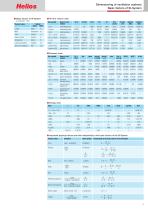
Dimensioning of ventilation systems Basic factors of SI-System I Basic factors of SI-System to DIN EN 1301 Physical value Einheit Name Short I Air flow volume units Unit symbol Name of unit symbol Electric current Luminous intensity I Pressure units Unit symbol Name of unit symbol millimetre water column techn. atmosphere physic. atmosphere millimetre mercury column pound-force per square inch pound-force per square foot inch mercury column inch water colume I Energy units Units I Important physical values and their relationship to the basic factors of the SI-System Physical value Short symbol...
Open the catalog to page 5
Dimensioning of ventilation systems Calculation of required air flow volume The required extract air or intake air volume of a room depends on the use and the contamination or odours that are created within it. A critical factor may also be the amount of heat that needs to be extracted. I Calculation of intake air flow volume per person (DIN EN 13779, as of 09.2007) I Calculation of air flow volume using the number of people (DIN EN 15251, as of 08.2007) The calculation of the air flow volume may be done using various criteria with the following equations and tables. In some cases, several ways...
Open the catalog to page 6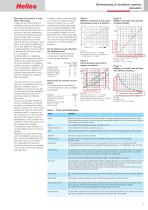
Dimensioning of ventilation systems Acoustics The noise level of a fan must be taken into consideration when designing a ventilation system. The affect of a sound source (fan) on the rooms that need ventilation and the neighbourhood can be estimated using the following information: The noise is primarily created by the fan, possibly also by ducting, and other components like filters, heaters, shutters etc. If the air flow speed is too high this will result in whistling noises. A maximum air flow speed of 6 m/s is recommended and at the same time noise transmission by fan or other components must...
Open the catalog to page 7
Dimensioning of ventilation systems Fan laws and performances curves Fan performance units . Air flow volume V [m3/h, m3/s] Total pressure Dptotal = Dpstat. + pdyn. [Pa] Static pressure Dpstat. = Dptotal - pdyn. [Pa] Dynamic pressurepdyn. = r/2·c2 [Pa] Shaft power Pw [W, kW] Nominal motor power P [W, kW] Sound power/pressure level LwA, LpA, [dB(A)] Calculation of the required shaft power of a fan . V · Dptot Pw1 = [kW] 1000 · h Dptot = Total pressure increase [Pa] h = Efficiency of the fan . V = Air flow volume in [m3/s] When using a pole-switching motor Stalling area Pole figure Performance...
Open the catalog to page 8
Dimensioning of ventilation systems Two-stage fan connections Two-stage operation with Z-unit I General Two-stage means, that two identical high-pressure fans which are arranged one behind the other operate in-line in a joint duct system. In this case the static pressure of both fans add up at constant air flow rate. · V = const. Dpfa = pfa1+ pfa2 I Operating modes (Fig. 11) For simultaneous operation of both fans the performances corresponds to curve Dpfa1 + Dpfa2. For individual operation of one fan the performance curve is reduced to curve Dpfa1 or curve Dpfa2. Via partial load control, use...
Open the catalog to page 9
Dimensioning of ventilation systems Pressure losses Ventilation systems consist of va- rious different components like: fan, bends, grilles, heat exchan- All these components have a resi- stance which needs to be conside- pressure loss Apstat (static pressu- re) of the total system is calculated by adding all individual resistances Figure 5 Pressure losses in a ventilation system - Shaped sections (bends, T-pieces) © - Other components (filters, heaters, grilles) © -ilter unit ^ain repellent- Pressure drop in circular or rectangular ducting AP/L1;2...: from table in figure 6 [Pa/m Correction...
Open the catalog to page 10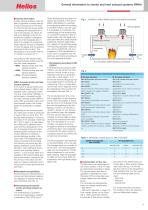
General information to smoke and heat exhaust systems (RWA) I General information Smoke exhaust systems have the task to garantee a smoke-free layer above the ground in the event of a fire.This should ensure visibility, enabling the evacuation of humans and animals, as well as an active fire-fighting by the fire department.In addition, emergency signs must be recogized also in panic.The creation of smoke-free areas reduces the risk of inhalation of toxic fire gases and the associated threat to life and limb. The temperature in the smoke-free layer should not exceed 70 °C. According to DIN 18232...
Open the catalog to page 11All Helios Ventilation catalogs and technical brochures
 GigaBox centrifugal fans
2 Pages
 Triple M1 MiniVent Family
16 Pages
 KWL Generation
65 Pages
 General catalog
414 Pages
Archived catalogs
 HECO Ventilation System
4 Pages
 ultraSilence Family
14 Pages
 Supply Air Handling Units
4 Pages
 SlimVent
4 Pages
 RenoPipe
8 Pages
 EC greenVent
84 Pages
 MegaBox centrifugal fan
12 Pages
 Roof fans
22 Pages
 The circular duct solutions
22 Pages
 Helios air treatment
10 Pages
 Axial Fans
30 Pages


