


KL6/260
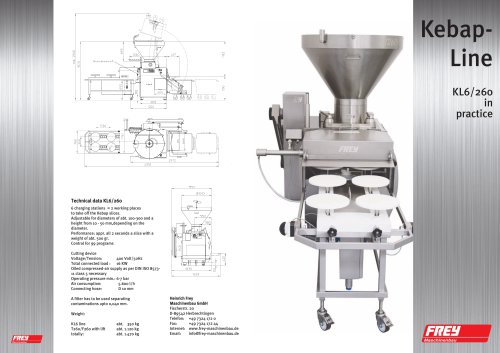
KL6/260
- The KL6/260 features 6 charging stations, equating to 2 working places for kebab slice removal.
- Adjustable for diameters approximately 100-300 mm and heights from 10-50 mm, depending on diameter.
- Performance: Approximately one slice every 2 seconds, each weighing about 500 grams.
- Control system supports 99 programs.
- Cutting device included.
- Voltage: 400 Volt/50Hz, Total connected load: 16 KW.
- Requires oiled compressed-air supply as per DIN ISO 8573-11 class 5, with a minimum operating pressure of 6-7 bar and air consumption of 5,600 l/h.
- Connecting hose diameter: 10 mm, with a filter for contaminants up to 0.040 mm.
- Weight: KL6 line approximately 350 kg, T260/F260 with lift approximately 1,120 kg, total approximately 1,470 kg.
- Increases production capacity while reducing staff requirements.
- Minimizes product heating due to quick processing.
- Ensures better slice and stick cohesion through vacuum technology.
- Improves product durability by evacuating air.
- Allows quick and simple changes in form and size of sticks through programming.
- Enables precise minced meat portioning via weight input control.
- Maintains high hygienic standards and provides ergonomic working conditions.
- Facilitates easy slice removal with a cut-off device and integrated lifting mechanism.
- For optimal performance, use F-LINE F260 and KONTI T260 as leading pumps, available with TC733 Touch Screen or LCD3 control.
- Ensure meat is processed at cold temperatures for hygiene and health safety.
- Program the machine to determine kebab stick form and size, allowing selection of 1-4 slices per process based on workforce.
- Manually set the thickness of Döner slices.
- Optimize production by assigning specific tasks to workers, such as slice removal and meat preparation.
- Heinrich Frey Maschinenbau GmbH, Fischerstr. 20, D-89542 Herbrechtingen
- Phone: +49 7324 172 0, Fax: +49 7324 172 44
- Website: www.frey-maschinenbau.de, Email: [email protected]
Catalog excerpts
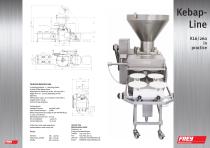
Technical data KL6/260 6 charging stations = 2 working places to take off the Kebap slices. Adjustable for diameters of abt. 100-300 and a height from 10 - 50 mm,depending on the diameter. Performance: appr. all 2 seconds a slice with a weight of abt. 500 gr. Control for 99 programs Cutting device Voltage/Tension: 400 Volt/50Hz Total connected load : 16 KW Oiled compressed-air supply as per DIN ISO 857311 class 5 necessary Operating pressure min.: 6-7 bar Air consumption: 5.600 l/h Connecting hose: D 10 mm A filter has to be used separating contaminations upto 0,040 mm. Weight: KL6 line T260/F260 with lift totally: Heinrich Frey Maschinenbau GmbH Fischerstr. 20 D-89542 Herbrechtingen Telefon: +49 7324 172 0 Fax: +49 7324 172 44 Internet: www.frey-maschinenbau.de Email: [email protected]
Open the catalog to page 1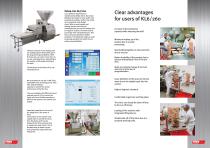
Kebap-Line KL6/260 is an optimum attachment for manufacturing Kebap slices. By simply filling up the hopper of your stuffer and pressing the program button, the machine is producing ready Kebap slices. With an exact weight and without further work they can immediately be put onto the Kebap stick. For hygienic reasons the meat must be processed with cold temperatures. This fact is obviously leading to health problems. The Kebap line makes a faster producing possible, the health of your staff can be protected. Clear advantages for users of KL6/260 Increase of the production capacity while reducing...
Open the catalog to page 2All Heinrich Frey Maschinenbau GmbH catalogs and technical brochures
 Firmenbrochure
11 Pages
 F100-F200
12 Pages
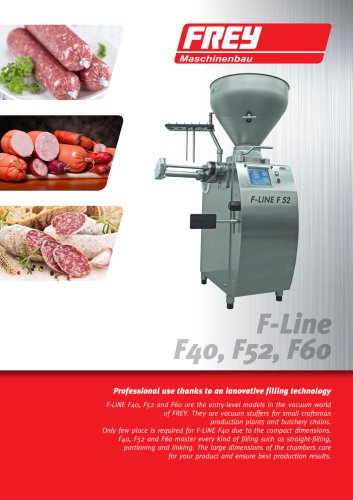 F40-F60
8 Pages
 F100/F160/F190/F200
12 Pages
 F50/F52/F60
8 Pages
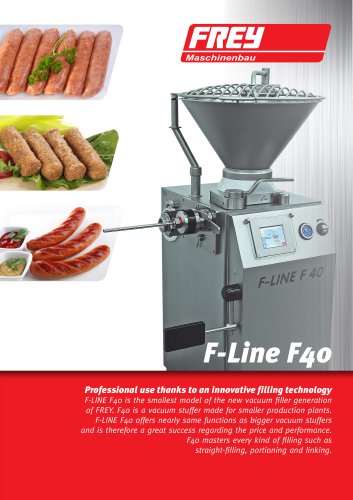 F40
F404 Pages
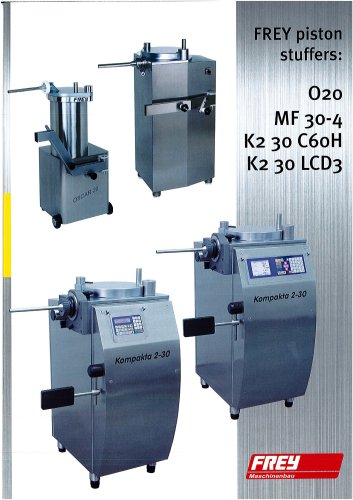 O20 / MF 30-4 / K2-30
12 Pages
- Making machine
- Volumetric dosing unit
- Liquids dispensing system
- Industrial slicing machine
- Automatic slicing machine
- Complete packaging line
- Meat slicing machine
- Dispensing system for the food industry
- Charging machine
- Meat forming machine
- Food production line
- Pneumatic dispensing system
- Automatic meat forming machine
- Piston dosing unit
- Vacuum filler
- Sausage vacuum filler
- Packaging line for the food industry
- Portioning machine
- Pasty product dispensing system