

HRR I
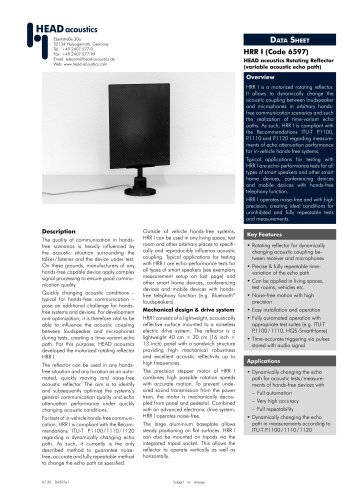
HRR I
The document describes the HRR I, a motorized rotating reflector developed by HEAD acoustics, designed to enhance communication quality in hands-free scenarios by dynamically altering the acoustic coupling between loudspeakers and microphones. This is crucial for testing and optimizing devices under rapidly changing acoustic conditions.
Specifications
The HRR I features a lightweight, acoustically reflective panel driven by a noiseless electric motor. It offers precise and repeatable echo path variations, compliant with ITU-T Recommendations P.1100, P.1110, and P.1120 for in-vehicle hands-free systems. The reflector can be used in various environments, including vehicles, living spaces, and test rooms.
Mechanical Design & Drive System
The reflector panel measures 40 cm x 30 cm and is mounted on a precision stepper motor that ensures high rotation speeds and accuracy. The motor is decoupled from the panel to prevent noise transmission. The device can be positioned on flat surfaces or mounted on tripods.
Applications
HRR I is used for echo-performance tests on smart speakers, smart home devices, conferencing devices, and mobile devices with hands-free telephony functions. It allows for full automation, high accuracy, and repeatability in tests.
Key Features
- Rotating reflector for dynamic acoustic coupling changes
- Noise-free operation with high precision
- Easy installation and operation
- Fully automated with appropriate test suites
- Time-accurate triggering via stored pulses
Technical Data
- Input: Pulse input, BNC
- Rotation angle: 360°
- Standard revolutions per minute: 15 rpm
- Motor torque: Max. 8 Ncm
- Angular resolution: 0.01°
- Operating temperature: 0° C – 45° C
- Power consumption: Typ. 2.5 W via USB 3.0
General Requirements
Software: ACQUA (version 3.4 or later) and ACOPT 01 for customized operation. Hardware: labCORE platform.
Delivery Items
- HRR I Rotating Reflector
- Adapter USB + BNC to D-SUB 9-pin RS 485
- Cable D-SUB 9-pin, 10 m
- Manual
Exemplary Measurement Setup
The document includes a setup example where HRR I is used in a test room with a smart speaker to evaluate echo attenuation performance under varying echo paths.
Catalog excerpts
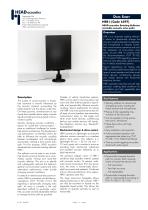
Data Sheet HEAD acoustics Rotating Reflector (variable acoustic echo path) 52134 Herzogenrath, Germany Tel.: +49 2407 577-0 Fax: +49 2407 577-99 Email: [email protected] Web: www.head-acoustics.com Description The quality of communication in handsfree scenarios is heavily influenced by the acoustic situation surrounding the talker / l istener and the device under test. On these grounds, manufacturers of any hands-free capable device apply complex signal processing to ensure good communication quality. Quickly changing acoustic conditions -typical for hands-free communication -pose an additional challenge for handsfree systems and devices. For development and optimization, it is therefore vital to be able to influence the acoustic coupling between loudspeaker and microphones during tests, creating a time-variant echo path. For this purpose, HEAD acoustics developed the motorized rotating reflector HRR I. The reflector can be used in any handsfree situation and any location as an automated, quickly moving and noise-free acoustic reflector. The aim is to identify and subsequently optimize the systems's general communication quality and echo attenuation performance under quickly changing acoustic conditions. For tests of in-vehicle hands-free communication, HRR I is compliant with the Recommendations ITU-T P.1100 / 1110 / 1120 regarding a dynamically changing echo path. As such, it currently is the only described method to guarantee noise-free, accurate and fully repeatable method to change the echo path as specified. Outside of vehicle hands-free systems, HRR I can be used in any living space, test room and other arbitrary places to specifically and reproducibly influence acoustic coupling. Typical applications for testing with HRR I are echo-performance tests for all types of smart speakers (see exemplary measurement setup on last page) and other smart home devices, conferencing devices and mobile devices with handsfree telephony function (e.g. Bluetooth® loudspeakers). HRR I consists of a lightweight, acoustically reflective surface mounted to a noiseless electric drive system. The reflector is a lightweight 40 cm X 30 cm (16 inch X 13 inch) panel with a sandwich structure providing high mechanical robustness and excellent acoustic reflectivity up to high frequencies. The precision stepper motor of HRR I combines high possible rotation speeds with accurate motion. To prevent undesired sound transmission from the power train, the motor is mechanically decoupled from panel and pedestal. Combined with an advanced electronic drive system, HRR I operates noise-free. The large aluminium baseplate allows steady positioning on flat surfaces. HRR I can also be mounted on tripods via the integrated tripod socket. This allows the reflector to operate vertically as well as horizontally. HRR I is a motorized rotating reflector. It allows to dynamically change the acoustic coupling between loudspeaker and microphones in arbitrary handsfree communication scenarios and such the realization of time-variant echo paths. As such, HRR I is compliant with the Recommendations ITU-T P1 100, P.1110 and P.1120 regarding measurements of echo attenuation performance for in-vehicle hands-free systems. Typical applications for testing with HRR I are echo-performance tests for all types of smart speakers and other smart home devices, conferencing devices and mobile devices with hands-free telephony function. HRR I operates noise-free and with high precision, creating ideal conditions for uninhibited and fully repeatable tests and measurements. • Rotating reflector for dynamically changing acoustic coupling between receiver and microphones • Precise & fully repeatable time-variation of the echo path • Can be applied in living spaces, test rooms, vehicles etc. • Noise-free motion with high precision • Easy installation and operation • Fully automated operation with appropriate test suites (e.g. ITU-T P.1 100 /1 110, HQS-SmartHome) • Time-accurate triggering via pulses stored with audio signal • Dynamically changing the echo path for acoustic tests / measurements of hands-free devices with - Full automation - Very high accuracy - Full repeatability • Dynamically changing the echo path in measurements according to ITU-T P.1100 / 1110 / 1120
Open the catalog to page 1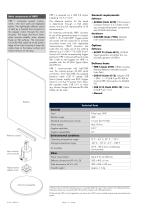
HRR I comprises several components - the main parts are displayed below. The lightweight reflector panel is held by a bracket that connects to the stepper motor through the main housing. The large aluminium baseplate ensures stability when placed freely on flat surfaces. The connector for the RS-485 cable sits at the bottom edge of the main housing to keep the cable close to the below surface and reduce tension on the plug. HRR I is powered via a USB 3.0 output supplying 1.0 A or more1. The reference position for the panel is determined through a Hall effect sensor, ensuring full reproducibility...
Open the catalog to page 2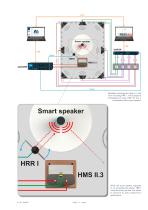
Exemplary measurement setup in a test room including HRR I. In the presence of background noise, HMS II.3 has a conversation with a smart speaker. HRR I HMS II.3 While the smart speaker responds to its conversational partner, HRR I varies the echo path and thus allows to examine its echo attenuation performance.
Open the catalog to page 3All HEAD acoustics GmbH catalogs and technical brochures
 HRT I
8 Pages
 labSAR I
6 Pages
 labM6 II
7 Pages
 labV8x3-Iso II
11 Pages
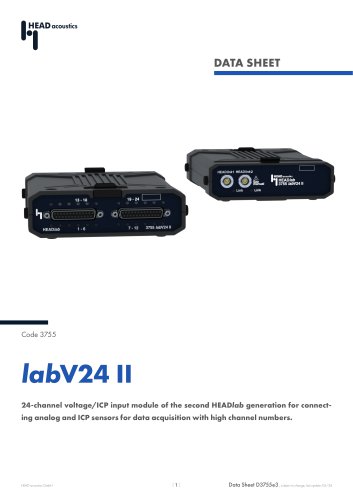 labV24 II
7 Pages
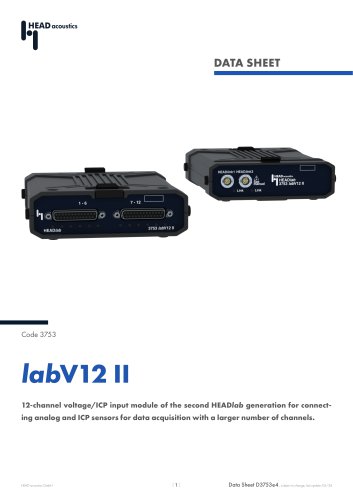 labV12 II
7 Pages
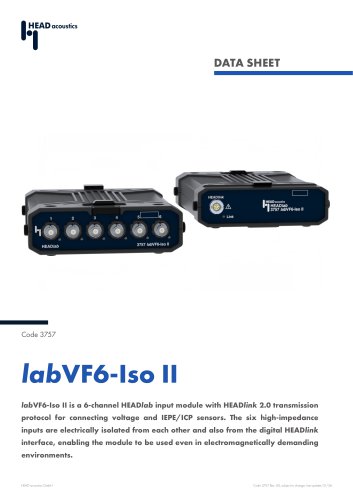 labVF6-Iso II
9 Pages
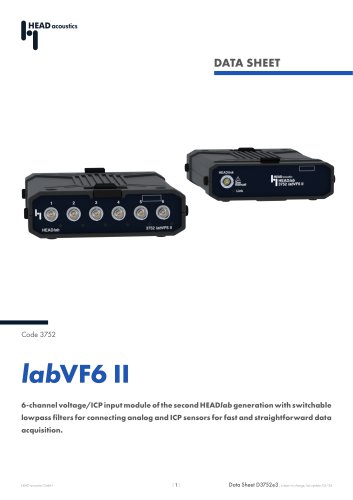 labVF6 II
7 Pages
 labCOMPACT12 II
10 Pages
 BHS II
4 Pages
 RC X.1
3 Pages
 SQuadriga III
26 Pages
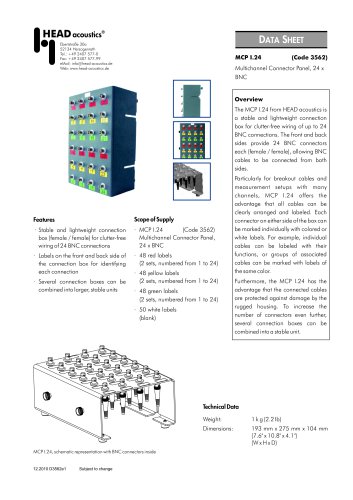 MCP I.24
1 Page
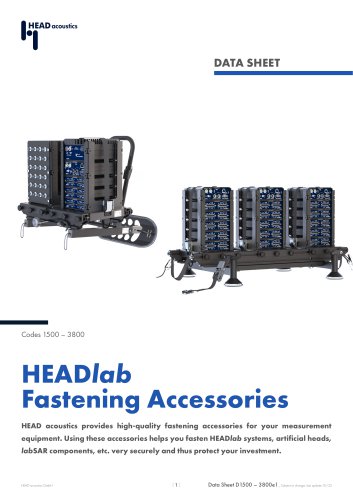 HEADlab Fastening Accessories
14 Pages
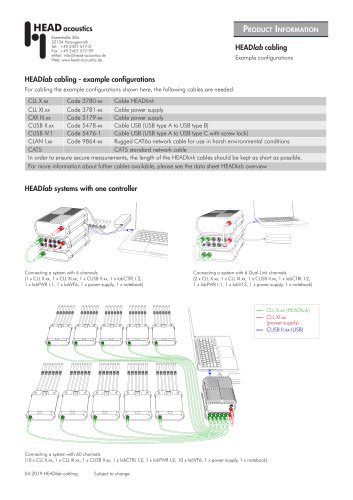 HEADlab cabling
5 Pages
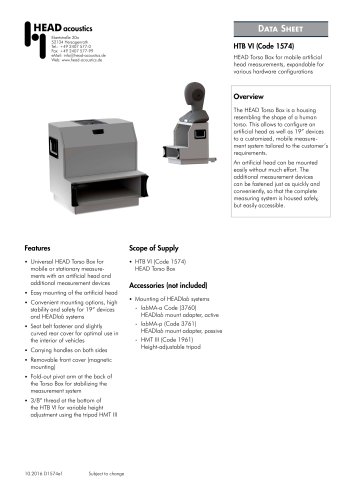 HTB VI (Code 1574
2 Pages
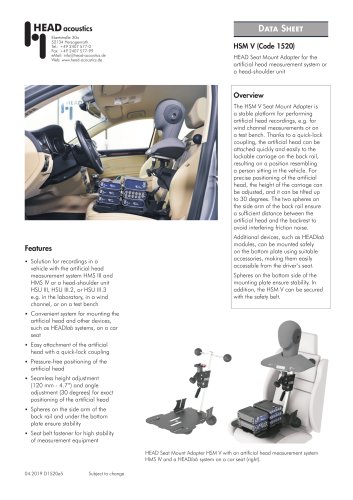 HSM V (Code 1520)
3 Pages
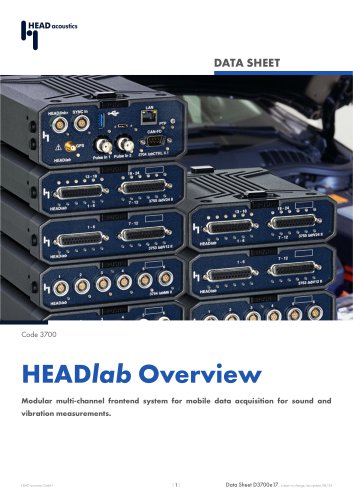 HEADlab Overview
21 Pages
 DO-160
1 Page
- Industrial camera module
- Analysis software solution
- Measuring machine
- Process software
- Measurement software
- Automatic tester
- Quality software
- Simulation software solution
- Automated software
- Test software
- High-precision measurement system
- Compact tester
- Data acquisition unit
- Measuring system for industrial applications
- USB tester
- Measurement microphone
- Compact measurement system
- Software suite
- Measuring system for the automotive industry
- USB recorder