

Electrostatics of freshly injected plastic mouldings

1 / 2 PagesView full catalog
Electrostatics of freshly injected plastic mouldings
Product catalog summary
Introduction
This document addresses the electrostatic challenges encountered with freshly injected plastic mouldings. It outlines the problems caused by electrostatic charges during various stages of the moulding process and proposes solutions using ionization systems.
Electrostatic Challenges
Solutions Using Ionization Systems
Conclusion
Electrostatic issues in plastic moulding are multifaceted and persist from part creation to final use. The implementation of HAUG ionization systems with compressed air can effectively mitigate these challenges, ensuring smooth processing and reducing contamination risks.
This document addresses the electrostatic challenges encountered with freshly injected plastic mouldings. It outlines the problems caused by electrostatic charges during various stages of the moulding process and proposes solutions using ionization systems.
Electrostatic Challenges
- During Demoulding: Parts often stick to the mould or ejector due to electrostatic charges, leading to potential damage when the mould closes again. This issue is particularly prevalent with light, small parts made of insulating plastics.
- Handling System Removal: Grippers or suction cups used to remove parts can cause them to stick and drop uncontrollably if they have little weight.
- Post-Demoulding Ejection: Charged parts may stick to machine parts or collecting containers, causing blockages.
- On the Conveyor Belt: Parts may adhere to the belt due to charges, leading to continuous travel and eventual dropping.
- In the Collecting Container: Accumulated charges can create a strong electrostatic field, causing parts to stick to container walls and attract dust, leading to contamination.
Solutions Using Ionization Systems
- Air Gates: Ionized air jets are used to neutralize charges. Air gates can be positioned above or beside the mould, along the conveyor belt, and at the collecting container to ensure complete discharge of parts.
- Installation Positions: Diagrams illustrate potential positions for air gates to effectively discharge parts at various stages, including above the mould, along the conveyor belt, and within the collecting container.
Conclusion
Electrostatic issues in plastic moulding are multifaceted and persist from part creation to final use. The implementation of HAUG ionization systems with compressed air can effectively mitigate these challenges, ensuring smooth processing and reducing contamination risks.
See more
Catalog excerpts

tr.row {} td.cell {} div.block {} div.paragraph {}
Open the catalog to page 1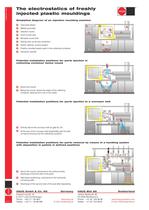
tr.row {} td.cell {} div.block {} div.paragraph {}
Open the catalog to page 2All HAUG catalogs and technical brochures
 Ionizing unit NI
2 Pages
 Ionizing unit LS GK
2 Pages
 Ionizing unit EI VS
2 Pages
 Ionizing unit EI VC
2 Pages
 Ionizing unit EI RN
2 Pages
 Ionizing unit EI SL
2 Pages
 Power pack EN 9 Sine
2 Pages
 Power pack Multistat Plus
2 Pages
 Power pack Multistat
2 Pages
 Air Line - Circle Cleaner 01
2 Pages
 Ionizing unit AJ
2 Pages
 Ionizing unit BI
2 Pages
 IML - In Mould Labelling
1 Page
 Analytical weighing
4 Pages
 Single cable technology
4 Pages
 Clean room
2 Pages
 Tampon print
2 Pages
 Folding machines
2 Pages
 Active ionizers
6 Pages
 Counter electrodes
1 Page
 Bar holder
2 Pages
 System X-2000
2 Pages
 Perforation counter PZ 3
2 Pages
 Anti-Neck-In-Triode ANT
2 Pages
 Charging electrode ALW
1 Page
 Charging bar ALS
2 Pages
 Statik-Air 09
2 Pages
 Statik-Air 08
2 Pages
 Ionizing air gun RI LG
2 Pages
 Needle ionizer NI
2 Pages
 Mini-Jet Ionisator MJ I
2 Pages
 Air gate KL GK (Uno)
2 Pages
 Ring ionizer EI RIF
2 Pages
 Delta blower DA TR
2 Pages
 Air Knife AK GK
2 Pages
 One-Point-Ionizer OPI
2 Pages
 Ionizing bar EI HRN
2 Pages
 Segment-Ionisator EI Form
2 Pages
 Power Pack EN 70 / EN 70 LC
2 Pages





Related Searches
- Power supply unit
- Measuring device
- Air blower
- Single-stage blower
- Tabletop power supply
- Generator
- Digital gauge
- Portable gauge
- Digital counter
- High-voltage power supply
- Benchtop measuring module
- AC/AC power supply
- Air gun
- Laboratory measuring instrument
- Electronic counter
- Voltage measuring module
- High-voltage tester
- Voltmeter
- Antistatic bar
- Field measuring instrument
*Prices are pre-tax. They exclude delivery charges and customs duties and do not include additional charges for installation or activation options. Prices are indicative only and may vary by country, with changes to the cost of raw materials and exchange rates.
About DirectIndustry
DirectIndustry is a marketplace that offers B2B players a complete experience, from product sourcing to purchase. DirectIndustry is an entity of VirtualExpo Group.
Are you a buyer?
Are you a supplier?