


- Company
- Products
- Catalogs
- News & Trends
- Exhibitions
HARTING Hall effect current sensors
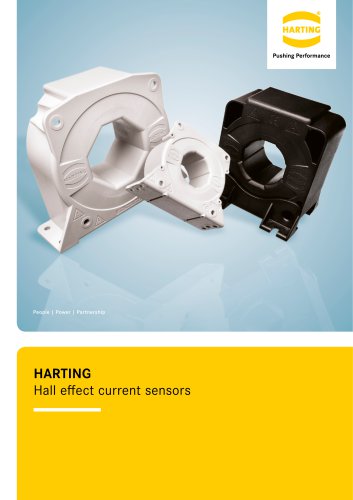
HARTING Hall effect current sensors
- All models provide galvanic insulation between primary and secondary currents.
- They are equipped with Hall effect compensation for high accuracy and wide measuring ranges.
- Designed for panel mounting with housing materials rated UL94 V0 for flammability.
- Compliant with standards such as EN 50 178 for power installations and EN 50 155 for railway applications.
- High current overload capability and low susceptibility to external magnetic fields.
- Models feature spring clamp terminals or screw terminals with faston connections.
- Installation involves steel screws with specified torque recommendations.
- Options for pluggable clamp terminals and separate signal cables are available.
- Sensors must be installed ensuring safe separation between primary and secondary circuits, adhering to Overvoltage Category III and Pollution Degree 2 standards.
- Protection degree is IP 20, and the temperature of the primary conductor should not exceed 100°C.
- Sensors should be connected to a power supply respecting SELV/PELV protective regulations according to EN 50 178.
Catalog excerpts
HARTING Hall effect current sensors
Open the catalog to page 1
HARTING worldwide Transforming customer wishes into concrete solutions The HARTING Technology Group is skilled in the fields of electrical, electronic and optical connection, transmission and networking, as well as in manufacturing, mechatronics and software creation. The Group uses these skills to develop customized solutions and products such as connectors for energy and data transmission applications including, for example, mechanical engineering, rail technology, a wind energy plants, factory automation and the telecommunications sector. In addition, HARTING also produces electro-magnetic...
Open the catalog to page 2
HARTING Subsidiary company HARTING Representatives Our people on location form the interface to the centrally Connectors ensure functionality. As core elements coordinated development and production departments. In this way, our customers can rely on consistently high, superior product quality – worldwide. enabling the modular construction of devices, machines and systems across a very wide range of industrial Our claim: Pushing Performance. guaranteeing smooth functioning in the manufacturing components. In order to serve our customers with the best area, in telecommunications, applications...
Open the catalog to page 3
HARTING worldwide HARTING technology creates added value for customers. or ultrahigh frequency applications that are finding use Technologies by HARTING are at work worldwide. in telecommunications or automation networks, in the HARTING’s presence stands for smoothly functioning automotive industry, or in industrial sensor and actuator systems, powered by intelligent connectors, smart applications, RFID and wireless technologies, in addition infrastructure solutions and mature network systems. In to packaging and housing made of plastics, aluminum or the course of many years of close, trust-based...
Open the catalog to page 4
HARTING knowledge is practical know-how generating synergy effects. HARTING The key focus is on applications in every solution approach. In this context, uncompromising, superior quality is our hallmark. Every new solution found will regard to the applications conditions of connectors in invariably flow back into the HARTING technology pool, telecommunications, computer and network technologies thereby enriching our resources. And every new solution and medical technologies, as well as industrial automation we go on to create will draw on this wealth of resources in technologies, such as the...
Open the catalog to page 5
General information General information: HARTING Hall effect current sensors are used for current measurement in power electronic applications. The hall effect sensors can measure different kinds of currents (AC, DC, pulsed... ) It is the user’s responsibility to check whether the components illustrated in this catalogue comply with different regulations from those stated in special fields of application which we are unable to foresee. ● Generators ● electrical drives We reserve the right to modify designs in order to improve quality, keep pace with technological advancement or meet particular...
Open the catalog to page 6
HARTING Hall effect current sensors Contents Measurement principles . . . . . . . . . . . . . . . . . . . . . . . . . . . . . . . . . . . . . . . . . . 8 Current measurement in power electronics . . . . . . . . . . . . . . . . . . . . . . . . . . . 9 Fields of applications . . . . . . . . . . . . . . . . . . . . . . . . . . . . . . . . . . . . . . . . . . . . 10 Industrial versions Current sensor HCS 200 A . . . . . . . . . . . . . . . . . . . . . . . . . . . . . . . . . . . . . . . 12 Current sensor HCS 300 A . . . . . . . . . . . . . . . . . . . . . . . . . . . . . . . . . . . . . . . 14...
Open the catalog to page 7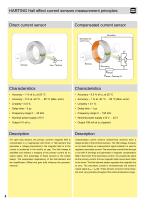
HARTING Hall effect current sensors measurement principles Direct current sensor Compensated current sensor • Nominal power supply ±15 V • Nominal power supply ±15 V ... 24 V For open loop sensors, the primary current‘s magnetic field is Compensated current sensors (Closed-loop sensors) have a concentrated in a magnetically soft toroid. A Hall element that design similar to that of direct sensors. The Hall voltage, however generates a voltage proportional to the magnetic field or to the is not used directly as measurement signal instead it is used to current is positioned in the toroid’s air...
Open the catalog to page 8
Current measurement in power electronics Application examples ● Frequency converter for drive control Measurement of the input currents and motor currents to control the system and for protection of the power semiconducters ● Frequency converter for Generator-Grid connection Measurement of the generator currents and output currents to control the system and for protection of the power semiconducters ● Switch mode power supplies ● Uninterruptible power supplies/ Battery systems ● Electrical heating
Open the catalog to page 9
Fields of applications for HARTING current sensors Other application environments - Robots - Elevators - Cranes - Welding systems - Electro-plating - Electric vehicles - Ship propulsion systems
Open the catalog to page 10
Fields of applications for HARTING current sensors ① Traction drive ② Auxilary converter ③ Full power converter ④ Pitch- and Yaw-Drive ⑤ Solar converter
Open the catalog to page 11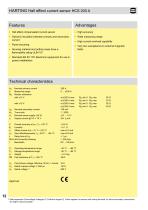
HARTING Hall effect current sensor HCS 200 A Features • Hall effect compensated current sensor • High accuracy • Galvanic insulation between primary and secondary current • Wide measuring range • Panel mounting • High current overload capability • Very low susceptance to external magnetic fields • Housing material and potting mass have a flammability rating UL94 V0 • Standard EN 50 178: Electronic equipment for use in power installations Nominal primary current Measuring range Burden resistance with ±12 V with ±15 V Nominal secondary current Turns ratio Nominal power supply (±5 %) Supply current...
Open the catalog to page 12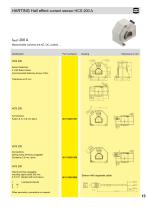
HARTING Hall effect current sensor HCS 200 A IPN= 200 A Measureable currents are AC, DC, pulsed … Identification Part numbered HCS 200 Sensor fastening: 2 x M5 Steel screws (recommended fastening torque 4 Nm) Tolerances ±0.5 mm HCS 200 Connections: Spring clamp terminal, pluggable Centerline 5.0 mm; 3pins HCS 200 Clamp terminal, pluggable including signal cable 300 mm, 0.5 mm², stripped with end sleeve 1 2 3 Sensor with separate cable (numbered stands) Other secondary connections on request
Open the catalog to page 13All HARTING catalogs and technical brochures
 09 45 453 2304
2 Pages
 09 45 453 2100
2 Pages
 09 45 453 2202
2 Pages
 Ha-VIS RFID4SMT
2 Pages
 Ha-VIS eCon 2050GX-I-A
3 Pages
 Ha-VIS eCon 3000
2 Pages
 Han-Modular® Switch US4
2 Pages
 STAF 6 STI-L
2 Pages
 Han 3A-eg-QB-PG-13.5
2 Pages
 SEK IDC Connectors
54 Pages
 Subminiature D Connectors
200 Pages
 Industrial Connectors Han®
52 Pages
 livebook
10 Pages
 HA-CheckOut® EK HE RL
2 Pages
 M12 Magnetics
1 Page
 M8 D-coded PCB adapter
1 Page
 Han® Pneumatic Module Metal
2 Pages
 Han-Modular® Sliding Frame
2 Pages
 HARTING Device Connectivity_2016
896 Pages
 HARTING Connectors DIN 41 612
230 Pages
 Coaxial and Metric Connectors
128 Pages
 HARTING Industrial Connectors han®
989 Pages
 Ha-VIS RFID RF-R300 Reader
4 Pages
 HARTING Component Range
40 Pages
 HARTING News 2016
120 Pages
 The Future needs the Past
11 Pages
 HIS Catalogue
32 Pages
 HIS Flyer
12 Pages


Archived catalogs
 HARTING Device Connectivity
824 Pages
 TCA Connectors
36 Pages
 Industrial Connectors (Han®)
33 Pages
- HARTING data connector
- Transformer
- Rectangular housing
- Ethernet switch
- HARTING electrical power supply connector
- Copper cable
- Metal connector
- Industrial network switch
- Circular connector
- HARTING plastic connector
- Plastic housing
- Junction block
- Screw-in connector
- HARTING female connector
- Gigabit Ethernet ethernet switch
- Industrial connector
- IP67 connector
- Rectangular connector
- DIN rail mounted network switch