
- Catalogs
- Hardinge Workholding
- Rotary Systems & Trunnions - Gear-driven and Direct-drive


Rotary Systems & Trunnions - Gear-driven and Direct-drive
1 / 28 PagesView full catalog
Rotary Systems & Trunnions - Gear-driven and Direct-drive
Product catalog summary
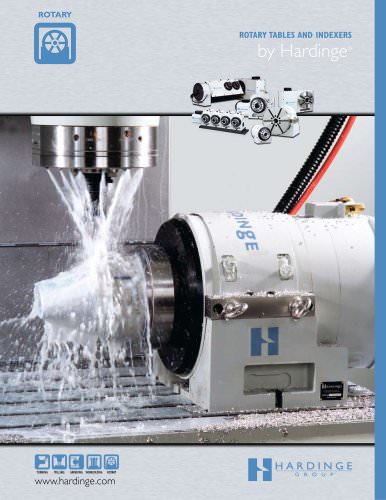
Overview: The document provides a comprehensive overview of Hardinge's rotary tables and indexers, emphasizing their flexibility, precision, and integration capabilities. It details various product lines, specifications, and the evolution of Hardinge's rotary systems.
Product Lineup: Hardinge offers a range of rotary products including A2-4 (5C) and A2-5 (16C) spindle nose designs, gear-driven rotary indexers, low-profile rotary tables, tilting dual-axis rotary indexers, and gearless direct-drive rotary table indexers. These products are designed for quick-change workholding and are compatible with various gripping devices.
Specifications: The rotary systems boast high accuracy (±3 arc-sec), repeatability (4 arc-sec), rapid positioning speeds, and zero backlash systems. They support heavy axial and radial loads and offer flexibility in workholding tooling.
Manufacturing Process: The document outlines the quality manufacturing processes, including precision machining and grinding of housings, spindles, bearings, and gears. The use of high-load, tapered dual roller bearings ensures durability and precision.
Technological Features: Hardinge's rotary systems feature infrared upload capability, zero-backlash direct-drive technology, and are manufactured in the USA. They can be integrated as a true 4th-axis with various CNC systems, enhancing their versatility in machining applications.
Interface Options: The systems can be interfaced with host machines via direct connection, RS-232 port, or CNC interface cable, allowing for seamless integration and control.
Historical Evolution: The document traces the evolution of Hardinge's rotary systems from the 1940s to the introduction of the next-generation 5C2 rotary system in 2007, emphasizing the company's long-standing expertise in spindle and indexer designs.
Technical Specifications: Detailed specifications are provided for the 5C2 rotary indexers, including servo control features, spindle characteristics, positioning accuracy, motor specifications, and operating conditions.
Workholding Capacities: The document lists the capacities for various collets, step chucks, and 3-jaw chucks, highlighting the system's adaptability to different workholding needs.
Standard Features: Common features across models include high precision, rapid indexing speeds, robust spindle designs, and compatibility with various collet systems. The equipment supports heavy axial and radial loads and offers configurations for single, dual, and multi-spindle setups.
Optional Features: Options include pneumatic collet closers, manual and pneumatic tailstocks, and a range of spindle tooling. Some models offer enhanced servo controls and programming capabilities.
Operating Specifications: The document specifies operating conditions such as duty cycle, operating temperature, power requirements, and air pressure. It also highlights the use of servo controls and programming interfaces like RS-232 and infrared upload/download.
Applications: The equipment is designed for high-force cutting applications, off-center drilling, and multi-part machining. It supports operations like spiral, arc, and linear milling, as well as standard indexing.
Conclusion: The document provides comprehensive information on the capabilities and configurations of rotary indexers, highlighting their precision, speed, and adaptability for various machining tasks.
See more
All Hardinge Workholding catalogs and technical brochures
 Sure-Grip 3-Jaw Power Chucks
24 Pages
 Workholding Product Overview
20 Pages
 HQC® Quick-Change Collets
12 Pages


Archived catalogs
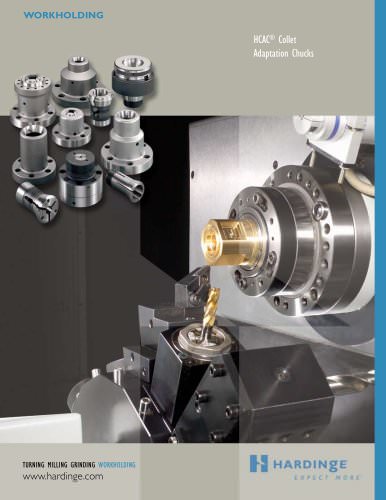 HCAC Collet Adaptation Chucks
28 Pages
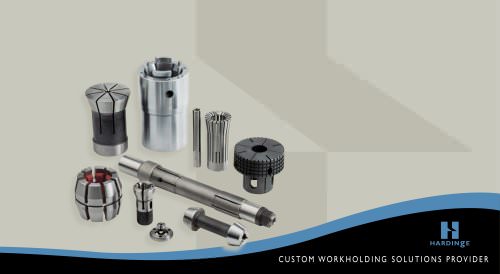 Custom Workholding Manufacturing
24 Pages
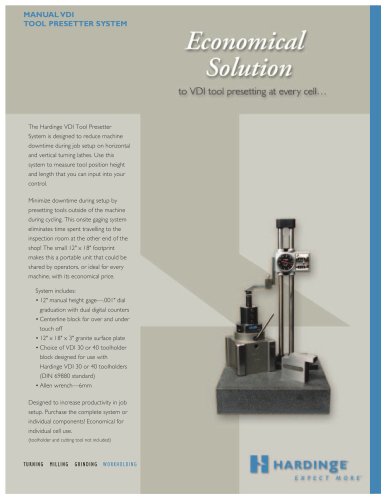 VDI Tool Presetter System
2 Pages
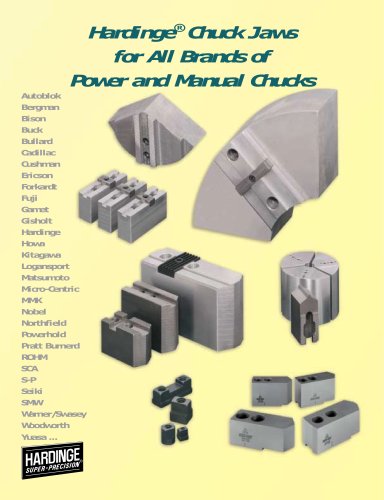 Hardinge® Chuck Jaws
32 Pages
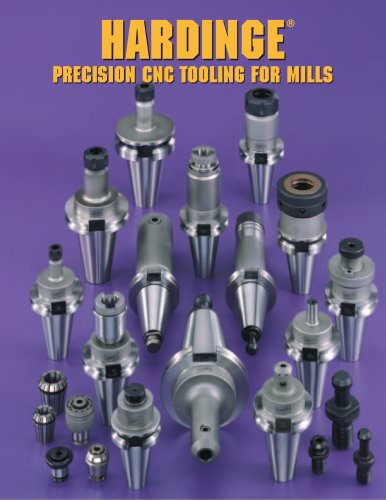 Precision CNC Tooling for Mills
48 Pages
Related Searches
- Cylinder
- Double-acting cylinder
- Hydraulic cylinder
- Pneumatic cylinder
- Piston cylinder
- Industrial cylinder
- Compact cylinder
- Aluminum alloy cylinder
- Collet chuck
- High-precision chuck
- Steel cylinder
- Workpiece clamping chuck
- Stainless steel cylinder
- Precision cylinder
- High-speed chuck
- Tie-rod cylinder
- Clamping cylinder
- CNC machine chuck
- Power chuck
*Prices are pre-tax. They exclude delivery charges and customs duties and do not include additional charges for installation or activation options. Prices are indicative only and may vary by country, with changes to the cost of raw materials and exchange rates.
About DirectIndustry
DirectIndustry is a marketplace that offers B2B players a complete experience, from product sourcing to purchase. DirectIndustry is an entity of VirtualExpo Group.
Are you a buyer?
Are you a supplier?