
- Catalogs
- HANSA FLEX AG
- Industrial Technology


Industrial Technology

Industrial Technology
HANSA-FLEX is a comprehensive hydraulics system partner offering services such as a 24-hour hose replacement service, industrial maintenance, power unit construction, and an online shop for hydraulic components.
This 24/7 service ensures rapid response to machine failures, minimizing downtime in sectors like construction and agriculture.
Focuses on preventative maintenance to maximize machine uptime and optimize operations, providing expert advice on hydraulic components.
Offers complete services from planning to commissioning of hydraulic power units, ensuring advanced engineering solutions.
Provides a wide range of hydraulic products for convenient 24/7 shopping, maintaining quality and variety.
A customer portal that aids preventative maintenance by providing technical data and maintenance schedules for hose lines.
Includes safety guidelines for hose line assembly, operation, and maintenance, emphasizing proper handling to prevent injuries and equipment failure.
Hose lines should be assembled by qualified personnel, ensuring accessibility, protection from damage, and proper installation for safe operation.
Regular inspections and maintenance are essential for hose line longevity and safety, with criteria for inspection and prompt replacement of damaged hoses outlined.
HANSA-FLEX offers a variety of products including hydraulic hoses, fittings, couplings, ball valves, and mounting technology for various industrial needs.
- Cross-Section: Choose a large diameter to reduce flow velocity and pressure losses.
- Torsion: Avoid twisting hoses to prevent reduced service life.
- Minimum Bending Radius: Exceeding this can reduce service life and cause oil spraying.
- Abrasion: Protect hoses from wear by avoiding edges and close proximity to other hoses.
- Tensile Load: Avoid tensile loads to maintain secure fittings.
- Hose Holders: Should not restrict natural movement; install on straight sections only.
- Whipping: Restrain hoses to prevent hazards from whipping in case of damage.
- Leaks: Shield hoses if leaks pose a hazard.
- Cold Flow: Regularly check fittings for leaks due to rubber creeping.
- Gases and Vapours: Consider permeation risks when selecting hoses.
- Commissioning: Conduct necessary tests and ensure personal protection measures are in place.
- Storage: Store hoses in cool, dry, and dust-free conditions, away from damaging materials.
- Inspection Intervals: Set by owner according to safety regulations, typically annually or more frequently under severe conditions.
- Inspection Criteria: Replace hoses with damage such as abrasion, brittleness, deformation, leaks, or impaired fittings.
- Repair and Painting: Not recommended; recoating violates identification requirements.
- Cleaning: Use gentle cleaning agents; avoid solvents and abrasive tools.
- Service Period: Limited by natural aging; follow DIN 20066 guidelines for storage and service periods.
Flexible, dimensionally stable spiral suction and pressure hoses made from soft PVC with a hard PVC helix, suitable for various water types and liquid manure, with a temperature range from -5°C to 60°C.
Lightweight hoses with a smooth outer cover, made of PVC with a rectangular PVC spiral insert, suitable for water and other media, with a temperature range from -25°C to 60°C.
Suitable for very cold climates, made with stable, high flexibility plasticised PVC and reinforced with a pressure-resistant PVC spiral, complying with ISO 1307 standards, with a temperature range from -40°C to 50°C.
Used for high-pressure cleaning and sewage cleaning, made with NR/SBR and two high-tensile synthetic textile braids, with a temperature range from -35°C to 70°C.
Silicone radiator hoses highly resistant to temperature extremes and various chemicals, complying with SAE 20 R3 standards, with a temperature range from -50°C to +150°C for water and antifreeze agents, and up to +180°C for hot air.
Fire service hoses made with aging and ozone-resistant EPDM compound, featuring high elasticity and abrasion resistance, complying with DIN 14,811 and BS6391 standards.
Flat water hoses suitable for agricultural, industrial, and construction applications, made of PVC with a textile insert, with a temperature range from -20°C to 100°C.
Flat water hoses designed for agricultural, construction, mining, and shipbuilding industries, made of PVC with a polyester braided insert, with a temperature range from -10°C to 60°C.
Used in industry and construction, featuring light metal Storz couplings, made with NBR and round woven polyester fabric, suitable for cold water.
Industrial water hoses used as low-pressure hoses in industry and construction, made of natural and synthetic rubber with a highly tear-resistant synthetic textile insert, with a temperature range from -25°C to 70°C.
Water and cleaning hoses suitable for agricultural, construction, and systems engineering, made with EPDM lining and synthetic thread braided inserts, with a temperature range from -30°C to 100°C.
Universal hoses for agricultural, construction, and systems engineering applications, made with EPDM and synthetic threads, with a temperature range from -40°C to 120°C.
Construction water hoses that are highly flexible and sturdy, made with EPDM lining and synthetic threads, with a temperature range from -40°C to 95°C, and can handle temperature peaks up to 110°C.
1. Rubber Industrial Hoses
- Applications: Shipyards, shipping, cleaning systems, nurseries, agriculture, industry, and construction.
- Features: Seawater and ozone resistant, weatherproof, aging resistant.
- Specifications: Made of synthetic rubber with a highly tear-resistant synthetic cord fabric insert. Temperature range from -35°C to 70°C.
- Media: Suitable for freshwater, seawater, contaminated water, and weakly acidic and alkaline liquids (pH 5 to 8).
- Applications: Industry, construction, and agricultural technology.
- Features: Exceptionally light, kink-resistant, flexible, high continuous operating pressure, and outstanding resistance to aging and ozone.
- Specifications: Made of high-quality EPDM rubber with a strong polyester yarn insert. Temperature range from -30°C to 100°C.
- Media: Water.
- Applications: Hot water or saturated steam applications.
- Features: High temperature, abrasion, and ozone resistance.
- Specifications: Made of EPDM with textile braided inserts. Temperature range from -40°C to 210°C.
- Media: Hot water and steam.
- Applications: Food industry, suitable for milk, cooking oil, and other foodstuffs.
- Features: Odourless, toxin-free, and compliant with European standards and FDA guidelines.
- Specifications: Made of special NBR rubber with synthetic textile inserts. Temperature range from -40°C to 80°C.
- Media: Milk, cooking oil, etc.
- Applications: Chemical industries, suitable for sea and industrial wastewater.
- Features: Chemical resistant, flame-retardant, and ozone/weather resistant.
- Specifications: Made of EPDM with textile inserts and antistatic copper braids. Temperature range from -35°C to 120°C.
- Media: Acids, solvents.
- Applications: Autogenous applications, suitable for oxygen and acetylene gases.
- Features: Smooth outer cover, compliant with EN ISO 3821.
- Specifications: Made of synthetic rubber with a braided textile insert.
- Media: Oxygen gas, acetylene gas.
Specifications for propane gas burners include compliance with EN ISO 3821, a synthetic rubber inner layer, and a temperature range of -20°C to 70°C. The hoses are designed for use with butane and propane gases.
These hoses are used in vehicles and mobile equipment, meeting DIN 4815 standards. They feature oil-resistant synthetic rubber and operate between -30°C and 85°C, suitable for liquid gas.
Designed for the construction and agricultural industries, these hoses are weatherproof and abrasion-resistant, with a temperature range of -25°C to 55°C. They are used for transporting cereals, cement, and gravel.
Available in various versions, these hoses are used for dedusting and extraction systems. They are flexible, oil and petrol resistant, and operate between -40°C and 90°C.
Used for unloading cement and other materials from silo transport vehicles, these hoses comply with ISO 1307 and have a temperature range of -40°C to 70°C.
These hoses are used for cleaning surfaces with abrasive media. They are highly abrasion-resistant and operate between -40°C and 70°C.
Designed for the construction industry, these hoses are highly abrasion-resistant and operate between -40°C and 70°C, suitable for mortar and concrete.
Various fuel hoses are available, each designed for low-pressure fuel lines. They are oil-resistant and operate between -35°C and 80°C, suitable for diesel, crude oil, and lubricating oil.
This document provides detailed specifications and descriptions of various components and fittings used in air conditioning and hose systems. It includes information on screw nipples, connector adapters, O-rings, clip nipples, pliers, oils, protective hoses, and various hose fittings.
- Components like screw nipples and block connections are used for air conditioning hoses, made of electro-galvanized steel.
- Connector adapters are specified with UNEF and UNF threads, suitable for different hose sizes.
- O-rings are available for different hose diameters, made from materials like NBR and chloroprene, suitable for temperatures ranging from -40°C to 150°C.
- Sealing rings are designed for specific coolants like R134a and R404a.
- Protective hoses are designed for thermal and condensation protection, with temperature ranges from -50°C to 220°C.
- Materials used include glass-fibre for heat protection and specialized materials for condensation protection.
- Various hose fittings are detailed, including swage ferrules, nipples, and metric series fittings.
- Materials are primarily steel with electro-galvanized surfaces, and fittings are designed for specific hose types and sizes.
- Tools like cutters for plastic pipes and pliers for hose clips are included, with specifications for spare parts and materials.
- Components like lashing straps for hose bundling and assembly oils for air conditioning hoses are described, highlighting their applications and material properties.
The document serves as a comprehensive guide for selecting and understanding various components used in air conditioning and hose systems, emphasizing material specifications, temperature ranges, and application suitability.
This document provides detailed specifications and guidelines for various hose fittings used in industrial applications. It includes information on connection types, sealing forms, materials, and standards for different hose fittings, such as swage nipples, banjos, and drive type nipples.
- Materials and Surface: Most fittings are made of steel and are electro-galvanized for corrosion resistance.
- Standards: The fittings conform to various international standards such as ISO 8434-1, ISO 228-1, BS 5200, and DIN 7642.
- Connection Types: Includes pipe sockets, BSP nut threads, metric banjos, and NPT external threads.
- Assembly: Final cutting ring assembly must be carried out in a hardened pre-assembly socket (VOM...).
- Selection: The appropriate ferrule must be chosen based on the hose type.
- Do not use certain fittings for new designs; alternatives such as SIN...AFL are recommended.
- Ensure compatibility of parts by replacing them with parts of the same type sizes.
- Hose Fittings: Detailed tables provide dimensions and specifications for various fittings, including swage nipples at different angles (45° and 90°), banjos, and drive type nipples.
- Applications: The fittings are suitable for applications involving hot water, saturated steam, and other industrial uses.
- Working Pressure: Some fittings are designed to handle pressures up to 18 bar.
- Temperature Range: Suitable for saturated steam up to +210 °C and hot water up to +120 °C.
This document is a technical catalogue from Hansa-Flex, dated June 2014, detailing various hose fittings and couplings used in industrial applications, specifically focusing on sandblasting and Perrot couplings.
- Includes hose fittings and accessories for sandblasting applications.
- Materials used include Perbunan with a hardness of 60° Shore A, in black color.
- Detailed specifications for female and male parts, including working pressure and coupling dimensions.
- Materials: Steel, with surfaces either hot galvanized or black.
- Sealing: O-ring seals are commonly used.
- Includes specifications for reducing couplings, both female and male parts.
- Materials: Steel, hot galvanized.
- Specifications for connectors and end plugs for Perrot couplings.
- Materials: Steel, hot galvanized.
- Screwed sockets for POLY hoses, made from electrically conductive polyurethane.
- Features include abrasion resistance and impact resistance.
- Brass fittings for tanker hoses, with BSP cylindrical external threads and safety collars.
- Standards: DIN EN 14 420-5.
- Various materials used include brass, stainless steel, and aluminium, depending on the application.
- Designs include safety features like collars and flat seals.
This document provides detailed specifications for various temperature control coupling sleeves without valves, including those with unlocking protection and integrated valves. The couplings are designed for use with mineral oil and are made from brass.
- Nominal Diameter (DN): Ranges from 6 mm to 19 mm.
- Working Pressure: Up to 19 bar.
- Temperature Range: -15°C to 150°C.
- Material: Brass with options for Viton and PFTE coated O-rings.
- Temperature Control Coupling Sleeves without Valve: Available in angles of 45° and 90°, with BSP or metric threads.
- Temperature Control Coupling Sleeves with Unlocking Protection: Includes integrated valves, available in straight, 45°, and 90° angles.
- Thread Types: BSP cylindrical internal and external threads, metric cylindrical outer threads.
- Sealing Form: 60° inner cone for secure sealing.
- Hose Connections: Available for various diameters, ensuring compatibility with different systems.
These couplings are suitable for systems requiring reliable temperature control and secure connections, particularly in environments with fluctuating temperatures and pressures.
This document provides detailed specifications and descriptions of various couplings and ball valves, focusing on temperature control couplings and low-pressure ball valves. The catalogue includes information on both couplings with and without valves, as well as connectors and locking sleeves.
- With Valve: These couplings are designed with unlocking protection and are available in various dimensions and working pressures. They are suitable for mineral oil temperatures ranging from -15°C to 150°C. Materials used include brass and Viton/PTFE coated O-rings.
- Without Valve: Similar to the couplings with valves, these also feature unlocking protection and are available in different configurations, including angles of 45° and 90°. They maintain the same temperature range and are constructed from brass.
- With Valve: These connectors are available with BSP external threads and are designed for a working pressure of 15 bar. They are suitable for mineral oil temperatures from -15°C to 150°C.
- Without Valve: These connectors come in various thread types, including BSP and metric cylindrical threads, and are also designed for a working pressure of 15 bar. They support the same temperature range as the connectors with valves.
- 2-Way Ball Valves: These low-pressure ball valves are available in various nominal diameters and are designed for working pressures ranging from 14 to 64 bar, depending on the size. They are suitable for temperatures from 0°C to 150°C for air and water applications. The valves are constructed with brass housing, aluminum handles, and PTFE ball seals.
- Special Features: Some ball valves have DVGW approval for gas applications, with specific temperature ranges for different media, including town gas, liquid gas, and methane gas.
The primary material used across the products is brass, with additional components such as Viton/PTFE coated O-rings, hard chrome-plated brass balls, and nickel-plated surfaces for enhanced durability and performance.
This document is a technical catalogue detailing various types of ball valves and hose clamps, primarily used in low-pressure applications. It includes specifications, materials, temperature ranges, and pressure ratings for different products.
- 2-Way Ball Valves: These valves are designed for low-pressure applications with BSP cylindrical internal threads. They operate within a temperature range of -20°C to +150°C for air and 0°C to +150°C for water. The materials used include brass housing, aluminium handle, and a hard chrome-plated brass ball with a PTFE ball seal.
- 3-Way Ball Valves: Available in L and T hole designs, these valves also feature BSP cylindrical internal threads and operate within the same temperature range as the 2-way valves. They are constructed with similar materials.
- 1-Ear and 2-Ear Clamps: These are used for hose mountings in low-pressure ranges. They are made from steel, either galvanised or stainless, and come in various clamping ranges and band widths.
- Worm Drive Hose Clamps: These clamps feature a hexagon screw with a slot and are made from galvanised steel or stainless steel. They are available in a wide range of clamping sizes.
- CLIC Clamps: These are screwless hose clamps made from rustproof chrome nickel steel, designed for reliable connections in hose socket systems.
- All products are detailed with nominal diameters, working pressures, and material specifications.
- Pressure figures are applicable for temperatures from 0°C to +25°C, with reductions required at higher temperatures.
- Standards such as DIN 3017 are referenced for certain hose clamps.
- Spare parts and accessories are available for various products, including handles for ball valves and screwdrivers for hose clamps.
- Each product section includes a catalogue reference date and a URL for further details.
This document provides technical specifications and details for various mounting and coupling products, primarily focusing on retaining clamps and water technology components. The document is structured into sections detailing product applications, design, standards, materials, and specific product versions.
- Application: Used for mounting pipes, hoses, and cables.
- Design: Pipe clamps with rubber profiles to dampen vibrations and prevent scratching.
- Standard: Conforms to DIN 3016.
- Material: Made of galvanized steel.
- Product Versions: Includes various sizes and materials such as chrome nickel steel (1.4301) and standard steel, with band widths of 15 mm, 20 mm, and 25 mm.
- Couplings: Includes claw couplings, plug-in couplings, and sliding sockets designed for water applications.
- Materials: Primarily made from hot pressed brass MS 58, with some components in stainless steel and NBR seals.
- Temperature Range: Suitable for temperatures from 0°C to 95°C, with specific pressure ratings depending on the coupling type.
- Design Features: Some couplings offer 360° axial rotation and are available in various thread sizes and configurations.
- Screwdrivers: Flexible screwdrivers made from chrome vanadium, designed for use with hose clamps.
- Pliers: Steel assembly pliers for Clic clamp sets, suitable for opening and closing clamps of all sizes.
- Retaining Clamps: Available in sizes ranging from 5 mm to 125 mm in diameter, with consistent band widths and hole diameters.
- Water Couplings: Include GEKA claw couplings with various working pressures and connection types, designed for both static and rotating applications.
- Sliding Sockets: Available in sizes from DN 6 to DN 100, with working pressures up to 10 bar.
The document provides comprehensive details on the specifications and applications of retaining clamps and water technology components, emphasizing their design, material composition, and compliance with industry standards.
This document is a technical catalogue from Hansa-Flex, dated June 2014, detailing various water technology components, specifically focusing on water nozzles, couplings, distributors, and seals used in fire service applications.
- Types: Includes hose nozzles and claw coupling nozzles.
- Designs: Light and heavy designs for full jet, sprinkler, mist, and shut-off applications.
- Materials: Made from hot pressed brass MS 58.
- Specifications: Various sizes with working pressures up to PN 10.
- Types: Suction couplings, fixed couplings, and cap fire hose couplings.
- Designs: Include claw and hose connections, with options for light and heavy designs.
- Materials: Primarily aluminium and brass, with seals made from nitrile rubber.
- Specifications: Various nominal sizes and cog spaces, compatible with Storz connections.
- Types: 3-way and 4-way pieces.
- Designs: Y-shaped distributors with BSP cylindrical threads.
- Materials: Malleable cast iron, electro-galvanised.
- Types: Flat sealing rings, suction seals, pressure seals, and pressure suction seals.
- Materials: Made from nitrile rubber, with options in white nitrile, Teflon, and Viton green.
- Applications: Used in various coupling and adapter products for fire brigade applications.
- Adapters: Reducing adapters for fire brigade couplings, made from aluminium.
- Jet Pipes: Multi-purpose jet pipes made from aluminium and polyamide, designed for cold and impact resistance.
- Includes tools for handling and maintenance of the components listed.
The catalogue provides comprehensive specifications and material details for water technology components used in fire service applications, emphasizing durability and compatibility with standard connections.
This document is a technical catalogue from Hansa-Flex, dated June 2014, focusing on compressed air technology, specifically detailing various types of couplings and air blast guns.
- Spanner for fire brigade couplings made of steel.
- Includes air blast guns with nozzles, claw couplings, plug-in couplings, and various connectors.
- Materials used include aluminium and brass, with temperature ranges from -20°C to 100°C.
- Various types including rotating, MODY, and those with BSP threads.
- Standardized under DIN 3489 and DIN 3238.
- Working pressure generally at PN 10 or PN 16.
- Materials include cast iron and malleable cast iron, often electro-galvanized.
- Couplings feature safety double cams and rubber sealing rings.
- Temperature range for most products is -40°C to 95°C.
- Specific designs for hose connections and thread protection.
- Includes rubber rings, retaining screws, and brass sleeves for couplings.
The catalogue provides comprehensive details on the specifications, materials, and applications of various compressed air technology components, emphasizing safety and durability.
1. LSK G AC MODY: Rubber rings for MODY coupling, designed for hose and claw couplings with a temperature range of -40°C to 95°C, made of electro-galvanized steel.
2. LSK VERSCHLUSS: Caps for claw couplings, available with or without chains, made of cast iron and electro-galvanized.
Plug-in Couplings
1. LKM HB: Quick release coupling sleeves with BSP external threads, made of brass and stainless steel components, suitable for a working pressure of 35 bar.
2. LKM IR: Similar to LKM HB but with BSP cylindrical internal threads.
3. LKM MM: Available in straight, 45°, and 90° angles, designed for hose connections.
4. LKM HR ST: Features a safety lock to prevent hazardous whiplash, made of steel/composite material.
Connectors
1. LKS HB: Quick release coupling plugs with BSP external threads, made of brass.
2. LKS HR ST: Electro-galvanized steel connectors with safety lock.
3. LKS IR: Internal thread connectors made of brass.
4. LKS MM: Hose connection plugs available in various sizes, made of brass or electro-galvanized steel.
Spare Parts
1. Rubber Rings: Various rubber rings for claw and MODY couplings, made from materials like silicone and Perbunan, with temperature ranges from -40°C to 200°C.
2. Specific Models: LSK GDOR, LSK GOOR, LSK SDOR, LSK SGOR, each designed for specific coupling types and conditions.
This document is a technical catalogue from Hansa-Flex, dated June 2014, focusing on components used in compressed air technology, specifically couplings, hose collars, and related spare parts. The document provides detailed specifications for various parts, including rubber rings, retaining screws, brass sleeves, hose rings, threaded nozzles, and conical nozzles.
- Rubber Ring for MODY Couplings: Made from oil-resistant synthetic rubber (Perbunan), suitable for temperatures ranging from -40°C to 90°C.
- Retaining Screw for Claw Coupling: Steel material with electro-galvanized surface, includes a brass seal. Used in various claw coupling models.
- Brass Sleeve for Claw Coupling: Designed for temperatures between -40°C and 95°C, made of brass with a brass seal.
- Hose Ring for Claw Coupling: Made from Perbunan, suitable for temperatures from -40°C to 95°C, includes a brass seal.
- Threaded Nozzles: Various models with different thread sizes and working pressures, primarily made of brass or steel, used for hose connections in compressed air systems.
- Conical Nozzles and Union Nuts: Designed for use in construction, mining, and tunnel building, made from steel or malleable cast iron, electro-galvanized, and suitable for temperatures from -40°C to 95°C.
- Components are designed to integrate with DIN standards, such as DIN 8537 and DIN 20039.
- Working pressures for various components range from PN 16 to PN 25.
- Materials used include steel, brass, and malleable cast iron, often with electro-galvanized surfaces for corrosion resistance.
The components are primarily used in systems engineering, industry, and construction, particularly in environments requiring robust and reliable compressed air and water connections.
This document is a technical catalogue detailing various components used in compressed air technology, specifically focusing on hose collars, hose connectors, and plastic connectors. The catalogue provides specifications, applications, and material details for each component type.
- Identified by SVB ND codes, these connectors are designed for integration with DIN 20038 and 20039 hose clamps.
- Specifications include hose ID, length, and working pressure, all standardized at PN 25.
- Materials used are primarily steel, suitable for compressed air applications.
- Includes screw-on and screw-in connectors with various thread types (UN/UNF, BSP, BSPT).
- Applications span pneumatic, vacuum, and food industries, handling air, fluid media, and inert gases like N2/CO2.
- Materials include acetal copolymer bodies with nitrile O-rings, available in black.
- Screw-on Connectors: Available in JG 45 series with UN/UNF and BSP threads, designed for easy integration with locking rings and caps.
- Screw-in Connectors: Offered in various shapes (straight, angle 90°, T-shaped, L-shaped) with encapsulated O-rings for sealing.
- Screw-in Sockets: JG 05 series includes brass versions, suitable for pipe connections without thread seals.
- Maximum hole size for optimal flow rate.
- Rotating nozzle contour for perfect hose seating.
- Standardized dimensions and pressure ratings for compatibility and safety.
This document provides detailed information on partial flow filter systems and various hydraulic and lubricating oil systems. It includes specifications, procedures, and recommendations for different types of filter systems and oil products.
- Partial flow filter systems enhance the reliability and operational readiness of hydraulic and lubricating oil systems by prolonging the service life of machines and systems.
- These systems operate independently of pressure or volume flow changes in the main system, featuring compact construction and low noise levels.
- Media compatible with these systems include mineral oil, synthetic oils, turbine oils, and vegetable oils.
- Various models of NSFA Type D and E filter systems are detailed, with specifications including voltage, power, volumetric flow, system size, and weight.
- Filter elements for these systems are made from inorganic materials, with mesh sizes specified for solid particle contamination and water absorption.
- The HK FAPC 016 is an oil service appliance designed for easy transportation and operation, equipped with hoses and a purity class monitor.
- It features EXAPOR® superfine filter elements for high separation rates and cleanliness, with a pressure gauge indicating when filter replacement is necessary.
- Various hydraulic oils are described, including mineral oil-based, biologically degradable, and synthetic options, each with specific viscosity classes and packaging units.
- Applications and classifications are provided, with standards such as DIN 51524-2 and DIN ISO 15380 mentioned.
- Includes oil drain valves, couplings, lubricating nipples, and tools like cutters and screwdrivers.
- Specifications for oil drain screws and valves are detailed, including material, temperature range, and design features.
This document is a technical catalogue from June 2014, detailing various accessories and tools related to oil drain valves and lubricating nipples. It includes specifications, materials, and design features for each product type.
- Products: BOE oil drain screws with valves, available in various thread sizes and materials (steel and brass).
- Design: The oil drain screw is closed at rest with an O-ring seal and opens when the oil drain hose is unscrewed.
- Specifications: Temperature range from -30°C to 200°C, with UN/UNF external threads and metric cylindrical outer threads.
- Materials: Seal washer in protective cap made of NBR, valve seat seal made of FPM (Viton).
- Types: Hydraulic-type, funnel-type, and flat lubricating nipples, available in straight, angle 45°, and angle 90° designs.
- Materials: Primarily steel, electro-galvanised, with some versions in brass and stainless steel.
- Standards: Conform to DIN 71412 and DIN 3405 standards.
- Design Features: Include self-forming threads, plastic balls, and various thread types (BSPT, NPT, metric).
- Sealing Washers: Available for different thread sizes, made of NBR.
- Caps for Drain Screws: Available with or without chains, made of brass with NBR seals.
- Oil Drain Hoses: Available in straight and 90° designs, with PVC hose couplings.
- Temperature Range: -30°C to 200°C for oil drain valves.
- Materials: Steel, brass, stainless steel, NBR, FPM (Viton).
- Thread Types: UNF, metric, BSPT, NPT.
This document is a technical catalogue detailing various accessories and tools, specifically focusing on lubricating nipples, mouthpieces, cutters for plastic pipes, screwdrivers, spanners, and pliers. The catalogue is organized by product type and provides specifications, materials, and design standards.
- Flat Lubricating Nipples: Available in different thread sizes (e.g., M8, M10) and materials (steel, brass). They are electro-galvanized and conform to DIN 3404 standards.
- Hexagonal Lubricating Head: Features a hexagonal head design, available in brass and steel, with a head diameter of 15 mm.
- Designed for grease guns, available with metric or imperial inner threads, and conform to DIN 71412 standards.
- Includes Tecalan cutters suitable for plastic pipes and hoses, with spare blades available.
- Flexible screwdrivers made from chrome vanadium, designed for use with various hose clamps.
- Steel spanners designed for fitting fire brigade couplings, available in various nominal sizes.
- Steel assembly pliers suitable for closing and opening CLIC clamp sets.
- All products adhere to relevant DIN standards, ensuring compatibility and quality.
- Materials used include steel and brass, with surface treatments like electro-galvanization for durability.
The catalogue provides comprehensive details on a range of industrial tools and accessories, emphasizing standard compliance and material quality. It serves as a valuable resource for selecting appropriate tools for specific industrial applications.
Catalog excerpts

Industrial Technology
Open the catalog to page 1
HANSA-FLEX – System Partner for Hydraulics Hose Replacement Service – 24h hour rapid response Our 280 service vans from the hydraulic emergency service are always just a call away. Whether on the construction site, during the harvest or in industrial applications: in case of a machine failure the job is carried out on site – and around the clock. Industrial Service – maintain and optimise Your machines must be running, around the clock. Preventative maintenance of the HANSA-FLEX Industrial Services helps you to save money and guarantees maximum machine uptime. We will advise you from the selection...
Open the catalog to page 2
Catalogue 3: Industrial Technology
Open the catalog to page 3
Industrial hoses Air conditioning hoses Page 95 Water hoses Page 43 Fittings for air conditioning hoses (AC-CLIP system) Page 97 Steam hoses Page 62 Fittings for air conditioning hoses (screw fittings) Page 125 Food hoses Page 65 Fittings for air conditioning hoses (individual parts) Page 132 Chemical hoses Page 69 Air conditioning hose protection Page 140 Hose protection Hoses for abrasive media Page 78 Hose bundling Page 143 Oil and fuel hoses Page 87 Accessories for plastic hoses Page 144
Open the catalog to page 4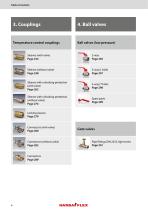
Temperature control couplings Ball valves (low pressure) Sleeves (with valve) Page 234 Sleeves (without valve) Page 248 Sleeves with unlocking protection (with valve) Page 263 Sleeves with unlocking protection (without valve) Page 274 Spare parts Page 299 Locking sleeves Page 279 Connectors (with valve) Page 280 Connectors (without valve) Page 282 Gate valves Pipe fittings DIN 2353, light series Page 301
Open the catalog to page 6
Hose clips Claw couplings Page 344 CLIC clamps Page 308 Plug-in couplings Page 354 Worm drive hose clamps Page 310 Hing bolt clamps Page 322 Clamping jaws Page 324 Sliding socket Sliding socket Page 358 Hose clamps Page 329 Retaining clamps Page 332 Water nozzles With hose connection Page 359 With claw connection Page 361
Open the catalog to page 7
Fire service applications Suction couplings Page 367 Fixed couplings Page 369 Cap fire hose couplings Page 371
Open the catalog to page 8
Air blast guns with nozzles Air blast guns with nozzles Page 382 Hose collars Threaded colars Page 429 Conical nozzles Page 434 Claw couplings Page 385 Conical nipples Page 439 Hose connectors Page 443 Claw couplings, rotating Page 392 Claw couplings MODY Page 396 Plug-in couplings Page 402 Spare parts Page 420
Open the catalog to page 9
Plastic conectors Plug valve Screw-on connectors Page 445 Double pug valve Page 481 Screw-in connectors Page 447 Plug valve for hammer drill Page 483 Screw-in sockets Page 455 Bulkhead connectors Page 458 Sealing plugs Page 469 Connectors for plastic pipes Connectors for plastic pipes Page 474
Open the catalog to page 10
Hydraulic fluids Fluid sampling sets Page 488 Individual parts Page 490 Oil binding agents Page 516 Partial flow filter systems Page 500
Open the catalog to page 11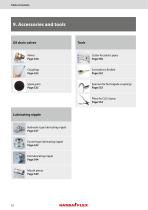
Cutter for plastic pipes Page 550 Screwdriver, flexible Page 552 Spare parts Page 525 Spanner for fire brigade couplings Page 553 Pliers for CLIC clamp Page 554 Lubricating nipple Hydraulic-type lubricating nipple Page 527 Funnel-type lubricating nipple Page 542 Flat lubricating nipple Page 544 Mouth pieces Page 549
Open the catalog to page 12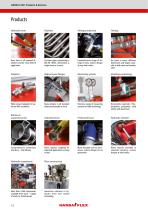
HANSA-FLEX Products & Services Hydraulic hoses Pipelines Fittings production Fittings Hose lines in all nominal di- Precision pipes conforming to Comprehensive range of fit- On hand in many different ameters and for every field of DIN EN 10305, deliverable as tings in stock, custom designs dimensions and shapes; avail- application single items or in series at very short notice able in both steel and stainless Adapters High pressure flanges Measuring systems Mounting technology Wide range of adapters for op- Many designs in all standard Extensive range of measuring Deliverable materials: Poly-...
Open the catalog to page 14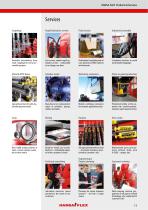
HANSA-FLEX Products & Services Available immediately from stock: couplings for every con- ceivable purpose Metal &PTFE hoses Special hose linesfor solid, liq- Rapid hydraulics service Full-service mobile rapid hy- draulics service - contactable Cylinder repair repair of cylinders, pumps, Fluid service care, provision of filter systems Workshop containers Mobile workshop containers for extreme application areas Industrial assembly Scheduled activities to avoid unscheduled stoppages Plant-in-plant production tomer's site - perfect synchro- nisation, rapid response times Seals Kitting Kanban Hose...
Open the catalog to page 15
Technical Information Technical Information
Open the catalog to page 16
Technical Information SAFETY GUIDELINES AND INFORMATION ON THE ASSEMBLY, OPERATION, MAINTENANCE AND INSPECTION OF HANSA-FLEX INDUSTRIE HOSE LINES 1.1 Fundamental Guidelines for the Assembly of Hose Lines 1.2 Additional Information on the Assembly of Hose Lines 2.1 Commissioning and Intended Use of Hose Lines 2.2 Storage of Hose Lines 2.3 Additional Information on the Storage of Hose Lines 3.1 Inspection Intervals for Hose Lines 3.2 Inspection Criteria for Hose Lines 3.3 Repair and Painting of Hose Lines 3.4 Additional Information on the Maintenance of Hose Lines
Open the catalog to page 17
Technical Information Hydraulic lines are capable of causing serious personal injury and environmental damage, but this danger is very often underestimated in practice. The wrong choice of hoses or improper use of hoses, hose lines, fittings and accessories can impair the functional safety of the product and lead to failure and hence personal injury or material damage. In extreme cases, violently spraying oil and ruptured lines can even cause fatal injuries. We therefore recommend most strongly that these safety guidelines are strictly observed! The owner of machines also bears a particular responsibility....
Open the catalog to page 18
Technical Information 1. ASSEMBLY 1.1 FUNDAMENTAL GUIDELINES FOR THE ASSEMBLY OF HOSE LINES In order to ensure the safe function of hose lines and to avoid shortening their service lives by additional loads, the following requirements have to be satisfied: • Hose lines may be assembled only by appropriately qualified personnel • Hose lines must be installed in such a way that they are accessible at all times and are not obstructed in their natural position and movement • Hose lines must generally not be subjected to torsion or compression by external influences during operation • The smallest...
Open the catalog to page 19All HANSA FLEX AG catalogs and technical brochures
 SKS ZUBS MULTI FL
1 Page
 SKS IR FS MULTI FL
1 Page
 SKS HL 2 MULTI R
1 Page
 SKM IR 2 MULTI Q
1 Page
 SKS IR 2 MULTI Q
1 Page
 MBA
MBA1 Page
 KBA
KBA1 Page
 KBO
KBO1 Page
 TF 200
1 Page
 TF 100
1 Page
 KP 200 S
1 Page
 KP 200 PRO (2SC)
1 Page
 KP 200 NO (2SC)
1 Page
 KP 200 RAIL
1 Page
 KP 200 (2SC)
1 Page
 HD 200 T (2SN)
1 Page
 HD 200 S (2SN)
1 Page
 HD 200 RM (2SN)
1 Page
 KP 200 RM
1 Page
 HD 200 (2SN)
1 Page
 KP 100 RAIL
1 Page
 KP 100 P
1 Page
 KPZ 200
1 Page
 KP 100 S (1SC)
1 Page
 KP 100 (1SC)
1 Page
 HD 100 T (1SN)
1 Page
 Connection Technology
1060 Pages
 Catalogue Sealing Technology
339 Pages
 Catalogue Metal Hoses
100 Pages
 Catalogue Hydraulic components
484 Pages
 PR V1 (M)
1 Page
 SKM HL / SKM HS
2 Pages
 KAX
KAX1 Page
 AKM IM ME
1 Page
 OR 70° Shore EPDM
1 Page
 Pneumatic Catalogue
1156 Pages
 Hydraulic Component
143 Pages
 Hose Technology
692 Pages
 HD 100 (1SN)
1 Page
 Compact Catalogue
608 Pages
 PYRO WAS RT
1 Page
 KUEHLER
1 Page
 KUEHLER SBL
1 Page