1. Catalogs
  2. HANSA FLEX AG
  3. Catalogue Metal Hoses
video corpo

Catalogue Metal Hoses

Catalogue Metal Hoses
1 / 100 PagesView full catalog

Catalogue Metal Hoses

Product catalog summary
Overview: This document provides comprehensive technical information on metal hoses, including specifications, installation, operation, and maintenance, intended for professionals in the hydraulics sector.
1. Product Description: Stainless steel and PTFE hose lines are detailed, including manufacturing processes, marking, and compliance with engineering standards. These hoses are designed for specific operating conditions and undergo rigorous testing.
2. Storage and Installation: Proper storage is crucial to prevent damage and contamination. Hoses should be stored dry, strain-free, and kink-free. Installation must be performed by qualified personnel, adhering to guidelines to avoid axial and torsional loads, and ensuring correct bending radii.
3. Commissioning and Operation: During operation, it is essential to observe pressure, temperature, and bending limits. Hoses must be used as intended, with precautions against burns and electrostatic discharge. Safety measures should be in place to prevent hazards.
4. Maintenance: Regular inspections are necessary to ensure safety. Damaged hoses must be replaced immediately, and repairs are not permitted. Maintenance intervals should be based on load and risk assessments.
5. Installation Requirements: Guidelines for handling and installing hoses include avoiding torsional loads, ensuring correct length and bending, and preventing kinks and buckling. Proper installation prevents premature failure.
6. Reduction Factors: Tables for dynamic and thermal reduction factors adjust the nominal pressure and bending radii based on operating conditions.
7. Design Considerations: The design of hose lines must consider operating conditions to ensure safety. The weakest component determines the nominal pressure, and reduction factors adjust for temperature and dynamic conditions.
8. Thermal Expansion: Metal hoses must accommodate thermal expansion without axial loading. Installation as a U-bend is recommended to handle large expansions.
9. Special Applications: Technical data for metal hose lines used in the food and chemical industries highlight differences in hose profiles for effective cleaning and residue removal.
Technical Specifications: Detailed specifications for various types of metal hoses and expansion joints include internal and external diameters, bending radii, operating pressures, and temperature ranges. Materials used are primarily stainless steel, with specific grades mentioned for different applications.
Procedures and Installation: Instructions for installation and use emphasize considering dynamic and thermal reduction factors when applying pressure values. A questionnaire for selecting appropriate expansion joints and hose lines requires input on movement types, operating conditions, and additional services like pressure testing and cleaning.
Standards and Approvals: Hoses conform to DIN EN ISO 10380 standards, ensuring quality and safety. Approvals for use with gases are specified according to DVGW Worksheet G 260 and DIN 3384, with additional certifications like CE, DNV GL, and others mentioned.
Recommendations and Best Practices: Recommendations include selecting the correct hose type based on application needs, such as resistance to corrosion and suitability for aggressive media. The document advises on considering the dynamic and thermal reduction factors for pressure values and highlights the availability of custom designs upon request.
Data Summary: Tables provide detailed measurements and specifications for different hose models, including identification codes, dimensions, pressure ratings, and weight per meter. These tables are crucial for selecting the appropriate hose for specific industrial applications.
Specifications: Temperature ranges from -200 °C to 550 °C for metal hoses and -70 °C to 260 °C for PTFE hoses. Materials include stainless steel (1.4541, 1.4404) for metal hoses and PTFE for PTFE hoses. Design features include parallel corrugation, single or double wall, with or without braiding.
Applications: Metal hoses are suitable for high-pressure applications and small bending radii, while PTFE hoses are used in chemical and food industries, suitable for low to medium pressure applications.
Performance Parameters: Pressure values vary based on hose type and size; dynamic and thermal reduction factors must be considered. Bending radius is specified for each hose type, important for installation and operation.
Product Variants: Variants include FBO, FPCA, DCA, DCO, DCB for metal hoses with varying braiding options, and TF 100, TF 200 for PTFE hoses with smooth inliner and braiding options.
Ordering Information: Detailed ordering information and product versions are available on the Hansa-Flex website.
Notes: Pressure values apply to hoses only, and reduction factors must be considered for temperatures above 50 °C for metal hoses and 120 °C for PTFE hoses. FDA approval for PTFE base material.
Specifications: PTFE hoses are made from FDA-approved PTFE, with temperature ranges from -70°C to 260°C, and specific designs up to 400°C. Designs include smooth inliner, thick-walled, helically wound, multilayer, and coil-corrugated options, with braiding options including no braiding, single or double steel wire braiding, and fiberglass anti-slip layers.
Applications: Suitable for high and low-pressure applications with small bending radii, medium pressure applications with hydraulic fluids and aggressive media, and low-pressure applications suitable for conveying exhaust gases.
Properties: Prevents residue buildup due to smooth inner liner, good self-cleaning properties, suitable for foodstuffs, and antistatic designs available for specific applications.
Pressure and Safety: Pressure values apply to hoses only, with safety factors against bursting (SF 3 or 4). Pressure reduction factors must be considered at elevated temperatures.
Ordering Information: Detailed product versions and ordering information are available on the Hansa-Flex website, with custom designs available upon request.
Key Data from Tables: Hoses are identified by internal and external diameters, minimum bending radius, operating pressure at 20°C, and weight per meter. Specific models like KTF, TFW, TFS, ATWE, AFW, and AVX are detailed with their respective dimensions and pressure ratings.
Overview: The document provides detailed specifications and applications for various types of hose fittings and connectors, primarily focusing on metal hoses. It includes information on protective helixes, connection fittings, and different connector types, both in steel and stainless steel variants.
Specifications: Various models of round spring steel wire protective helixes, such as SSR 37-2 VA, SSR 40-2 VA, etc., are listed with their respective dimensions and applications. These helixes are designed to protect hoses against external abrasion and to reinforce the bending radius.
Applications: The primary application of these products is for hose lines subjected to shearing loads during movement. They serve as external protection and reinforcement for hose lines.
Materials: Materials used include stainless steel for the protective helixes and both steel and stainless steel for the connectors.
Ordering Information: Web links are provided for ordering different product versions, such as SSRVA and WAAVA, indicating the availability of various sizes and designs upon request.
Connector Types: Several connector types are detailed, including WA A and WA A VA, WA AFL and WA AFL VA, WA AOL and WA AOL VA, WA HL and WA HL VA, WA AFS and WA AFS VA, WA AOS and WA AOS VA, WA HS and WA HS VA, and WA AB and WA AB VA, each adhering to specific DIN and ISO standards.
Standards and Codes: The document references several standards, including DIN 3863, DIN 2353, ISO 8434-1, ISO 228-1, and BS 5200, ensuring compatibility and quality assurance for the fittings and connectors.
Additional Notes: Other designs are available upon request, and width across flats values are provided for reference purposes.
Specifications: Connectors are identified by a code indicating type, nominal diameter (DN), and pressure rating (PN). Materials include steel, stainless steel, malleable cast iron, red bronze, and copper. Standards include ISO 228-1, ISO 8434-6, BS 5200, DIN EN 10226, ISO 7-1, and SAE J514.
Applications: Connectors are designed for use with metal hoses, providing secure and reliable connections in various industrial applications. Different sealing forms are available, including 60° inner cone, flat sealing, and thread seal, depending on the connector type.
Product Variants: Connectors are available in different configurations, such as straight construction, with options for external or internal threads. Variants include WA HB, WA AR, WA HR, WA IR, WA HN, WA AJ, WA HJ, and WA FL, each with specific features and material options.
Ordering Information: Detailed ordering information is available on the Hansa-Flex website, with specific URLs provided for each connector type. Custom designs are available upon request, catering to specific industrial needs.
Notes: Width across flats values are provided for reference purposes. Working pressure ratings are specified for temperatures ranging from -20 °C to 120 °C, with adjustments for higher temperatures up to 200 °C.
Specifications: Connectors are available in PN6, PN10, PN16, and PN40 pressure ratings. Materials include steel, stainless steel, and combinations thereof for collars, flanges, and pipe sockets. Temperature resistance varies, with soldered variants up to 200°C and welded stainless steel variants up to 550°C. Standards include DIN 2673, DIN 2641, DIN 2656, and DIN EN 1092-1.
Applications: Designed for use as connection fittings for metal hoses in various industries, including food processing, chemical, and water supply. Suitable for media such as oil, water, steam, gases, fuels, and more.
Construction and Design: Connectors are straight in construction with flat sealing forms. Available in different configurations such as short stub ends, plain collars, and welding neck flanges with loose or fixed flanges.
Ordering Information: Product versions are available in different material combinations and pressure ratings. Custom designs can be requested. Web links are provided for detailed product information and ordering.
Technical Values for Seals: Compressibility, resilience, and creep resistance values are provided for seals of 2 mm thickness. Seals are made from aramid fibers bonded with NBR, suitable for high-pressure applications.
Conclusion: This comprehensive guide serves as a reference for selecting appropriate metal hose connectors and fittings based on specific industrial requirements, ensuring compatibility with existing systems and adherence to international standards.
See more

Catalog excerpts

Catalogue Metal Hoses-2

HANSA-FLEX – System Partner for Hydraulics Hose Replacement Service – 24h hour rapid response Our 280 service vans from the hydraulic emergency service are always just a call away. Whether on the construction site, during the harvest or in industrial applications: in case of a machine failure the job is carried out on site – and around the clock. Industrial Service – maintain and optimise Your machines must be running, around the clock. Preventative maintenance of the HANSA-FLEX Industrial Services helps you to save money and guarantees maximum machine uptime. We will advise you from the selection...

 Open the catalog to page 2

Catalogue Metal Hoses-3

Metal Hoses Technical Information Hose fittings Subject Index / Index Metal hoses – Date: 10/2015

 Open the catalog to page 3
Catalogue Metal Hoses-4

2 HANSA^FLEX Metal hoses-Date: 10/2015

 Open the catalog to page 4
Catalogue Metal Hoses-5

Metal hose connectors Metric connectors Page 48 Imperial connectors Page 55 Pipe connectors Page 64 Fittings for the food industry Page 77 Flange connections Page 80 Metal hoses – Date: 10/2015

 Open the catalog to page 5
Catalogue Metal Hoses-6

Technical Information Metal hoses – Date: 10/2015

 Open the catalog to page 6
Catalogue Metal Hoses-7

Technical Information 1. INSTRUCTION MANUAL FOR STORAGE, INSTALLATION, OPERATION & MAINTENANCE Product description Pressure equipment type: Stainless steel hose lines, PTFE hose lines in various versions (nominal sizes, lengths, materials, connection fittings etc.) In accordance with HANSA-FLEX nomenclature Marking (minimum scope): Manufacturer's marking (HF-I0)/ Manufacturing date (MM, YYYY) 1.1 GENERAL The hose lines are designed for the prevailing operating conditions. They are manufactured by expert personnel using proven and approved manufacturing methods. The hose lines undergo a final...

 Open the catalog to page 7
Catalogue Metal Hoses-8

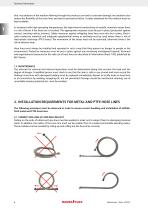
Technical Information tion. Incrustations in the medium flowing through the products can lead to corrosion damage. Incrustations also reduce the flexibility of the hose lines and lead to premature failure. A safety datasheet for the medium must be kept available. In situations with high operating temperatures, the high thermal conductivity of metallic materials means there is a risk of burns if the hose line is touched. The appropriate measures must be put in place (protection against contact, warning notices, barriers). Safety measures against whipping hose lines must also be in place. Electrically...

 Open the catalog to page 8
Catalogue Metal Hoses-9

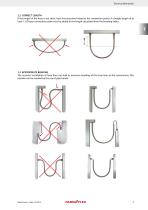
Technical Information 2.2 CORRECT LENGTH If the length of the hose is too short, hose lines become kinked at the connection points. A straight length of at least 1 x DN per connection point must be added to the length calculated from the bending radius. 2.3 APPROPRIATE BENDING The incorrect installation of hose lines can lead to excessive bending of the hose lines at the connections. This mistake can be avoided by the use of pipe bends. Metal hoses – Date: 10/2015

 Open the catalog to page 9
Catalogue Metal Hoses-10

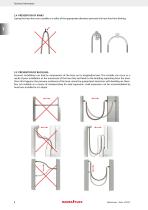
Technical Information 2.4 PREVENTION OF KINKS Laying the hose line over a saddle or a roller of the appropriate diameter prevents the hose line from kinking. 2.5 PREVENTION OF BUCKLING Incorrect installation can lead to compression of the hose on its longitudinal axis. This mistake can occur as a result of poor installation or the movement of the hose line and leads to the braiding separating from the hose. Once this happens, the pressure resistance of the hose cannot be guaranteed. Hose lines with braiding are therefore not suitable as a means of compensating for axial expansion. Axial expansion...

 Open the catalog to page 10
Catalogue Metal Hoses-11

Technical Information 2.6 TORSIONAL MOVEMENT The greatest mistake during installation is to end up with the hose line twisting during operation. Torsional movement leads to early failure of the hose line. Ensure that the pipe and hose axes and the direction of movement lie in the same plane. During installation, the hose line must be held with a second spanner. This ensures that the hose line cannot be subjected to torsion during installation. Metal hoses – Date: 10/2015

 Open the catalog to page 11
Catalogue Metal Hoses-12

Technical Information 3. REDUCTION FACTORS FOR METAL HOSES 3.1 DYNAMIC REDUCTION Table of dynamic reduction factors kd: No vibration, slight, slow movement Slight vibration, frequent, uniform movement Significant vibration with continuous movement Static or uniform flow Pulsating and dynamic flow Rhythmic and intermittent flow Highly intermittent flow Movement / flow 3.2 THERMAL REDUCTION Table of thermal reduction factors kt: Operating temp. °C Machining steel In acc. with DIN 3859-1 up to max. 120 °C, manufacturerdependent up to 200 °C, reduction subject to separate request

 Open the catalog to page 12
Catalogue Metal Hoses-13

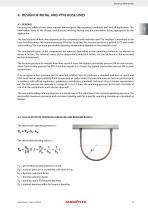
Technical Information 4. DESIGN OF METAL AND PTFE HOSE LINES 4.1 GENERAL Ensuring the safety of hose lines requires knowledge of the operating conditions and field of application. This information leads to the design, manufacture, marking, testing and documentation being appropriate for the application. The load capacity of hose lines depends on the components and methods used. The “weakest” component of the hose line determines the nominal pressure PN of the hose line. The nominal pressure is valid at 20 °C and under static loading. The maximum permissible operating temperature depends on the...

 Open the catalog to page 13
Catalogue Metal Hoses-14

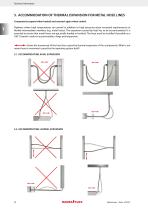
Technical Information 5. ACCOMMODATION OF THERMAL EXPANSION FOR METAL HOSE LINES Components expand when heated and contract again when cooled. Pipelines where high temperatures can prevail in addition to high pressures place increased requirements on flexible intermediate members (e.g. metal hoses). The expansion caused by heat has to be accommodated. It is essential to ensure that metal hoses are not axially loaded or buckled. The hose must be installed if possible as a 180° U-bend in order to accommodate a large axial expansion. : shows the movement of the hose line caused by thermal expansion...

 Open the catalog to page 14
Catalogue Metal Hoses-15

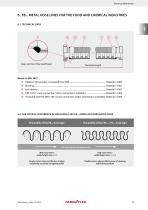
Technical Information 6. FB... METAL HOSE LINES FOR THE FOOD AND CHEMICAL INDUSTRIES 6.1 TECHNICAL DATA Gap- and burr-free weld bead Nominal length 6.2 THE CRITICAL DIFFERENCE IN THE HANSA-FLEX FB... ANNULAR CORRUGATED HOSE The profile of the FB... hose type The profile of the FPC... / PC... hose type Flow during the cleaning process Wide wave with a width/height ratio = 1:1 High wave with a width/height ratio >= 1:2 Simple vortex cleans and flushes residues completely out of the corrugated profile Double vortex reduces effectiveness of cleaning and flushing residues Metal hoses – Date: 10/2015...

 Open the catalog to page 15

All HANSA FLEX AG catalogs and technical brochures

  1. MBA

    1  Page

  2. KBA

    1  Page

  3. KBO

    1  Page

  4. TF 200

    1  Page

  5. TF 100

    1  Page

  6. KP 200 S

    1  Page

  7. KP 200 RAIL

    1  Page

  8. KP 200 (2SC)

    1  Page

  9. KP 200 RM

    1  Page

  10. HD 200 (2SN)

    1  Page

  11. KP 100 RAIL

    1  Page

  12. KP 100 P

    1  Page

  13. KPZ 200

    1  Page

  14. KP 100 (1SC)

    1  Page

  15. PR V1 (M)

    1  Page

  16. KAX

    1  Page

  17. AKM IM ME

    1  Page

  18. Hose Technology

    692  Pages

  19. HD 100 (1SN)

    1  Page

  20. PYRO WAS RT

    1  Page

  21. KUEHLER

    1  Page

  22. KUEHLER SBL

    1  Page

*Prices are pre-tax. They exclude delivery charges and customs duties and do not include additional charges for installation or activation options. Prices are indicative only and may vary by country, with changes to the cost of raw materials and exchange rates.