
- Catalogs
- Hamilton Process Analytics
- Hamilton Sensors for Cultivated Meat and Seafood

Hamilton Sensors for Cultivated Meat and Seafood

Hamilton Sensors for Cultivated Meat and Seafood
The global demand for meat and seafood is projected to rise significantly by 2050, highlighting the need for sustainable production methods. Cultivated meat and seafood present a viable solution but face challenges such as regulatory approval, taste development, scalability, and cost-effectiveness.
Process Analytical Technology (PAT)
Commercial Viability: To achieve cost-effective production, it is essential to optimize cell growth conditions, including feeding strategies and environmental parameters like pH and dissolved gases.
Media Optimization: Media costs account for 55-95% of production expenses. Utilizing real-time monitoring and data-driven media formulation can reduce these costs and enhance yields.
Scaling Strategies: Scaling up production requires optimizing conditions and employing in-line PAT for real-time feedback to ensure efficient cell growth and high yields.
The Cultivated Meat and Seafood Process
This process involves deriving cell lines from animal cells, expanding them in bioreactors, and differentiating them into final products. Monitoring key parameters such as pH, dissolved oxygen, and cell density is crucial for optimizing growth and product quality.
Recommended Products and Sensors
Hamilton provides a variety of sensors for monitoring critical parameters in the cultivation process, including:
- Viable Cell Density Sensor: Offers real-time metrics for process control.
- Conductivity Sensor: Ensures water purity and media quality.
- pH Sensor: Maintains optimal pH levels for cell growth.
- Dissolved CO2 Sensor: Regulates CO2 levels for improved yields.
- Dissolved Oxygen Sensor: Essential for cellular respiration and growth.
Intelligent Sensor Revolution
Intelligent sensors provide advanced diagnostics and reduce operational costs. They deliver real-time data, which is crucial for efficient process control and cost reduction.
Conclusion
Hamilton's advanced sensor technology facilitates the efficient and cost-effective production of cultivated meat and seafood, enhancing process control and scalability.
Catalog excerpts

CULTIVATED MEAT AND SEAFOOD Innovative Solutions for Process Analytics
Open the catalog to page 1
INTRODUCTION By 2050, the annual global demand for meat is set to grow from 350 billion kg to 460-570 billion kg, while seafood is predicted to double to ~62 billion kg compared to today's consumption. This, along with environmental concerns including agricultural land availability and over-fishing highlights the need to find sustainable sources. Foods produced by cultivated methods could become staple components of future diets worldwide, however, developing this revolutionary technology is scientifically and culturally challenging. Critical hurdles include regulatory approval, developing a...
Open the catalog to page 2
THE CULTIVATED MEAT AND SEAFOOD PROCESS Cultivated Meat and Seafood processes rely on the growth of large volumes of cells either as the end-product themselves, or as synthesizers of biomolecules. Where can in-line sensor systems be used during the cultivated meat process? The main step where in-line sensors can help to improve process performance is at the primary bioreactor during proliferation. 1. Stem cells and muscle cells harvested from target meat (initial focuses are chicken, beef, pork) and seafood (e.g., salmon, tuna, white fish, crab, lobster, shrimp) are multiplied through a seed...
Open the catalog to page 3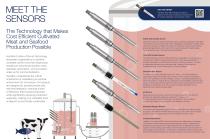
Flamilton also offers Single-Use Sensor options for pH and conductivity measurement for media preparation and process control. The Technology that Makes Cost Efficient Cultivated Meat and Seafood Production Possible Hamilton’s state-of-the-art technology empowers organizations to achieve complete control over their bioprocess, resulting in reduced production costs, seamless automation, and successful scale-up for commercialization. Hamilton understands the critical importance of maintaining an optimal environment for cell culture. Our sensors are designed to provide precise and real-time feedback,...
Open the catalog to page 4
THE INTELLIGENT SENSOR REVOLUTION Over 95% of process engineers surveyed find value in using intelligent sensors Less than half of engineers felt they fully utilized their smart sensor. The key to getting the most out of your smart sensor is choosing the implementation that best fits your application. Hamilton offers two versions of smart sensors each equipped with our best-in-class measurement technology. Cost Comparison Benefits of Intelligent Sensors 89% Lower Maintenance Costs Lower Documentation Costs CONTROLLED L ABORATORY ENVIRONMENT MOBILE DIAGNOSTICS AUTOMATIC REPORT GENERATION USER...
Open the catalog to page 5
HAMILTON SENSORS DETAILS AND BENEFITS VisiFerm Family The VisiFerm is the optimal optical process sensor for the measurement of dissolved oxygen in cultured food applications and processes. It has significant advantages compared to classical Clark cells. Available with the innovative Arc technology. No polarization time required Easily replaceable sensor cap Digital and analog (4—20 mA) signal output ECS-mode available (Clark cell simulation) The EasyFerm Bio families of pH and ORP sensors are ideal for biotech and cultivated food applications, like fermentations, where autoclavations, steam...
Open the catalog to page 6
HAMILTON SENSORS DETAILS AND BENEFITS (CONTINUED) The Incyte sensors enable realtime, on-line measurement of viable cells in cultivated food, yeast, and fermentation processes. On-line measurement allows the detection of events and responses in real-time without sampling. The CO2NTROL sensor performs online measurement of dissolved carbon dioxide using MIR (midinfrared) wavelengths. Insensitive to media changes, microcarriers, dead cells Detect changes in physiology with frequency scanning Direct quantification of dissolved CO2 Solid-state sensor requiring minimal maintenance Early detection...
Open the catalog to page 7
To find a subsidiary or distributor in your area, please visit, www.hamiltoncompany.com/process-analytics/support. 14
Open the catalog to page 8
SCAN TO READ OUR APP NOTE Potential to Maximize Cultivated Meat Productivity Through VCD In-Situ Measurement © 2023 Hamilton Company. All rights reserved. All trademarks are owned and/or registered by Hamilton Company in the U.S. and/or other countries. Lit. No. 10166122/00 - 10/2023 HAMILTON To find a representative in your area, please visit: www.hamiltoncompany.com/contacts Hamilton Americas & Pacific Rim Hamilton Company Inc. 4970 Energy Way Reno, Nevada 89502 USA Tel: +1-775-858-3000 Fax: +1-775-856-7259 [email protected] Hamilton Europe, Asia & Africa Hamilton Bonaduz A.G. Via Crusch...
Open the catalog to page 9All Hamilton Process Analytics catalogs and technical brochures
 Polilyte PRO VP 120
2 Pages
 Polilyte Plus PHI Arc 120
2 Pages
 Polilyte Plus HB Arc 120
2 Pages
 EasyFerm Plus HB S8 120
2 Pages
 EasyFerm Plus HB K8 120
2 Pages
 Incyte Arc Expert - 120
2 Pages
 Dencytee RS485 120
2 Pages
 Conducell 4UTF Arc 120
2 Pages
 Conducell UPW PG 13,5
1 Page
 Conducell 4USF Arc 120
2 Pages
 Conducell 4UTF VP 120
1 Page
 Conducell 4USF VP 120
1 Page
 Conducell 4UPtF VP 120
1 Page
 Conducell 4UPtF Arc 120
2 Pages
 Conducell 4UHF VP 120
1 Page
 Conducell 4UHF Arc 120
2 Pages
 Conducell 2DC-PG
1 Page
 CO₂NTROL RS485 120
2 Pages
 VisiWater DO Arc 120 FC10
2 Pages
 VisiTrace RS485 120 L1
2 Pages
 VisiTrace mA 120 L1
2 Pages
 VisiFerm RS485-ECS 120 H4
2 Pages
 VisiFerm RS485-ECS 120 H3
2 Pages
 VisiFerm RS485-ECS 120 H2
2 Pages
 VisiFerm RS485-ECS 120 H0
2 Pages
 VisiFerm mA 120 H4
2 Pages
 VisiFerm mA 120 H3
2 Pages
 OxyGold G Arc 120
2 Pages
 OxyGold G 120
2 Pages
 OxyGold B 120
2 Pages
 OxyFerm FDA VP 120
2 Pages
 OxyFerm FDA MS 120
2 Pages
 OxyFerm FDA Arc 120
2 Pages
 OxyFerm FDA 120
2 Pages
 Polilyte RX 120
2 Pages
 Polilyte PRO 120
2 Pages
 Polilyte Plus XP VP 120
2 Pages
 Polilyte Plus XP 120
2 Pages
 Polilyte Plus PHI S8 120
2 Pages
 Polilyte Plus PHI MS 120
2 Pages
 Polilyte Plus ORP S8 120
2 Pages
 Polilyte Plus ORP Arc 120
2 Pages
 Polilyte Plus HF S8 120
2 Pages
 Polilyte Plus HF MS 120
2 Pages
 Polilyte Plus HF Arc 120
2 Pages
 Polilyte Plus HB S8 120
2 Pages
 Polilyte Plus H S8 120
2 Pages
 Polilyte Plus H MS 120
2 Pages
 Polilyte Plus H Arc 120
2 Pages
 OneFerm pH VP 120 NTC
2 Pages
 EasyFerm Plus PHI MS 120
2 Pages
 Chemotrode P PHI 120
2 Pages
 OneFerm pH VP 120 Pt1000
2 Pages
 OneFerm pH VP 120 Pt100
2 Pages
 OneFerm pH K8 120
2 Pages
 MecoTrode VP 120
2 Pages
 MecoTrode HF MS 120
2 Pages
 FermoTrode 120
2 Pages
 EasyFerm Plus PHI S8 120
2 Pages
 EasyFerm Plus PHI K8 120
2 Pages
 EasyFerm Plus PHI Arc 120
2 Pages
 EasyFerm Plus ORP S8 120
2 Pages
 EasyFerm Plus ORP Arc 120
2 Pages
 EasyFerm Plus HB MS 120
2 Pages
 EasyFerm Plus HB Arc 120
2 Pages
 EasyFerm Bio PHI S8 120
2 Pages
 EasyFerm Bio PHI MS 120
2 Pages
 EasyFerm Bio PHI K8 120
2 Pages
 EasyFerm Bio PHI Arc 120
2 Pages
 EasyFerm Bio HB VP 120 Pt100
2 Pages
 EasyFerm Bio HB S8 120
2 Pages
 EasyFerm Bio HB MS 120
2 Pages
 EasyFerm Bio HB K8 120
2 Pages
 EasyControl 120
2 Pages
 EasyFerm Bio HB Arc 120
2 Pages
 Chemotrode VP 120
2 Pages
 ChemoTrode ORP 120
2 Pages
 ChemoTrode Bridge 120
2 Pages
 Chemotrode 120
2 Pages
 Hamilton CO2 Sensors
5 Pages
 Hamilton Single Use Sensors
5 Pages
 Arc Intelligent Sensors
7 Pages
 Hamilton Sensors for Biopharma
13 Pages


- Gas sensor
- Water pH sensor
- Water conductivity sensor
- Analog pH sensor
- Redox pH sensor
- Digital dissolved oxygen sensor
- Analog conductivity sensor
- Process dissolved oxygen sensor
- Digital pH sensor
- Optical dissolved oxygen sensor
- 4-electrode conductivity sensor
- 2-electrode conductivity sensor
- Wastewater conductivity sensor
- RS-485 dissolved oxygen sensor
- Modbus dissolved oxygen sensor
- Polarographic dissolved oxygen sensor
- Real-time dissolved oxygen sensor