


- Products
- Catalogs
- News & Trends
- Exhibitions
LCOS-SLM (Liquid Crystal on Silicon - Spatial Light Modulator) X15213 series

LCOS-SLM (Liquid Crystal on Silicon - Spatial Light Modulator) X15213 series
Catalog excerpts

LCOS-SLM (Liquid Crystal on Silicon - Spatial Light Modulator) X15213 series Control your light ! Shape your beam ! Improve your image ! The X15213 series devices are a reflective type of pure phase Spatial Light Modulators (SLMs), based on Liquid Crystal on Silicon (LCOS) technology in which liquid crystal (LC) is controlled by a direct and accurate voltage, and can modulate a wavefront of light beam. The LCOS-SLMs are carefully designed to achieve high light utilization efficiency from various points of view, such as reflectivity, aperture ratio and diffraction noise due to the pixel structure. The X15213 series can be controlled via a PC using the Digital Video Interface (DVI), which is a standard interface for PC displays. The distortions in the LCOS chip, such as wavefront distortion and non-linear response of the LC, are efficiently compensated by the controller. Easy PC control, precise and linear phase modulation characteristics can be accomplished with the X15213 series. They can also provide high diffraction efficiency and high light utilization efficiency. We also provide water cooled types with a built-in water-cooled heatsink for improved power handling capability. Pure, linear and precise phase control Laser material processing High light utilization efficiency Optical manipulation High diffraction efficiency Wavefront correction High power handling capability Pulse shaping Optical testing Reflective type LCOS chip inside the head
Open the catalog to page 1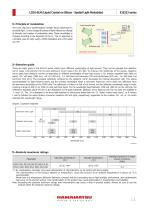
LCOS-SLM (Liquid Crystal on Silicon - Spatial Light Modulator) Input readout light The LCOS chip has a parallel-aligned nematic liquid crystal layer to modulate light. It only changes the phase of light without any change of intensity and rotation of polarization state. Phase modulation is changed according to the alignment of the LC. The LC alignment is controlled, pixel by pixel, using a CMOS backplane and a DVI signal via a PC. LCOS chip DVI signal LCOS-SLM CONTROLLER Controller Reflected light Modulated only phase ! KACCC1037EA Selection guide There are eight types in the X15213 series, which...
Open the catalog to page 2
LCOS-SLM (Liquid Crystal on Silicon - Spatial Light Modulator) Structure Head Parameter X15213 series Number of pixels (pixels) Effective area size (mm) Fill factor (%) Weight (g) 150 (Water cooled type: 550) Controller Parameter X15213 series Weight Supply voltage Power supply frequency Main unit Including cables AC (V) (Hz) (g) (g) 100 to 230 DVI signal Input signal DVI frame Power rate format level consumption (Hz) (pixels) (levels) (W) Digital Video Interface (DVI-D) 1280 × 256 60 15 1024 /USB-B (2.0 High-speed) Input signal Readout light wavelength (nm) 400 to 700 Light utilization efficiency...
Open the catalog to page 3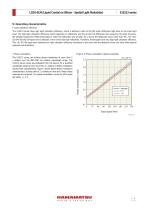
LCOS-SLM (Liquid Crystal on Silicon - Spatial Light Modulator) Operating characteristics Figure 2 Phase modulation characteristics Light utilization efficiency The X15213 series have high light utilization efficiency, which is defined a ratio of the 0th order diffraction light level to the input light level. The high light utilization efficiency mainly depends on reflectivity, and the amount of diffraction loss caused by the pixel structure. We adopted advanced CMOS technology to make the diffraction loss smaller. As a result, the diffraction loss is less than 5%. The -02/03/-04/-05/-06/-09 types...
Open the catalog to page 4
LCOS-SLM (Liquid Crystal on Silicon - Spatial Light Modulator) Diffraction efficiency Diffraction efficiency The X15213 series is a pure phase SLM with high precision phase control; therefore, it has high diffraction efficiency close to the theoretical values. Figure 3 shows images of diffracted spots, when a multi-level phase grating is formed in the X15213 series and Figure 4 shows typical diffraction efficiency characteristics. Here, the diffraction efficiency is defined I1/I0, I1 is intensity of the 1st order diffraction spot, I0 is the intensity of the 0th order light when no pattern is...
Open the catalog to page 5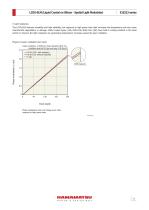
Laser irradiation test result LCOS-SLM (Liquid Crystal on Silicon - Spatial Light Modulator) Light resistance The LCOS-SLM features versatility and high reliability, but exposure to high power laser light increases the temperature and may cause characteristic degradation or damage. Water cooled types (-02L/-02R/-03L/-03R/-16L/-16R) have built-in cooling heatsink in the head section to improve the light resistance by suppressing temperature increases caused by laser irradiation. [Figure 6] Laser irradiation test result [Laser conditions: λ=1030 nm, beam diameter= 5.5 mm, irradiation level=50 W...
Open the catalog to page 6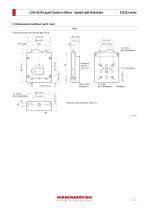
LCOS-SLM (Liquid Crystal on Silicon - Spatial Light Modulator) Dimensional outlines (unit: mm) Dimensional outlines (unit: mm) Head Quartz glass thickness 3 Tolerance unless otherwise noted: ±1
Open the catalog to page 7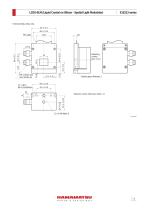
LCOS-SLM (Liquid Crystal on Silicon - Spatial Light Modulator) sional outlines (unit: mm) Quartz glass thickness 3 SMC compliant tube outer diameter 6 Tolerance unless otherwise noted: ±1 32.2 ± 0.15
Open the catalog to page 8
LCOS-SLM (Liquid Crystal on Silicon - Spatial Light Modulator) ensional outlines (unit: mm) SMC compliant tube outer diameter 6 Quartz glass thickness 3 (2 ×) 3.2 6.5 counterbore Tolerance unless otherwise noted: ±1
Open the catalog to page 9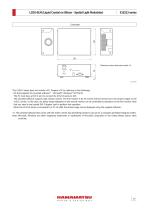
LCOS-SLM Dimensional outlines (unit: mm) (Liquid Crystal on Silicon - Spatial Light Modulator) 165 Tolerance unless otherwise noted: ±1 The X15213 series does not include a PC. Prepare a PC by referring to the followings: ∙ OS that supports the provided software*3 : Microsoft® Windows® XP/7/8/10 KACCA0458EA ∙ The PC must have a DVI-D port to connect the X15213 series to DVI. ∙ The provided software supports dual monitor control. The first monitor is for PC screen and the second one is for phase images on the X15213 series. In this case, the phase image displayed on the second monitor can be controlled...
Open the catalog to page 10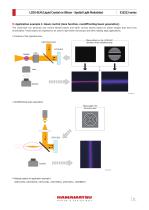
LCOS-SLM (Liquid Crystal on Silicon - Spatial Light Modulator) Application example 1: Beam control (lens function, nondiffracting beam generation) The LCOS-SLM can generate and control Bessel beams and other various beams based on phase images that have lens functionality. These beams are expected to be used in light sheet microscopy and other leading edge applications. Function of the cylindrical lens Function of the cylindrical lens Phase pattern on the LCOS-SLM (function of the cylindrical lens) Light sheet beam Nondiffracting beam generation Nondiffracting beam generation Phase pattern for...
Open the catalog to page 11All HAMAMATSU catalogs and technical brochures
 PHOTON COUTING HEAD
4 Pages
 SPAD MODULES
5 Pages
 LIGHTNINGCURE
29 Pages
 Xenon Flash Lamps
19 Pages
 ORCA-FUSION C14440-20UP
12 Pages
 NanoZommer series
8 Pages
 C13410 series
4 Pages
 C13410-06A
4 Pages
 PMA-12
8 Pages
 L12542
4 Pages
 FLAT EXCIMER
16 Pages
 OPTICAL PINHOLE INSPECTION UNITS
20 Pages
 Optical Gauge series
23 Pages
 L15208-01
3 Pages
 Pulsed Fiber Laser L15187
3 Pages
 L15856-01
3 Pages
 L14001-01
2 Pages
 L11854-336-05
2 Pages
 L14351-02
4 Pages
 LIGHTNINGCURE LC-L1V5
4 Pages
 GC-113A
2 Pages
 Infrared LED L14337-0085R
4 Pages
 Infrared LED L12509 series
9 Pages
 InGaAs camera C12741-11
2 Pages
 InGaAs camera C12741-03
2 Pages
 IMAGEMX2 series
8 Pages
 ORCA-Flash4.0V3 C13440-20CU
4 Pages
 ORCA-Fusion BT
9 Pages
 DIUTHAME
12 Pages
 J12853
2 Pages
 J12432-01
2 Pages
 J10919 SERIES
2 Pages
 Si APD S14644 series
6 Pages
 C15780-401
4 Pages
 CMOS area image sensor S14501
15 Pages
 H15460-40
4 Pages
 R14755U-100
2 Pages
 MPPC modules C14556 series
5 Pages
 Photo IC for rangefinder
14 Pages
 InGaAs APD G14858-0020AA
4 Pages
 Si APD S14124-20
3 Pages
 Si strip detector S13804
3 Pages
 Si photodiode S15289-33
4 Pages
 Si PIN photodiode S15137
4 Pages
 Si PIN photodiode S14605
3 Pages
 Si PIN photodiode S13993
3 Pages
 Si photodiodes S12915 series
4 Pages
 Si photodiode S12742 series
4 Pages
 Si photodiodes S12698 series
5 Pages
 Si PIN photodiode S12271
4 Pages
 Si photodiode S10625-01CT
5 Pages
 Si photodiode S10043
3 Pages
 Si photodiode S9981-01CT
5 Pages
 Si photodiode S9674
5 Pages
 Si photodiodes S9055 series
4 Pages
 Si PIN photodiode S8650
3 Pages
 Si photodiode S8559
3 Pages
 Si photodiodes S8552, S8553
4 Pages
 Si photodiode 8193
3 Pages
 Si photodiode S7686
4 Pages
 Si PIN photodiode S7478
4 Pages
 Si PIN photodiode S4707-01
3 Pages
 Si PIN photodiode S3994-01
3 Pages
 Si PIN photodiode S3759
4 Pages
 Si photodiode S2551
4 Pages
 Si photodiodes S2387 series
4 Pages
 Si photodiodes S2386 series
4 Pages
 Si photodiodes S2281 series
3 Pages
 Si photodiode S1787 series
3 Pages
 Si photodiodes S1337 series
6 Pages
 Si photodiodes S1336 series
6 Pages
 Si photodiodes S1227 series
5 Pages
 Si photodiodes S1226 series
6 Pages
 Si photodiode 16008-33
4 Pages
 Si PIN photodiode S13337-01
4 Pages
 C13398 series
5 Pages
 InGaAs Image sensors
17 Pages
 Thermopile detector T15770
3 Pages
 CMOS linear image sensor S14772
18 Pages
 Si APD S14645 series
6 Pages
 Si APD S14643-02
6 Pages
 One-dimensional PSD S14241
5 Pages
 MEMS mirror S13989-01H
9 Pages
 MEMS mirror S13124-01
10 Pages
 PHOTOMULTIPLIER TUBE R14657
2 Pages
 PHOTON COUNTING HEAD H12775
2 Pages
 MPPC® modules C14452 series
5 Pages
 MEMS-FPI spectrum sensor C14273
11 Pages
 Photodiode modules C10439 series
13 Pages
 Phototransistor S2829
4 Pages
 InGaAs APD G8931 series
4 Pages
 Hamamatsu News 2017 Vol. 1
36 Pages
 Hamamatsu News 2017:Cover Story
36 Pages
 Photomultiplier Tube Modules
76 Pages
 LIGHT SOURCES
23 Pages
 PHOTOTUBES
8 Pages
 FLAME SENSOR UVTRON
4 Pages
 Opto-semiconductor Modules
28 Pages
 PSD
PSD8 Pages
 InGaAs Photodiodes
20 Pages
 Infrared Detectors
36 Pages
 Photo IC
8 Pages
 Image Sensors
48 Pages
 Si Photodiodes
48 Pages
 Si APD
16 Pages
 MPPC®, MPPC modules
34 Pages
 Photonic Devices
44 Pages
 IMAGE INTENSIFIERS
20 Pages
 THERMOELECTRIC COOLED
4 Pages
 FLOW CELLS
4 Pages
 COMPACT HIGH VOLTAGE
2 Pages
 SCANBLOCK C10516
4 Pages
 Immunochromato-Reader C10066
4 Pages
 UV TRONR DRIVING
2 Pages
 PULSE DELAY GENERATOR C10149
4 Pages
 High sensitivity
2 Pages
 FOP (FIBER OPTIC PLATE)
3 Pages
 20 W XENON FLASH LAMP
4 Pages
 UV POWER METERS C6080 SERIES
2 Pages
 Si photodiodes
41 Pages
 Digital CCD Cameras, ORCA-HR
2 Pages


Archived catalogs
 PHOTOSENSOR AMPLIFIER
7 Pages
 FLAT PANEL TYPE
4 Pages
 Microfocus X-ray Sources
2 Pages
 Digital CCD Camera ORCA-HR
2 Pages
 EM-TDI CCD Camera C9100-03
2 Pages
 Infrared LED L10596-02
4 Pages
 Opto-semiconductor Catalog
38 Pages
 2008 Photonic Devices Catalog
32 Pages


- Digital imager
- Visible imager
- CMOS camera module
- Industrial camera module
- Measuring machine
- Full-color camera system
- Monitoring camera system
- Microscope
- Screening unit
- USB camera module
- Spectrometer
- Optical microscope
- Inspection system
- Compact imager
- Photoelectric sensor
- Inspection imager
- Laboratory microscope
- Rectangular photoelectric sensor
- Automatic inspection system
- USB 3.0 camera module