


- Products
- Catalogs
- News & Trends
- Exhibitions
Fluorescence lifetime spectrometer C16361 series

Fluorescence lifetime spectrometer C16361 series
Catalog excerpts

Fluorescence lifetime spectrometer C16361 series
Open the catalog to page 1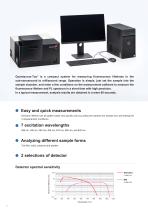
Quantaurus-Tau® is a compact system for measuring fluorescence lifetimes in the sub-nanosecond to millisecond range. Operation is simple, just set the sample into the sample chamber, and enter a few conditions on the measurement software to measure the fluorescence lifetime and PL spectrum in a short time with high precision. In a typical measurement, analysis results are obtained in a mere 60 seconds. Easy and quick measurements Emission lifetime can be gotten easily and quickly only by putting the sample into sample box and setting the 4 measurement conditions. Analyzing different sample forms...
Open the catalog to page 2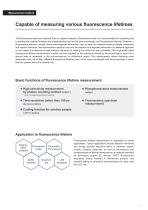
Capable of measuring various fluorescence lifetimes The fluorescence spectrum obtained from an organic material or fluorescent probe is a vital parameter for controlling and evaluating the material functions and characteristics such as the peak wavelength and fluorescence intensity. However, a fluorescence spectrum usually shows time-integrated information, and so when the material contains multiple substances and reactive elements, their fluorescence spectrum can only be acquired as integrated information. An effective approach in such cases is to observe the light emission dynamics by making...
Open the catalog to page 3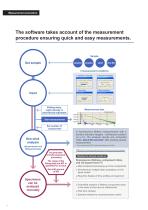
The software takes account of the measurement procedure ensuring quick and easy measurements. 4 measurement conditions Excitation wavelength Time range Shifting delay, Light intensity is automatically adjustable. Emission wavelength Stop conditions Measurement data Start measurement Set number of components One-click analysis In fluorescence lifetime measurements with a solution standard reagent - anthracene solution (QY=0.27), the analysis results are computed within about 60 seconds* after starting sample measurement * If pre-measuring the IRF (Instrument Response Function) deconvolution and...
Open the catalog to page 4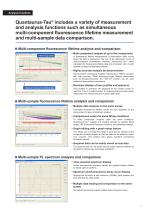
Quantaurus-Tau® includes a variety of measurement and analysis functions such as simultaneous multi-component fluorescence lifetime measurement and multi-sample data comparison. Multi-component fluorescence lifetime analysis and comparison Fitted decay curve Multi-component analysis of up to five components In fluorescence lifetime measurement, a phenomenon often occurs where the data is observed as the sum of the attenuation curves of multi-component fluorescence lifetimes. Quantaurus-Tau® easily calculates the fluorescence lifetime data and component ratio of each element by using the dedicated...
Open the catalog to page 5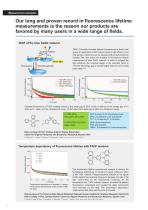
Our long and proven record in fluorescence lifetime measurements is the reason our products are favored by many users in a wide range of fields. TADF of the blue OLED material e TADF (Thermally activated delayed fluorescence) is known well as the 3rd generation OLED material which is high efficiency and cost saving, furthermore can be replaced with phosphorescence material. The data shows the example of fluorescence lifetime measurement of blue TADF material. In order to achieve the high efficiency, the molecule design is the important factor to minimize the energy gap of excited singlet state...
Open the catalog to page 6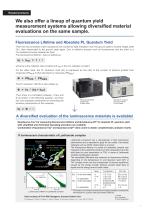
We also offer a lineup of quantum yield measurement systems allowing diversified material evaluations on the same sample. Fluorescence Lifetime and Absolute PL Quantum Yield There are two processes when substances are excited by light irradiation from the ground state to excited singlet state (S1), then deactivated to the ground state again. One is radiative process such as fluorescence and the other is a non-radiative process released as heat. The fluorescence lifetime τ (tau) is defined as k f + k nr = 1 / τ where kf is the radiative rate constant and knr is the non-radiative constant. On the...
Open the catalog to page 7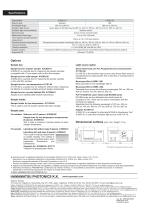
Type number Detector type Wavelength range Excitation light source Excitation light source switching Monochromator Measurement time range Time range for phosphorescence measurement Phosphorescence measurement Time axis channel Total time resolution Analysis function Supported OS C16361-01 C16361-02 Standard NIR 300 nm to 800 nm 380 nm to 1030 nm Seven types of LED light source (280 nm, 340 nm, 365 nm, 405 nm, 470 nm, 590 nm, 630 nm) Software control Czerny-Turner monochromator 4 ns to 10 s / full scale 200 μs to 10 s / full scale (option) Phosphorescence excitation wavelength (280 nm, 340 nm,...
Open the catalog to page 8All HAMAMATSU catalogs and technical brochures
 PHOTON COUTING HEAD
4 Pages
 SPAD MODULES
5 Pages
 LIGHTNINGCURE
29 Pages
 Xenon Flash Lamps
19 Pages
 ORCA-FUSION C14440-20UP
12 Pages
 NanoZommer series
8 Pages
 C13410 series
4 Pages
 C13410-06A
4 Pages
 PMA-12
8 Pages
 L12542
4 Pages
 FLAT EXCIMER
16 Pages
 OPTICAL PINHOLE INSPECTION UNITS
20 Pages
 Optical Gauge series
23 Pages
 L15208-01
3 Pages
 Pulsed Fiber Laser L15187
3 Pages
 L15856-01
3 Pages
 L14001-01
2 Pages
 L11854-336-05
2 Pages
 L14351-02
4 Pages
 LIGHTNINGCURE LC-L1V5
4 Pages
 GC-113A
2 Pages
 Infrared LED L14337-0085R
4 Pages
 Infrared LED L12509 series
9 Pages
 InGaAs camera C12741-11
2 Pages
 InGaAs camera C12741-03
2 Pages
 IMAGEMX2 series
8 Pages
 ORCA-Flash4.0V3 C13440-20CU
4 Pages
 ORCA-Fusion BT
9 Pages
 DIUTHAME
12 Pages
 J12853
2 Pages
 J12432-01
2 Pages
 J10919 SERIES
2 Pages
 Si APD S14644 series
6 Pages
 C15780-401
4 Pages
 CMOS area image sensor S14501
15 Pages
 H15460-40
4 Pages
 R14755U-100
2 Pages
 MPPC modules C14556 series
5 Pages
 Photo IC for rangefinder
14 Pages
 InGaAs APD G14858-0020AA
4 Pages
 Si APD S14124-20
3 Pages
 Si strip detector S13804
3 Pages
 Si photodiode S15289-33
4 Pages
 Si PIN photodiode S15137
4 Pages
 Si PIN photodiode S14605
3 Pages
 Si PIN photodiode S13993
3 Pages
 Si photodiodes S12915 series
4 Pages
 Si photodiode S12742 series
4 Pages
 Si photodiodes S12698 series
5 Pages
 Si PIN photodiode S12271
4 Pages
 Si photodiode S10625-01CT
5 Pages
 Si photodiode S10043
3 Pages
 Si photodiode S9981-01CT
5 Pages
 Si photodiode S9674
5 Pages
 Si photodiodes S9055 series
4 Pages
 Si PIN photodiode S8650
3 Pages
 Si photodiode S8559
3 Pages
 Si photodiodes S8552, S8553
4 Pages
 Si photodiode 8193
3 Pages
 Si photodiode S7686
4 Pages
 Si PIN photodiode S7478
4 Pages
 Si PIN photodiode S4707-01
3 Pages
 Si PIN photodiode S3994-01
3 Pages
 Si PIN photodiode S3759
4 Pages
 Si photodiode S2551
4 Pages
 Si photodiodes S2387 series
4 Pages
 Si photodiodes S2386 series
4 Pages
 Si photodiodes S2281 series
3 Pages
 Si photodiode S1787 series
3 Pages
 Si photodiodes S1337 series
6 Pages
 Si photodiodes S1336 series
6 Pages
 Si photodiodes S1227 series
5 Pages
 Si photodiodes S1226 series
6 Pages
 Si photodiode 16008-33
4 Pages
 Si PIN photodiode S13337-01
4 Pages
 C13398 series
5 Pages
 InGaAs Image sensors
17 Pages
 Thermopile detector T15770
3 Pages
 CMOS linear image sensor S14772
18 Pages
 Si APD S14645 series
6 Pages
 Si APD S14643-02
6 Pages
 One-dimensional PSD S14241
5 Pages
 MEMS mirror S13989-01H
9 Pages
 MEMS mirror S13124-01
10 Pages
 PHOTOMULTIPLIER TUBE R14657
2 Pages
 PHOTON COUNTING HEAD H12775
2 Pages
 MPPC® modules C14452 series
5 Pages
 MEMS-FPI spectrum sensor C14273
11 Pages
 Photodiode modules C10439 series
13 Pages
 Phototransistor S2829
4 Pages
 InGaAs APD G8931 series
4 Pages
 Hamamatsu News 2017 Vol. 1
36 Pages
 Hamamatsu News 2017:Cover Story
36 Pages
 Photomultiplier Tube Modules
76 Pages
 LIGHT SOURCES
23 Pages
 PHOTOTUBES
8 Pages
 FLAME SENSOR UVTRON
4 Pages
 Opto-semiconductor Modules
28 Pages
 PSD
PSD8 Pages
 InGaAs Photodiodes
20 Pages
 Infrared Detectors
36 Pages
 Photo IC
8 Pages
 Image Sensors
48 Pages
 Si Photodiodes
48 Pages
 Si APD
16 Pages
 MPPC®, MPPC modules
34 Pages
 Photonic Devices
44 Pages
 IMAGE INTENSIFIERS
20 Pages
 THERMOELECTRIC COOLED
4 Pages
 FLOW CELLS
4 Pages
 COMPACT HIGH VOLTAGE
2 Pages
 SCANBLOCK C10516
4 Pages
 Immunochromato-Reader C10066
4 Pages
 UV TRONR DRIVING
2 Pages
 PULSE DELAY GENERATOR C10149
4 Pages
 High sensitivity
2 Pages
 FOP (FIBER OPTIC PLATE)
3 Pages
 20 W XENON FLASH LAMP
4 Pages
 UV POWER METERS C6080 SERIES
2 Pages
 Si photodiodes
41 Pages
 Digital CCD Cameras, ORCA-HR
2 Pages


Archived catalogs
 PHOTOSENSOR AMPLIFIER
7 Pages
 FLAT PANEL TYPE
4 Pages
 Microfocus X-ray Sources
2 Pages
 Digital CCD Camera ORCA-HR
2 Pages
 EM-TDI CCD Camera C9100-03
2 Pages
 Infrared LED L10596-02
4 Pages
 Opto-semiconductor Catalog
38 Pages
 2008 Photonic Devices Catalog
32 Pages


- Digital imager
- Visible imager
- CMOS camera module
- Industrial camera module
- Measuring machine
- Full-color camera system
- Monitoring camera system
- Microscope
- Screening unit
- USB camera module
- Optical microscope
- Inspection system
- Compact imager
- Photoelectric sensor
- Inspection imager
- Laboratory microscope
- Rectangular photoelectric sensor
- Automatic inspection system
- USB 3.0 camera module