
- Catalogs
- halstrup-walcher GmbH
- Direct drives and positioning systems catalog


- Company
- Products
- Catalogs
- News & Trends
- Exhibitions
Direct drives and positioning systems catalog

Direct drives and positioning systems catalog
Halstrup-Walcher specializes in automatic format adjustment solutions for machines, focusing on positioning systems, pressure measurement technology, and calibration services. The company is committed to quality, cost-efficiency, and punctuality, backed by ISO 9001:2015 and ISO 14001:2015 certifications.
Positioning systems include motors, gears, absolute encoders, and motor control systems with various bus communications. They are designed for high precision and quick format changes, enhancing machine availability through condition monitoring.
High-precision instruments for pressure measurement are provided, including transmitters, calibration devices, and digital manometers, suitable for cleanrooms and air conditioning technology.
The company operates a DAkkS-accredited calibration laboratory, offering DAkkS or ISO calibration certificates for pressure measuring instruments.
Lean management is employed to optimize processes, focusing on eliminating faults and waste. Daily employee consultations address and resolve issues promptly, fostering a culture of continuous improvement.
The document provides a detailed product overview, including various series of positioning systems (PSE, PSS, PSW, PSD) with specifications on IP protection classes, bus communication, and wiring options.
Automated positioning systems offer time savings, increased quality, and self-monitoring capabilities, supporting predictive maintenance and reducing errors in format changeovers.
Solutions with different IP protection classes and a wide range of bus communication standards are offered, catering to diverse application needs.
Positioning systems can be connected directly or indirectly to control units, with direct wiring offering space and cost advantages, while indirect wiring saves time and cables.
- Reduced cabling and connectors due to the use of a single cable for positioning systems, minimizing costs and cable clutter.
- Modular machine design supported by a hub/gateway system, reducing bus nodes and allowing for flexible component integration.
- IO-Link connection allows for easy changes in bus communication by exchanging the master interface.
- Power and communication can be supplied via Y-coded or D-coded cables, with specific configurations for Ethernet-based buses.
- Torque calculation for vertical adjustments is provided, with examples for different spindle types (ball screw and trapezoidal threaded spindle).
- Positioning systems offer various IP protection classes (IP 54, IP 65, IP 68) and are compatible with multiple bus systems.
- Systems include absolute measurement systems, ensuring precise positioning without the need for reference runs.
- Separate power supplies for motor and control units prevent interference and ensure bus communication remains available during emergencies.
- Optional brakes and self-holding torque options are available for maintaining positions when power is off.
- Torque limiting to prevent overloads, with allowances for temporary peak levels.
- Spindle offset run to eliminate inaccuracies due to spindle lash.
- Intelligent differentiation between obstacles and dirt to ensure smooth operation.
- Synchronization capabilities for parallel movement of objects by multiple positioning systems.
- Easy mounting with hollow shafts and integrated address switches for straightforward setup and maintenance.
- Manual adjustment options available for specific applications.
The PSE, PSS, and PSW series offer a compact, flexible, and reliable solution for precise positioning in machinery, with a focus on reducing setup times, ensuring safety, and maintaining high performance across various applications.
Condition monitoring is crucial for machine availability, allowing for the detection of deviations from normal operations, which can indicate malfunctions. This proactive approach helps prevent equipment damage and identifies spindle wear.
The system monitors temperature to protect the drive and components, shutting down the motor if temperatures exceed or fall below safe levels.
The document provides examples of order keys for different positioning systems, specifying protection class, torque, speed, shaft type, and bus communication options.
The STO function is a safety feature that stops the motor by cutting off torque. It is implemented in hardware and complies with standards like DIN EN ISO 13849 and EN IEC 61508.
The document lists technical specifications for various models, including nominal torque, speed, positioning accuracy, shock and vibration resistance, and environmental conditions.
Accessories for the PSE, PSS, and PSW series include connectors and jog key boxes. The document provides order numbers for these accessories and mentions the availability of functional modules and description files for various buses.
1. Positioning Accuracy: Absolute measurement directly at the output shaft with an accuracy of 0.9°.
2. Positioning Range: 250 rotations, not subject to mechanical limits.
3. Shock Resistance: 50 g for 11 ms, compliant with IEC / DIN EN 60068-2-27.
4. Vibration Resistance: 10-55 Hz at 1.5 mm, 55-1000 Hz at 10 g, 10-2000 Hz at 5 g, compliant with IEC / DIN EN 60068-2-6.
5. Output Shaft: Available in 8 mm and 14 mm hollow shafts with adjustable collars.
6. Maximum Forces: Axial force of 20 N and radial force of 40 N.
7. Temperature Range: Ambient temperature 0-45°C, storage temperature -10-70°C.
8. Protection Class: IP 54 standard, IP 65 available on request.
9. Weight: Ranges from 700 g to 1350 g depending on the model.
10. Certificates: CE, optional NRTL, and STO with/without test pulses for specific configurations.
1. Duty Cycle: 20-30% based on a 300-600 s basis time, operating mode S3.
2. Supply Voltage: 24 V DC ± 10%, galvanically separated between control, motor, and bus.
3. Nominal Current: Varies by model, ranging from 2.2 A to 7.8 A.
4. Power Consumption: Control unit consumes 0.1 A.
Supports multiple interfaces including CANopen, PROFIBUS DP, DeviceNet, Modbus RTU, Sercos, EtherCAT, PROFINET, EtherNet/IP, POWERLINK, and IO-Link.
1. PSE Series: Includes models like PSE 311-8, PSE 312-8, PSE 315-8, etc., with varying nominal torques and speeds.
2. PSS Series: Includes models like PSS 301-8, PSS 302-8, PSS 305-8, etc., with different torque and speed specifications.
3. Characteristic Curves: Provided for each series to illustrate performance metrics.
1. Snap-on Brake: Optional, with holding torque equal to nominal torque.
2. Material: Stainless steel housing for certain models.
3. Accessories: Order key and accessories details available on specified pages.
The document outlines the specifications for various models of direct drives and motors, including PSS and PSW series. Key specifications include a supply voltage of 24 V DC ± 10%, nominal currents ranging from 2.2 A to 3.1 A, and power consumption of 0.1 A for control units. Positioning accuracy is noted at 0.9° with a positioning range of 250 rotations. Shock and vibration resistance are specified according to IEC/DIN EN standards.
The output shafts are available in solid or hollow forms with adjustable collars. Maximum axial and radial forces are 20 N and 40 N, respectively. The ambient temperature range is 0 to 45°C, with a storage temperature range of -10 to 70°C. Protection classes vary between IP 65 and IP 68, depending on the model and operational conditions.
The materials used include stainless steel housings, with weights ranging from 650 g to 1350 g depending on the model.
Products are CE certified, with optional NRTL and STO certifications. Data interfaces include CANopen, PROFIBUS DP, DeviceNet, Modbus RTU, Sercos, EtherCAT, PROFINET, EtherNet/IP, POWERLINK, and IO-Link.
The document provides detailed performance characteristics for each model, including nominal torque, self-holding torque, and nominal rated speed. Duty cycles are specified at 20% with a basis time of 600 seconds.
The PSD 4 series direct drives are highlighted for their compact design and integrated control, eliminating the need for external controllers. They are designed for automatic format changeovers, offering time savings and improved quality over manual adjustments.
The direct drives are designed for flexibility, with options for different directions of rotation and optional attachments. The document emphasizes the benefits of automatic format changeovers, including reduced downtime and improved system monitoring.
The document provides detailed information about halstrup-walcher's PSD series direct drives, highlighting their features, specifications, and applications. These drives are designed for automatic format changeover and offer a wide range of bus interfaces, modular design, and high flexibility.
- Compact Design: The drives are compact, making them suitable for slim machine designs.
- Flexibility: Variable alignment of connectors and rotatable attachment housing allow for versatile installation.
- Simple Assembly: Optional hollow shaft with torque support enables easy mounting without a coupling.
- No Reference Run: Absolute measurement system provides precise position feedback without a battery.
- Bus Systems: Compatible with various bus systems including CANopen, IO-Link, PROFINET, and EtherCAT.
- Address Switches: Simplifies setup and servicing by setting addresses directly on the device.
- Manual Rotation: Protects electronics during slow or rapid rotations.
- Customised Design: Customization options available for corporate colors and labels.
- 1-Connector Solution: Separate power supplies for motor and control units prevent interference.
- Status LED: Provides continuous status display without needing to check the control unit.
- Includes adjustment function, current and voltage monitoring, temperature monitoring, and automatic correction for spindle backlash.
- Reference Loop: Higher breakaway torque for starting drives after standstills.
- Changeover of Parameter Set: Allows quick changes in running behavior using predefined parameter sets.
- Modulo Function: Enables infinite positioning without limits, ideal for applications with consistent rotation direction.
- Various models available with different torque and speed specifications.
- Protection class options include IP 50 and IP 65.
- Positioning accuracy varies by model, with options for solid or hollow shafts.
- Suitable for frequent format changeovers and setups in application gaps.
- Can be used with additional gear units for higher torque requirements.
The PSD series direct drives from halstrup-walcher offer a versatile and reliable solution for various industrial applications, providing flexibility, precision, and ease of use.
The document outlines the specifications for the HIPERDRIVE HDA 70 and PSE series positioning systems. Key specifications include a supply voltage of 24 V DC ± 15%, nominal current of 4.8 A, and positioning accuracy of ± 1°. The positioning range is 32,000 rotations, and the systems are not subject to mechanical limits. Shock and vibration resistance are in accordance with IEC/DIN EN 60068 standards. The protection class is IP 65, and the systems are CE certified.
The systems comply with IEC/DIN EN 60068-2-27 for shock resistance and IEC/DIN EN 60068-2-6 for vibration resistance. The insulation class is B (120 °C).
The document recommends using the systems in environments with ambient temperatures up to 45 °C and storage temperatures between -25 °C and 75 °C. It also provides details on bus communication options, including PROFIBUS DP, EtherCAT, PROFINET, and EtherNet/IP.
Various accessories are available, including bus cables and connector sets for different communication protocols. The document provides order numbers for these accessories.
The document discusses the integration of positioning systems into Industry 4.0 environments, highlighting their role as cyber-physical systems. It emphasizes the importance of predictive maintenance to ensure optimal machine operation and minimize downtime.
Detailed information on bus topology, maximum number of connections, and baud rates for different communication protocols is provided. The document also includes information on terminating resistances and connection types.
The document lists contact details for distributors and partners in various countries, including Finland, Great Britain, India, Italy, and others.
Catalog excerpts

Positioning systems Automatic format adjustment in machines – Professional conversion to various product formats
Open the catalog to page 1
A FAMILY-OWNED AND HIGHLY INNOVATIVE SUPPLIER OF CUSTOMISED SOLUTIONS We offer both standardised products and customised solutions. With our own development department (electronics / construction) and a remarkable depth of production expertise, we master numerous variants. A strong quality assurance programme and lean processes have made us a highly professional partner with impressive performance in quality, deadlines and costs. Our quality management system is certified in accordance with ISO 9001:2015. Our responsible approach to the environment in all processes and business decisions is also...
Open the catalog to page 2
LEAN MANAGEMENT AT HALSTRUP-WALCHER Focus on the customer and optimised internal processes A number of years ago, business theorists spoke of a „magic triangle“ of quality, costs and punctuality. These three factors were considered magical because any measures for improvement could benefit no more than two of them at any time – and these gains could only be obtained at the expense of the third. With the help of lean management, halstrup-walcher has succeeded in breaking the spell of this magic triangle. Faults, disruptions and waste are eliminated systematically from all relevant processes. This...
Open the catalog to page 3
CONTENTS Product overview drives and positioning systems Changing formats with positioning systems IP protection classes and bus communication Direct / indirect wiring Finding the right drive PSE / PSS / PSW 3 series device and software features Direct drives PSD 4 series More positioning systems CONFIGURE YOUR DRIVES Just click to go to the right positioning system. Find your right device with our product configurator. You can then: y see technical details y note and compare products or y make a direct request for an offer or advice www.positioning
Open the catalog to page 4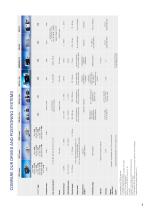
8 mm solid shaft or 8 / 14 mm hollow shaft optional (holding brake) for 14 mm output shaft not necessary because of self-holding torque analog set value: 0 .. 10 V DC (R L > 2 kΩ) 0 / 4 .. 20 mA (R L < 500 Ω) unlimited (quasi-absolute measuring system) 64 rotations (absolute measuring system) - absolute / quasi-absolute 7), magnetic 977 .. 4026 rotations 8) (dependent on gearbox ratio) 10 mm solid shaft 10 / 12 mm hollow shaft 8 mm solid shaft / 8 mm hollow shaft 986 rotations 8) with gearbox 4026 rotations8) without gearbox 5 mm solid shaft or 8 / 14 mm hollow shaft standard, only possible with...
Open the catalog to page 5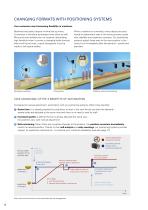
CHANGING FORMATS WITH POSITIONING SYSTEMS Your customers want increasing flexibility in machines. Machines and plants require minimal set-up times. Conversion is therefore automated more often as well. More and more bottlers are, for instance, demanding high flexibility when it comes to changing bottle formats: after small round ones, a quick changeover must be made to tall square bottles. Packaging machines When a machine is converted, many objects are positioned on adjustment axes in the entire process: guide rails, labellers and inspection cameras. Our positioning systems adjust these axes...
Open the catalog to page 6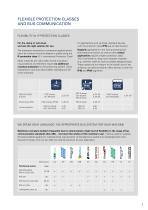
FLEXIBLE PROTECTION CLASSES AND BUS COMMUNICATION FLEXIBILITY IN IP PROTECTION CLASSES For dry, damp or wet areas: we have the right solution for you. For applications such as these, standard devices with the protection class IP 54 are an ideal solution. The protection required by a component against penetration by moisture and dust / objects is stated using the IP protection class (IP = International Protection Code). Hygienic applications in the food processing and pharmaceutical sectors as well as other critical applications require a higher protection class. This is achieved by using more...
Open the catalog to page 7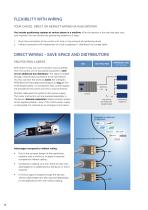
FLEXIBILITY WITH WIRING YOUR CHOICE: DIRECT OR INDIRECT WIRING VIA HUB / GATEWAY You include positioning systems at various places in a machine. Wire the devices in the way that best suits your machine. You can connect our positioning systems in 2 ways: 1. Direct bus connection to the control unit: Line or ring wiring of all positioning drives 2. Indirect connection with interposition of a hub or gateway (= distributor) via a single cable DIRECT WIRING – SAVE SPACE AND DISTRIBUTORS PSE / PSS / PSW 3 SERIES With direct wiring, bus communication occurs directly from the control unit to the positioning...
Open the catalog to page 8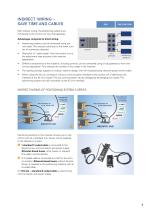
INDIRECT WIRING – SAVE TIME AND CABLES With indirect wiring, the positioning systems are connected to the control unit via a hub / gateway. Advantages compared to direct wiring: • Positioning systems can be connected using just one cable. This reduces costs due to the lower number of connectors required. • Reduction of “cable tangle” from the control unit to the adjustment axes ensures a tidy machine appearance: hub / gateway positioning systems • Different components of the machine, including controls, can be combined using a hub / gateway to form one unit per application. This reduces the...
Open the catalog to page 9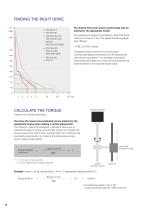
FINDING THE RIGHT DRIVE rpm min -1 You already know your torque / speed range and are looking for the appropriate model. For example you require the protection class IP 54 and a maximum torque of 2 Nm. The speed should be greater than 100 rpm. This graphic always shows the nominal torque nominal rated speed combinations for the halstrup-walcher positioning systems. It is intended to provide an initial guide and enable you to find the correct positioning systems based on the required torque range. CALCULATE THE TORQUE positioning system (relevant for vertical positioning) You know the mass...
Open the catalog to page 10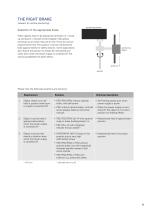
THE RIGHT BRAKE (relevant for vertical positioning) Selection of the appropriate brake positioning system When objects have to be positioned vertically (i.e. moved up and down), it should not be forgotten that gravity continues to act when they are at rest. There are various requirements here: The position must be maintained at least approximately for safety reasons. Some applications also require the position to always be maintained precisely even when the power supply is switched off. The various possibilities are given below. positioning object guide rail spindle Please note the following...
Open the catalog to page 11All Halstrup-walcher GmbH catalogs and technical brochures
 HIPERDRIVE HDA 70
2 Pages
 Data sheet HDA 70
2 Pages
 Flow rate calibrations
4 Pages


Archived catalogs
 Drive technology catalog
36 Pages
- Actuator
- Electric actuator
- Pressure transmitter
- Pressure gauge
- Calibration system
- Analog pressure transmitter
- Waterproof pressure transmitter
- Membrane pressure transmitter
- Compact actuator
- Digital pressure transmitter
- Gas pressure transmitter
- Industrial actuator
- Gas pressure gauge
- DC actuator
- Portable calibrator
- Rotary actuator
- Temperature calibration system
- 24-volt actuator
- DC pressure transmitter
- IP65 pressure transmitter