


VALVES FOR HYDROGEN PROCESSES

VALVES FOR HYDROGEN PROCESSES
This document provides an in-depth analysis of valves specifically designed for hydrogen processes, highlighting their performance in challenging applications. It underscores the company's leadership in the hydrogen valve market, offering a comprehensive range of ball valves and actuators that adhere to advanced standards and safety certifications.
The document details the hydrogen supply chain, covering production methods such as conventional techniques and electrolysis, conditioning through compression and liquefaction, delivery via cylinders, road transport, and pipelines, and industrial applications for processes and energy.
Habonim's valves are engineered for compatibility across the hydrogen supply chain, ensuring high quality, durability, and safety. Notable features include ultra-high and high-pressure capabilities, a Total HermetiX™ Integrity Package, and compliance with standards and certifications like TPED, ISO 19880-3, ATEX, SIL, and API standards.
The document discusses conventional hydrogen production through steam reforming and electrolysis methods such as PEM and SOEC, stressing the importance of hydrogen purity and clean valves to maintain fuel cell efficiency.
Details on hydrogen compression and fixed storage emphasize the risks of hydrogen gas embrittlement and the materials used to mitigate these risks. The document specifies pressure ranges, piping diameters, and connection styles for high-pressure applications.
Liquefied hydrogen is presented as an efficient storage method for large energy quantities. The document describes the use of Habonim valves in LH2 applications, noting their capability to handle cryogenic temperatures and maintain high sealing levels.
This section covers the use of ball valves in high-pressure, high-purity applications, with specifications for pressure ranges, piping diameters, and connection styles.
The document concludes with a brief mention of standards for gas cylinders and ball valves used in transport applications.
The document outlines the design, testing, and manufacturing requirements for ball valves used in various applications, such as closures for gas cylinders, main valves for cylinder bundles, and valves for cargo transport units. Key tests include a 2,000 cycles test under 1.2 times the maximal working pressure, leak tests at various temperatures, a burst test under 2.25 times the maximal working pressure, and a flame impingement test.
The document specifies working pressures based on cylinder technologies, primarily fiberglass and composite materials, with pressures of 500 bar (7,000 psi) and 700 bar (10,000 psi). Certification for transportation includes TPED (Europe), TPE (UK), and ISO 23826.
The document discusses the local distribution of hydrogen and its use in mixing with natural gas to reduce carbon emissions. It highlights the use of medium pressure hydrogen-use valves and the standards required for these applications.
Hydrogen is used in various industrial processes, including hydrocracking in petroleum refining and chemical production. The document emphasizes the need for industrial standards and certifications for tubing and piping systems handling hydrogen.
Hydrogen is highlighted as an ideal energy storage medium, particularly when produced through environmentally clean processes. Fuel cells, which convert hydrogen and oxygen into electricity, are discussed, with an emphasis on their efficiency and applications in mobile and stationary power generation.
The document details the pressures and standards for hydrogen-powered vehicles and fueling stations, including ISO 19880-3, which specifies requirements for valves used in high-pressure hydrogen fueling stations.
On-site renewable energy supply systems are described, including components like renewable energy generation devices, hydrogen electrolysis devices, and hydrogen storage and dispensing systems. The document outlines the standards and regulations applicable to these systems, such as ISO 19880-3.
The document concludes with a focus on the design and manufacturing of ball valves and actuators for demanding applications, emphasizing safety, integrity, and sustainability.
Catalog excerpts

VALVES FOR HYDROGEN PROCESSES(TH)HABONIM ft PERFORMING IN DEMANDING APPLICATIONS
Open the catalog to page 1
We are leading the emerging Hydrogen-as-a-full process valve market with our unique full range of ball valves and actuators, covering the entire value chain of this new realm. With Ultra-High-Pressure, High-Cycle Hydrogen valves, designs that support the most advanced standards, and a full set of product type approval and safety certifications, our Hydrogen valve product offer is the natural choice for Hydrogen system designers and manufacturers. Our experience in successfully supplying hydrogen service valves and automated-valves, stretches for over a decade with a wide install base in hydrogen...
Open the catalog to page 3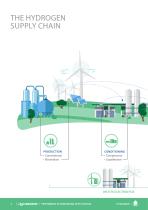
PRODUCTION • Conventional • Electrolysis - CONDITIONING • Compression • Liquefaction — | (Tf^HABONIM | PERFORMING IN DEMANDING APPLICATIONS
Open the catalog to page 4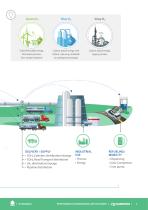
Green/Renuable energy. Electrolysis process. Zero carbon footprint. Carbon based energy with carbon capturing, utilization or underground storage. Carbon based energy. Legacy process. DELIVERY / SUPPLY • CGH2 Cylinders distribution/storage • CGH2 Road Transport distribution • LH2 distribution/storage • Pipeline distribution INDUSTRIAL USE • Process • Energy REFUELING/ MOBILITY • Dispensing • Ionic Compressor • Cryo pump
Open the catalog to page 5
HYDROGEN SERVICE PROCESS VALVES Habonim's Hydrogen Service process valves are designed, tested, and certified to provide the compatibility required in the hydrogen supply chain, end-to-end. The valves design, materials selection, and certification process are made specifically to support the Hydrogen-as-a-full eco-system with process grade valves with the highest quality, durability, and safety. With decades of proven safe and long-lasting use in hydrogen applications, Habonim Hydrogen- service ball valves deliver un-matched integrity and overall best cost of ownership for Hydrogen systems from...
Open the catalog to page 6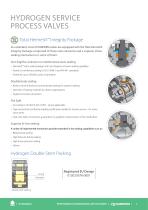
HYDROGEN SERVICE PROCESS VALVESTotal HermetiX™ Integrity Package As a standard, most of HABONIM valves are equipped with the Total HermetiX Integrity Package comprised of three main elements and a superior inline sealing mechanisms in some of them: Zero fugitive-emission no maintenance stem sealing • HermetiX™ stem sealing design with zero fugitive emission sealing capability. • Tested or certified according to ISO 15848-1 and API 641 standards. • Tested for up to 500,000 cycles of operation. Double body sealing • Body-to-ends & body-to-bonnet double sealing for superior sealing. • Selection...
Open the catalog to page 7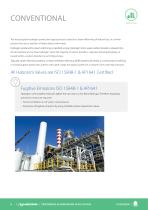
CONVENTIONAL The most popular hydrogen production legacy process is based on Steam Reforming of Natural Gas, or a similar process that uses a reaction of hydrocarbons with water. Hydrogen produced by steam reforming is classified as'gray hydrogen'when waste carbon dioxide is released into the atmosphere and as 'blue hydrogen' when the majority of carbon dioxide is captured, stored geologically, or reused within a carbon dioxide non-emitting process. Typically, steam reforming systems, or steam methane reforming (SMR) systems are similar in construction to refining or industrial gases production...
Open the catalog to page 8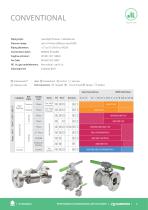
Piping style: Low/High Pressure - Industrial use Pressure range: Piping diameters: Connections styles: Welded; Threaded Fugitive emission: Fire Safe: Cleaning level: Industrial level Total HermetiX™ Ordering Code Standard Port Full Port Tube Size Cone & Thread Design Type High Pressure Ball Valve Valve Size (Inches) Multiport/ Diverter Control PERFORMING IN DEMANDING APPLIC
Open the catalog to page 9
Green Hydrogen production is mainly based on utilizing clean energy to produce hydrogen from water using electrolysis. PEM - Polymer electrolyte membrane electrolysis is the electrolysis of water in a cell equipped with a solid polymer electrolyte. SOEC - Solid Oxide Electrolyzer Cell is the electrolysis of water in a cell using a solid oxide, or ceramic, electrolyte. Some technologies allow using CO2 to produce Hydrogen as part of transforming excessive CO2 to clean energy. Oxygen O2 PEM Alkaline Solid Oxide Hydrogen Purity & Clean Valves • Fuel Cells efficiency is damaged by Hydrogen impurities...
Open the catalog to page 10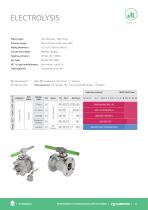
ELECTROLYSIS Piping style: Pressure range: Piping diameters: Connections styles: Fugitive emission: Fire Safe: HE - H2 gas embrittlement: Cleaning level: Low Pressures - High Purity Up to 725 psi; 50 bar; class #300 1/2" to 6"; DN15 to DN150 Welded; Flanged API 641; ISO 15848-1 API 607; ISO 10497 Non-critical - use St. St. Cleaned for H2 service ® Total HermetiX™ | Port © Standard Port ® Full Port O Tube Size ©Ordering Code | End Connections © Threaded Cone & Thread © Flanged 0 Welded Valve Size (Inches) Ball Valve Design Type Multiport/ Diverter PERFORMING IN DEMANDING APPLICATIONS | (T|4)HABONIM...
Open the catalog to page 11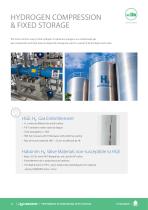
HYDROGEN COMPRESSION & FIXED STORAGE The most common way to store hydrogen in stationary storage is as a compressed gas. Gas compression and High-pressure large bulk storage are used in a variety of technologies and scales. HGE: H2 Gas Embrittlement • H2 molecule diffuses into metal surface • P & T variations create cracks by fatigue • Crack propagation = HGE • HGE risk increases with P/decreases with polishing-coating • Rule of thumb: materials HRC < 32 are not affected by HE Habonim H2 Valve Materials non-susceptible to HGE • Body: SS316L shell; A479 (forged bar, not cast) for HP valves • Embrittlement...
Open the catalog to page 12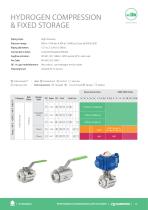
HYDROGEN COMPRESSION & FIXED STORAGE Piping style: High Pressures Pressure range: Piping diameters: Connections styles: Coned & Threaded; Welded Fugitive emission: API 641; ISO 15848-1; With special HP H2 stem seal Fire Safe: Very critical - use Hydrogen service valves Cleaning level: Total HermetiX™ Ordering Code Standard Port Full Port Tube Size Cone & Thread Valve Size (Inches) Ball Valve Design Type Threaded body Floating High Pressure PERFORMING IN DEMANDING APPLICA
Open the catalog to page 13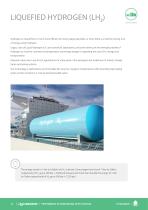
Hydrogen in a liquid form is much more efficient for storing large quantities, or when there is a need for storing a lot of energy using Hydrogen. Legacy uses of Liquid Hydrogen (LH2) are rocket-fuel, laboratories, and some others, yet the emerging market of Hydrogen as a fuel for commercial transportation and energy storage is expanding the use of LH2 storage and transportation. Habonim valves are in use for LH2 applications for many years in the aerospace and rocket launch market, storage tanks, and testing systems. Our technology is optimized to accommodate the very low cryogenic temperatures...
Open the catalog to page 14All HABONIM catalogs and technical brochures
 PRODUCT LINE
28 Pages