


Product Guide HabasitLINK

Product Guide HabasitLINK
The document provides detailed specifications for various types of modular belts and sprockets used in industrial applications. The belts are primarily made from materials such as POM, PA, PP, and PE, with rods made from materials like PA, POM, and PP. The nominal tensile strength varies depending on the material and belt type, with values provided in both N/m and lb/ft. The temperature range for operation is specified for each material, with some belts capable of operating from -40°C to 93°C (-40°F to 200°F).
Procedures and Guidelines:
The document outlines procedures for calculating the effective tensile force, which depends on the operating temperature near the drive sprockets. It emphasizes the importance of referring to the HabasitLINK® Engineering Guidelines for detailed calculations. The document also provides guidelines for sprocket positioning and the arrangement of wearstrips, which are crucial for the proper functioning of the belt system.
Standards and Recommendations:
The document recommends using specific diameters for idling rollers, support rollers, and gravity take-up rollers. It also suggests using the largest possible backbending radius for elevators with side guards or hold-down devices. The sprocket series are designed to follow European and US standards for metric and imperial sizes, respectively.
Key Features and Accessories:
The belts feature various designs such as solid plates, open hinges, and dynamic open hinges for easy cleaning. They are available in standard and non-standard widths, with specific increments provided. Accessories like flights, side guards, and GripTop modules are available for certain belt types. The document highlights the availability of food-approved materials and the importance of using the correct sprocket and hub sizes.
Data Interpretation:
The tables and diagrams in the document provide critical data on belt widths, sprocket dimensions, and the number of sprockets and wearstrips required for different belt widths. This information is essential for selecting the appropriate components for specific applications and ensuring optimal performance.
- Temperature Range: Belts operate between -40°C to +93°C (-40°F to +200°F), with some materials allowing short-term exposure up to 160°C (320°F).
- Material Options: Belts and rods are available in materials such as POM, PA, PP, and PBT, with food-approved options.
- Design Features: Belts feature open areas for drainage, smooth surfaces, and robust edges for durability. They are compatible with M1200 sprockets and designed for self-clearing transfers.
- Installation: Belts should be installed with appropriate sprocket spacing and wearstrip arrangements to ensure optimal performance.
- Maintenance: Regular checks on tensile strength and temperature exposure are recommended to maintain belt integrity.
- Calculation Guide: For precise tensile force calculations, refer to the HabasitLINK® Engineering Guidelines.
- Dimensions: Standard belt widths are provided in both metric and imperial units, with real widths slightly smaller due to manufacturing tolerances.
- Sprocket Design: Sprockets are available in one-piece and split designs, with specific arrangements for different belt types.
- Use Cases: Belts are suitable for food processing and other industries requiring robust, hygienic conveyor solutions.
- Accessories: Options include flights and side guards for inclined conveyors, enhancing product handling capabilities.
- Tensile Strength: Varies by material, with POM +LF offering the highest strength at 21400 N/m.
- Belt Weight: Ranges from 5.2 kg/m² to 8.2 kg/m² depending on material and design.
- Roller Diameters: Minimum diameters for idling, support, and drive rollers are specified to ensure proper belt function.
- M2472 Perforated Flat Top: Available in standard widths from 152 mm to 1981 mm. Made from PP and POM materials with a nominal tensile strength of up to 30000 N/m. Suitable for temperatures ranging from -40°C to 105°C.
- M2480 Flush Grid: Offers a 25% open area and is available in widths from 76 mm to 991 mm. Made from POM and PP materials, with tensile strengths up to 30000 N/m. Temperature range is -40°C to 105°C.
- M2480 ActivXchange: Features a smooth surface with a 25% open area. Compatible with all M2400 sprockets and available in food-approved materials.
- M2510 Flat Top: Provides a 0% open area with dynamic open hinges for easy cleaning. Available in widths from 50 mm to 700 mm, with tensile strengths up to 21900 N/m.
- M2511 Mesh Top: Features a 16% open area and is designed for easy cleaning. Available in widths from 50 mm to 700 mm, with tensile strengths up to 18000 N/m.
- Sprocket Series M2400: Includes molded, machined, and multi-hub sprockets. Available in various sizes and materials, including PA and PA+GS. Designed for use with 1" pitch belting.
- Use idle roller widths with a minimum of 25 mm free belt edge on each side.
- Standard belt widths are in increments of 76.2 mm, with non-standard widths available in increments of 15.24 mm.
- The nominal tensile strength is valid at 23°C, and the admissible tensile force varies with temperature.
- For detailed calculations, refer to the HabasitLINK® Engineering Guidelines.
- Available accessories include flights, scoops, side guards, and hold-down devices.
- Wearstrips are recommended between driving shafts and idling sprockets for optimal performance.
The document provides detailed specifications for various types of HabasitLINK® straight 1" pitch belting, including M2516 Diamond Top, M2520 Flat Top, M2520 GripTop, M2520 Roller Top, M2527 Minirib, and M2531 Raised Rib. Each type has specific belt and rod materials, nominal tensile strength, temperature range, and belt weight.
Procedures and Recommendations:
For optimal performance, the document recommends using the largest possible backbending radius for elevators with side guards or hold-down devices. It also advises on the correct calculation of effective tensile force, which depends on the operating temperature near the drive sprockets.
Standards and Norms:
The belts are available in standard widths in increments of 50 mm (2") or 100 mm (4"), with non-standard widths offered in increments of 16.66 mm (0.66"). The nominal tensile strength is valid for 23 °C (73 °F), and the admissible tensile force varies with temperature.
Accessories:
Available accessories include flights, scoops, side guards, hold-down devices, and GripTop modules. Specific accessories are recommended for each belt type to enhance functionality.
Key Data from Tables:
The tables provide minimum diameters for idling rollers, support rollers, gravity take-up, and center drive rollers, as well as backbending radii for elevators. The belt data tables specify the nominal tensile strength in N/m and lb/ft, temperature ranges in °C and °F, and belt weight in kg/m² and lb/sqft.
Material Properties:
For detailed material properties, the document refers to additional pages (282 - 289) and emphasizes the importance of consulting the HabasitLINK® Engineering Guidelines for precise calculations.
The document provides detailed specifications for the HabasitLINK® M2544 Tight Radius GripTop 1" pitch belting. The belt is made from polypropylene (PP) with a GripTop material of thermoplastic elastomer (TPE) and rod material of polyoxymethylene (POM) or polyamide (PA). The nominal tensile strength for straight runs is 14000 N/m (959 lb/ft), while in curves, it is 600 N (135 lbf). The temperature range for operation is 5 - 60°C (40 - 140°F), and the belt weight is 7.2 kg/m² (1.47 lb/sqft).
For effective tensile force calculations, refer to the Calculation Guide in the HabasitLINK® Engineering Guidelines. The document also outlines the standard range of belt widths and collapse factors, with specific recommendations for belt widths larger than 1200 mm (48") not being recommended.
The document adheres to European and US standards for key ways in round bore shapes. It provides detailed dimensions and specifications for sprockets and wearstrips, including the number of sprockets and wearstrips required for various belt widths.
For applications with limited space, the belt is ideal due to its tight radius and high friction GripTop. It is also recommended for cooling and draining applications due to its open area design. Adjustable radius plugs and side guards are available as accessories.
The nominal tensile strength is valid at 23°C (73°F), and the admissible tensile force varies with temperature. The document emphasizes the importance of using the LINK-SeleCalc tool for calculating the correct number of sprockets based on belt load.
- Belt Widths: Standard widths are provided in both metric and imperial units, with real widths slightly smaller by 0.1% to 0.3%.
- Materials: Belts are made from materials like PP, POM, and PA, with rods made from PA, PBT, or PP.
- Temperature Range: Varies by material, from -40°C to +105°C (-40°F to +220°F).
- Tensile Strength: Nominal tensile strength is specified for each belt type, with variations based on temperature.
- Calculation of Tensile Force: The admissible tensile force varies with temperature and should be calculated using the HabasitLINK® Engineering Guidelines.
- Sprocket Arrangement: Guidelines for sprocket positioning and the number of sprockets required based on belt width and load.
- Sprocket Series M2600: Includes specifications for one-piece and split sprockets, with details on material and dimensions.
- Wearstrips: Recommendations for using UHMW Polyethylene or other suitable materials for slider support.
- Material Selection: Choose materials based on the specific application requirements, considering factors like temperature and load.
- Use of Accessories: Various accessories like GripTop modules and standard guiding profiles are available for enhanced performance.
- Temperature Impact: Operating temperature significantly affects the tensile strength and should be carefully monitored.
- Custom Widths: Non-standard widths are available in specific increments, allowing for customization.
The document provides detailed specifications for various types of HabasitLINK® belting systems, including M2670 ActivXchange, M2791 Radius Flush Grid, IS610 GT, IS610-R, CT610-R, ST610, VT610, HDS610 FT, and HDS610 CVT. Each belt type is described with its material composition, tensile strength, temperature range, and weight. The nominal tensile strength is specified for both straight runs and curves, with variations based on temperature.
Procedures:
The document advises using LINK-SeleCalc for calculating the correct number of sprockets based on belt load, which may differ for driving and idling shafts. It also provides guidelines for sprocket positioning and wear strip arrangements.
Norms and Standards:
Key dimensions and material standards are provided for sprockets, including the number of teeth, pitch diameter, and hub thickness. The document follows European and US standards for key ways in round bore shapes.
Recommendations:
Recommendations include using specific materials for wear strips and ensuring proper sprocket positioning. The document suggests contacting local partners for non-standard belt widths and material selections that may affect belt dimensions.
Key Data from Tables:
- Belt widths are generally 0.1% to 0.3% smaller than nominal.
- Temperature ranges for materials like POM, PBT, and PA are specified, with operational limits from -40°C to +105°C.
- Sprocket availability includes molded and machined options, with various bore sizes and materials like PA and POM.
Critical Information:
- The admissible tensile force varies significantly with temperature, affecting the effective tensile force calculations.
- The document emphasizes the importance of correct sprocket and wear strip arrangements to ensure optimal belt performance.
- 208 FT, 208 35, 208 RR: These belts have a 1-inch pitch, are bi-directional, and made from food-approved materials. They offer various open areas and tensile strengths, with standard and non-standard width increments available.
- MB610 and MB610 MTW: Heavy-duty flat top belts with a 1-inch pitch, available with or without tabs, and made from POM and PA materials. They have a high tensile strength and are suitable for bi-directional use.
- F51, F52, F53, F54: These belts have a 1.1-inch pitch and varying open areas. They are made from materials like PP, POM, and Nylon, with different tensile strengths and temperature ranges.
- PR612 1.6: A radius belt with a 1-1/5 inch pitch, designed for tight turn applications, with a 63% open area and made from POM and PA materials.
The document provides detailed specifications for various types of HabasitLINK® radius belting, including materials, tensile strength, temperature range, and belt weight. The belts are available in different materials such as POM, PP, and Nylon, with tensile strengths varying based on belt width and material. The temperature range for these belts is from -40°C to 105°C (-40°F to 220°F), depending on the material.
Procedures:
The document outlines the procedures for selecting the appropriate belt width and material, emphasizing the importance of contacting local partners for precise dimensions. It also provides guidelines for the use of hold-down tabs and side guards, which are available in various heights.
Standards and Recommendations:
Standard belt widths are provided in increments of 50 mm (2 inches), with non-standard widths available in increments of 25 mm (1 inch). The document advises against using belt widths larger than 1200 mm (48 inches) and recommends consulting with Habasit representatives for such cases. The nominal tensile strength is specified for 23°C (73°F), with variations in admissible tensile force based on operating temperature.
Accessories and Additional Features:
Various accessories are available, including hold-down tabs, flights, side guards, and GripTop modules. The document also details the specifications for sprockets and rollers, including part numbers, number of teeth, and dimensions.
Key Data from Tables and Charts:
The document includes tables with detailed measurements for sprockets and rollers, specifying nominal pitch diameter, shaft center to top of wearstrip, and hub thickness. It also provides a standard range of belt widths and collapse factors, emphasizing the importance of using the largest possible backbending radius for elevators with side guards or hold-down devices.
Critical Information:
The document highlights the importance of selecting the correct material and belt width for specific applications, considering factors such as tensile strength, temperature range, and open area percentage. It also stresses the need for proper calculation of effective tensile force using the HabasitLINK® Engineering Guidelines.
- ST615 & VT615 Belts: 1-1/2 inch pitch, available in PP and PE materials, with a nominal tensile strength of 26262 N/m (1800 lb/ft) for straight runs. Temperature range is 5 - 105°C (40 - 220°F) for PP and -70 - 65°C (-94 - 150°F) for PE. Standard belt colors are gray and white.
- CC41 & CC42 Belts: 1-3/4 inch pitch, available in PP, PE, and Nylon materials. Nominal tensile strength varies by material, with a maximum of 37944 N/m (2600 lb/ft) for Nylon. Temperature ranges vary by material, with a maximum of -40 - 118°C (-40 - 245°F) for Nylon. Standard belt colors include gray/white, dark gray, white, and beige.
- M5010 & M5011 Belts: 2 inch pitch, available in PP, PE, POM, and Nylon materials. Nominal tensile strength ranges from 10000 N/m (685 lb/ft) to 30000 N/m (2055 lb/ft) depending on material. Temperature ranges vary by material, with a maximum of -40 - 93°C (-40 - 200°F) for POM. Standard belt colors include gray, white, and beige.
- Material selection may affect belt width; contact local partners for actual dimensions.
- Use the largest possible backbending radius for elevators with side guards or hold-down devices.
- For detailed material properties and tensile force calculations, refer to the HabasitLINK® Engineering Guidelines.
- Side guards available in various heights.
- Flights and scoops available in multiple heights and configurations.
- Additional belt colors and materials, including abrasive-resistant Nylon rods, are available.
- Molded and machined sprockets available with various bore sizes and materials, including UHMW, Nylon, and Urethane.
- Split sprockets and other tooth sizes are available upon request.
- Belt Widths: Standard widths range from 75 mm to 1200 mm, with real widths slightly smaller by 0.1% to 0.3%.
- Materials: Belts are made from PP, PE, POM, with rods made from PP, PA, PE, PBT, and PA.
- Tensile Strength: Varies by model, with nominal tensile strengths ranging from 10,000 N/m to 60,000 N/m.
- Temperature Range: Operating temperatures range from -70°C to 105°C, depending on the material.
- Belt Weight: Ranges from 8.4 kg/m² to 14.9 kg/m².
- Roller Diameters: Minimum diameters for idling, support, and drive rollers are specified to ensure proper operation.
- Backbending Radius: Recommendations for elevators with and without side guards or hold-down devices are provided.
- Temperature Considerations: The admissible tensile force varies with temperature, requiring adjustments based on operating conditions.
- Available accessories include flights, scoops, side guards, hold-down devices, and GripTop modules.
- Features such as open hinges for easy cleaning, solid plates, and dynamic hinge gaps are highlighted for specific models.
- Use the largest possible backbending radius for elevators with side guards or hold-down devices.
- Refer to the HabasitLINK® Engineering Guidelines for detailed calculations of effective tensile force.
- Temperature Range: Varies by material, with ranges from -70°C to 105°C (-94°F to 220°F).
- Belt Weight: Ranges from 6.8 kg/m² (1.39 lb/sqft) to 17.7 kg/m² (3.63 lb/sqft).
- Nominal Tensile Strength: Varies by model, with values from 8,000 N/m (548 lb/ft) to 41,000 N/m (2809 lb/ft).
- Open area percentages and largest opening dimensions are specified for each model, enhancing flushing, draining, and cleaning capabilities.
- Closed and open hinge designs are available, with food-approved materials.
- Rod diameter is consistently 7 mm (0.27").
- Minimum diameters for idling, support, and drive rollers are specified, with recommendations for backbending radii.
- Roller spacing and offset details are provided for different configurations.
- Standard belt widths are provided in increments, with non-standard widths available.
- Guidelines for calculating effective tensile force based on operating temperature are included.
- Belt Materials: Options include PP, PE, POM, and PA, with specific combinations for different applications.
- Rod Materials: Available in PP, PA, PE, and POM.
- Nominal Tensile Strength: Varies by material and configuration, with values provided in N/m and lb/ft.
- Temperature Range: Operating temperatures range from -70°C to 105°C (-94°F to 220°F) depending on material.
- Belt Weight: Specified in kg/m² and lb/sqft, with variations based on material.
- Belts feature a 0% open area, solid plate design, and dynamic open hinge for easy cleaning.
- Strong link design with a 1" link-pitch and a rod diameter of 7 mm (0.27").
- Smart Fit rod retention and reinforced edge links are included.
- Food-approved materials are available for specific applications.
- Available accessories include flights with ribs and hold-down devices.
- Standard belt widths are offered in increments of 4.0" (101 mm), with non-standard widths available in 1.0" (25.4 mm) increments.
- Sprockets are available in one-piece or split designs, with options for square or round shafts.
- Material options include POM and PA, with specific configurations for different belt types.
- Sprocket positioning and wearstrip guidelines are provided for optimal performance.
- The nominal tensile strength is valid at 23°C (73°F), with variations in admissible tensile force based on operating temperature.
- Detailed calculations for effective tensile force are available in the HabasitLINK® Engineering Guidelines.
- For detailed material properties, refer to pages 282 - 289 of the document.
- Use the largest possible backbending radius for elevators with side guards or hold-down devices.
This document provides detailed specifications and guidelines for HabasitLINK® modular belts and accessories, focusing on flight modules, side guards, and sprockets. It includes information on dimensions, materials, and installation procedures.
Flight Modules
Flight modules are injection-molded, one-piece designs that integrate into the belt. They are available with ribs on one side for improved release of wet or sticky food products and can be cut to nonstandard heights. The document specifies different flight types, including straight, corrugated, and scoop designs, with detailed measurements for each.
Specifications
- Flights M5000 series have a link increment of 18.75 mm (0.74") and are available in various heights and lengths.
- Flights M5060 series have a link increment of 25.4 mm (1") and are designed for imperial belt widths.
- All flights have an open hinge design and can be cut to a minimum height of 25 mm for high-impact applications.
Compatibility and Installation
All 2" flights can be used with 2" belts, but some combinations may reduce the belt's nominal tensile strength. The document provides a compatibility table for different belt and rod materials, along with their nominal tensile strengths.
Indents and Notches
The document explains the importance of flight indents and notches for belt support and back-bending applications. It provides measurements for indents and notches for both M5000 and M5060 series.
Hold-Down Devices
Hold-down devices are used in elevators with back-bending to keep the belt on track. The document specifies the minimum back-bending radius and compatible belt series for these devices.
Sprockets
The document details the specifications for sprocket series M5100, including the number of teeth, shaft size, and material. It also provides guidelines for sprocket positioning and the number of sprockets required for different belt widths.
Key Points
- The document emphasizes the importance of correct installation and compatibility to ensure optimal performance.
- It provides detailed tables and diagrams to assist in the selection and installation of flights, side guards, and sprockets.
- The document includes specific guidelines for handling different materials and environmental conditions.
- Belt Types: Includes M5131, M5290, M5293, SP620, SE620, IS620-R, and HDS620, each with specific applications such as radius and straight conveying, spiral applications, and cooling and draining.
- Materials: Belts and rods are made from materials like PP, POM, PA, and Nylon, with temperature ranges from -70°C to 118°C (-94°F to 245°F).
- Dimensions: Belt widths range from 508 mm (20 inches) to 1575 mm (62 inches), with specific collapse factors and tensile strengths provided for each type.
- Installation: Combs are fixed using special bushings to allow lateral movement, adapting to thermal expansion. Belt widths up to 300 mm can have firmly fixed plates.
- Sprocket Arrangement: Sprockets are positioned based on belt width and link increment, with specific criteria for offset positioning.
- Temperature and Tensile Strength: Nominal tensile strength is valid at 23°C (73°F), with variations based on operating temperature.
- Material Selection: Material choice affects belt width and performance; consultation with local partners is recommended for precise dimensions.
- Side Guards and Lane Dividers: Used for product separation on belts, available in clip-on versions.
- Standard Flights: Available in various heights, with high friction options.
- Belt Widths and Collapse Factors: Detailed for each belt type, indicating suitability for specific applications.
- Sprocket and Wearstrip Numbers: Provided for different belt widths, essential for correct installation and operation.
- Pitch: 2 inches
- Connecting Rod Diameter: 0.312 inch (7.9 mm)
- Standard Belt Width Increments: 1 inch (25.4 mm), starting from 4 inches (101.6 mm)
- Material Options: PP, PE, POM, Nylon (PA +IM), with rod materials in PP and PE
- Temperature Range: Varies by material, from -70°C to 105°C (-94°F to 220°F)
- Nominal Tensile Strength: Up to 30646 N/m (2100 lb/ft)
- Belt Weight: Varies by material, from 6.2 kg/m² (1.27 lb/sqft) to 12.7 kg/m² (2.60 lb/sqft)
- Surface Options: Solid top, vented top, curved top, and easy release
- Open Area: Up to 35% for certain models
- Side Guards: Available in 2", 3", and 4" heights, with specific indentation requirements
- Flights: Standard, rough duty, and easy release flights available in various heights
- Inserts: May affect belt pull
- Sprockets: Molded and machined options available, with various bore sizes
- Belt Materials: Options include Polypropylene (PP), Polyoxymethylene (POM), and Nylon (Polyamide), with stainless steel rods available for enhanced durability.
- Temperature Range: Belts can operate in temperatures ranging from -40°C to 105°C (-40°F to 220°F), depending on the material.
- Tensile Strength: Varies by belt type, with nominal tensile strengths provided for straight and curved runs.
- Standard Belt Colors: Typically available in white, gray, or blue, with additional colors upon request.
- Belt Widths: Standard increments are 3 inches for straight belts and 1 inch for radius belts, with non-standard widths available upon request.
- Connecting Rods: Standard diameter is 0.250 inches (6.4 mm).
- Flight Heights: Standard flights are available in heights of 1, 2, 3, 4, and 6 inches.
- Sprocket Configurations: Available in molded and machined forms, with various bore sizes and materials like UHMW, Nylon, and Urethane.
- Food Safety: All materials used are food-approved, ensuring compliance with industry standards.
- Open Area: Belts feature varying open areas (e.g., 35% for straight belts, 65% for radius belts) to facilitate cleaning and drainage.
- Bi-directional Operation: Most belts are designed for bi-directional use.
- Adjustable Radius Plugs: Available for radius belts to accommodate different turning radii.
- Accessories: Lane dividers and side guards are available in multiple heights to customize the belt system.
The document outlines specifications for various belt types and sprocket configurations. It includes details on sprocket spacing, edge distance, and criteria for center sprocket positioning. The offset is determined based on whether the result of a formula is an even or odd number, with specific offsets applied accordingly.
Guidelines are provided for determining the number of sprockets and wearstrips based on standard belt widths. The number of sprockets depends on the belt load and may vary for driving and idling shafts. The document recommends using LINK-SeleCalc for accurate calculations.
The document references various standards, including DIN EN 1637 for electrical resistance and DIN EN 13501 for flammability classification, particularly in the context of materials used in belt manufacturing.
Recommendations are provided for selecting materials based on application requirements, such as temperature range, chemical resistance, and impact resistance. Specific materials are suggested for applications involving high impact, low temperatures, or specific chemical exposures.
The document details the properties of standard and special belt materials, including polypropylene, polyethylene, polyoxymethylene (acetal), and polyamide (nylon). Each material's density, temperature range, and specific characteristics like chemical resistance and electrical conductivity are outlined.
The tables provide critical data on sprocket configurations, belt widths, and material properties. For example, the number of sprockets per shaft and wearstrips varies with belt width, and material properties such as density and temperature range are specified for each type of thermoplastic material.
Catalog excerpts

HabasitLINK® Plastic Modular Belts Product Guide Habasit– Solutions in motion
Open the catalog to page 1
Product liability, application considerations If the proper selection and application of Habasit products are not recommended by an authorized Habasit sales specialist, the selection and application of Habasit products, including the related area of product safety, are the responsibility of the customer. All indications / information are recommendations and believed to be reliable, but no representations, guarantees, or warranties of any kind are made as to their accuracy or suitability for particular applications. The data provided herein are based on laboratory work with small-scale test equipment,...
Open the catalog to page 2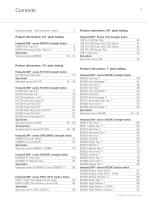
Getting started - Belt selection criteria 7 Product information: 3/4" pitch belting Product Information: 0.3" pitch belting HabasitLINK® Series 106 (straight belts) HabasitLINK® series M0870 (straight belts) 106 10 (106 Mesh Top 10% Open) 41 Sprocket series M0800 10- 12 Sprockets Product Information: 1/2" pitch belting Product information: 1" pitch belting HabasitLINK® series M1100 (straight belts) M1185 Flush Grid 0.5" 13 HabasitLINK® series M2400 (straight belts) HabasitLINK® series M1200 (straight belts) M2470 Flat Top 1" 49 M1234 Nub Top Flush Grid 0.5" 23 Sprockets Sprockets HabasitLINK®...
Open the catalog to page 3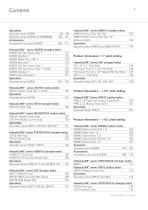
HabasitLINK® series M2600 (straight belts) M2620 Flat Top Heavy Duty 1" 112 M2670 Flat Top Heavy Duty 1' M2670 Flat Top Heavy Duty 1" MTW HabasitLINK® series MB610 (straight belts) MB610 (Heavy Duty Flat Top) MB610 MTW (Heavy Duty Flat Top Product information: 1.1" pitch belting HabasitLINK® Series F50 (straight belts) F52 Smart Fit (1/2" x 1/2" Flat Wire) 146 F53 Smart Fit (1/2" x 1/2" Raised Rib Flat Wire) 147 HabasitLINK® series M2700 (radius belts) M2791 Radius Flush Grid 1" MTW HabasitLINK® series IS610 (straight belts) HabasitLINK® series IS610/CT610 (radius belts) IS610-R (Radius Flush...
Open the catalog to page 4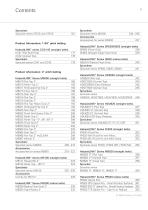
Sprockets Sprocket series ST615 and VT615 Sprockets Sprocket series M5200 Accessories Accessories for series M5200 Product Information: 1-3⁄4" pitch belting HabasitLINK® series CC41/42 (straight belts) CC41 (Flat Solid Top) CC42 (Vented Top) Sprockets Sprocket series CC41 and CC42 HabasitLINK® Series SP620/IS620 (straight belts) SP620 (Flush Grid) 238 SE620 (Straight Edge Flush Grid) 239 HabasitLINK® Series IS620 (radius belts) IS620-R (Radius Flush Grid) Sprockets Sprocket series SP620, IS620, SE620 Product information: 2" pitch belting HabasitLINK® Series M5000 (straight belts) M5010 Flat Top...
Open the catalog to page 5
Product information: 2.2" pitch belting HabasitLINK® series M5400 (straight belts) Product information: 2-1/2" pitch belting HabasitLINK® series M6300 (straight belts) HabasitLINK® series M6400 (straight belts) M6420 Flat Top Heavy Duty 2.5" 273 Materials for belts, sprockets, wear strips and guides 282 - 289
Open the catalog to page 6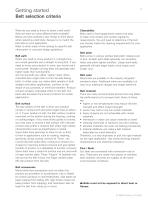
Getting started Belt selection criteria What do you need to know to select a belt style? Why are there so many different belts available? Below we have outlined a few things to think about when selecting a belt style. Always try to match the belt style to your application. Refer to other areas of the catalog for specific belt information or conveyor design guidelines. Belt path When you need to move product in a straight line, you would generally use a straight running belt. If you need to move your product in turns, you would use a turning belt. Straight running belts will generally take higher...
Open the catalog to page 7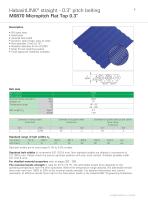
HabasitLINK® straight - 0.3" pitch belting M0870 Micropitch Flat Top 0.3" Description • • • • • • • • 0% open area Solid plate Imperial belt width Dynamic open hinge, easy to clean Rod diameter 3 mm (0.12") Nosebar diameter 6 mm (0.236") Snap Fit rod retaining system Food approved materials available Belt data Belt material Rod material Nominal tensile strength F'N straight run Temperature range N/m lb/ft °C °F kg/m² lb/sqft Diameter of idling rollers (minimum) Diameter of support rollers (minimum) Diameter for gravity take-up and center drive rollers (minimum) mm inch 50 2 Standard range of...
Open the catalog to page 8
HabasitLINK® straight - 0.3" pitch belting M0873 Micropitch Non Slip 0.3" Description • • • • • • • • 0% open area Solid plate Imperial belt width Dynamic open hinge, easy to clean Rod diameter 3 mm (0.12") Nosebar diameter 6 mm (0.236") Snap Fit rod retaining system Food approved materials available Belt data Belt material Rod material Nominal tensile strength F'N straight run Temperature range N/m lb/ft °C °F kg/m² lb/sqft Diameter of idling rollers (minimum) Diameter of support rollers (minimum) Diameter for gravity take-up and center drive rollers (minimum) mm inch 50 2 Standard range of...
Open the catalog to page 9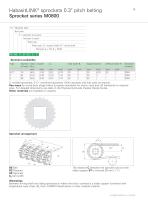
HabasitLINK® sprockets 0.3" pitch belting Sprocket series M0800 M = Modular belts Belt pitch S = sprocket one-piece Number of teeth Shaft size Shaft type: Q = square shaft; R = round shaft Material: 8 = PA; 6 = POM M 08 Sprocket availability Type Number Diam. of pitch of teeth Ø dp mm inch 18 46.5 1.83 24 61.8 2.43 36 92.6 3.65 S: molded sprockets; S-C1: machined sprockets. Other sprocket and hub sizes on request. Key ways for round bore shape follow European standards for metric sizes and US standards for imperial sizes. For detailed dimensions see table in the Engineering Guide chapter Design...
Open the catalog to page 10
HabasitLINK® sprockets 0.3" pitch belting Sprocket series M0800 Sprocket positioning For correct positioning of the center sprocket divide the belt width by the link increment. The rounded result will be an even or an odd number. These numbers are the criteria for offset or no offset, see table. Belt type Sprocket spacing a Sprocket edge Criteria for distance (minimal) center sprocket position XR minimal maximal XL mm mm mm mm mm inch inch inch inch inch 76.2 152.4 25 25 b0 / 50.8 b0 / 2 3 6 1 1 Result of formula (rounded) Offset to which side right or left side right or left side right or left...
Open the catalog to page 11All Habasit catalogs and technical brochures
 Meat and Poultry Industry
24 Pages
 Textile Industry
24 Pages
 Bakery Industry
20 Pages
 HabaSYNC® Wide Timing Belts
4 Pages
 E-RB-F
2 Pages
 Higher Chain Conveyor Speeds
4 Pages
 NHM-10ELBV-E3
3 Pages
 ENI-5EE
3 Pages
 ENI-5P
3 Pages
 ENI-12P
3 Pages
 HabaSYNC Timing Belts
76 Pages
 Habasit America
4 Pages
 Specialty Belts & Components
2 Pages
 HabaSYNC® WH-A-02
2 Pages
 HabiPLZST Guides and Profiles
60 Pages
 Habasit Cleandrive™
16 Pages
 Habasit Crosslapper Belts
6 Pages
 Material Handling Industry
20 Pages
 Tape MVT-6P
2 Pages
 MVM-5E Machine Tape
2 Pages
 MAV-5E Machine Tape
2 Pages
 Flexfold
2 Pages
 HabaCHAIN
4 Pages
 Details about Yarn Processing
28 Pages
 Handling and Maintenance
24 Pages
 Textile Industry
12 Pages
 Confectionery Industry
22 Pages
 HySAN Food Conveyor Belts
4 Pages
 EU Food Regulations
6 Pages
 Beverage Industry
34 Pages
 Tire Industry
20 Pages
 Automotive Industry
4 Pages
 Airport Industry
12 Pages
 GRABBER FFS Series
4 Pages
 Habiblue
2 Pages
 Thermoplastic Extruded Profiles
19 Pages
 HabaDRIVE
4 Pages
 Habasit Spiral Belts
12 Pages
 MNI-7E Machine Tape
2 Pages
 Habasit Cleanline (4063)
12 Pages
 Printing Blanket ENU-50AXBD
2 Pages
 Habasit Fitline TMBE02404
4 Pages
 Habasit Eff-Line belts
4 Pages
 Habasit Cleanline
12 Pages
 HabaCHAIN Product Guide
128 Pages
 HabasitLINK®
100 Pages


Archived catalogs
 Packaging Industry
26 Pages
 Wood Industry (2055)
24 Pages
 Tobacco Industry (2010)
16 Pages
 Habasit Tire Industry (2036)
32 Pages
 Habasit Yarn Processing (2006)
28 Pages
 Habasit Bakery (2005)
28 Pages


- Metal profile
- Habasit industrial belt
- Habasit plastic conveyor belt
- Rubber strip
- Industrial profile
- Habasit industrial conveyor belt
- Flush grid conveyor belt
- Industrial belt
- Habasit conveyor chain
- Modular conveyor belt
- Timing belt
- Habasit conveyor belt for the food industry
- Rectangular profile
- V power transmission belt
- Habasit sturdy belt
- Polyurethane power transmission belt
- VirtualExpo Group
- Our Partners
- Recruitment
- Testimonials