


HabasitLINK®

HabasitLINK®
This document serves as an engineering guide for HabasitLINK® plastic modular belts, focusing on product liability, application considerations, and safety warnings. It highlights the customer's responsibility in selecting and applying products, as usage conditions are beyond Habasit's control.
HabasitLINK® modular belts are made from thermoplastic modules connected by plastic rods, offering durability and performance. They come in various pitches and styles, including micropitch, minipitch, and heavy-duty options, with designs tailored for sanitation in food applications.
The guide details various belt types with specific pitches and open area percentages, suitable for applications like tight transfers, heavy-duty conveying, and food processing. The belts comply with FDA and EU food contact regulations, with some USDA approvals.
This section provides guidelines for designing conveyors using HabasitLINK® belts, covering horizontal, elevating, and spiral conveyors. It includes drive concepts, sprocket evaluation, and product transfer systems.
The guide outlines procedures for calculating belt tensile forces, shaft and sprocket dimensions, and driving power, including formulas and steps for verifying belt strength and calculating effective belt length and width.
Information on chemical resistance and general material data is provided to help users select appropriate materials for specific applications.
The appendix includes a troubleshooting guide, list of abbreviations, unit conversion tables, and design recommendations, along with coefficient of friction values for different materials.
The document is a comprehensive guide for engineers and customers using HabasitLINK® modular belts, offering detailed specifications, design recommendations, and calculation methods to ensure optimal performance and safety.
The document outlines the product range of conveyor belts, focusing on Series M5000, M5100, M5200, M6400, and M6300, with various belt types like Roller Top, Flush Grid, and Flat Top, detailing specifications like pitch size and open area percentage.
Different configurations of GripTop belts are available, including ULTRA with straight indent, staggered indent, and alternating configurations, with standard indent sizes provided for various belt types.
The document details thermoplastic materials used in belt manufacturing, including Polypropylene (PP), Polyethylene (PE), Polyoxymethylene (POM), and Polyamide (PA), describing their properties, food approval status, density, and temperature range.
Special materials like Antistatic, Detectable, Electrically Conductive, and Flame Retardant are highlighted for enhanced performance in specific applications.
Each material is evaluated for suitability in wet and dry conditions, with specific temperature ranges provided, emphasizing the importance of selecting the right material based on application requirements.
- Meat Processing: Various belt types are recommended for stages like slaughtering, cutting, and freezing.
- Poultry and Seafood: Specific belt styles are suggested for processes like skinning, trimming, and freezing.
- Bakery: Belts are categorized for raw dough handling, cooling lines, and freezing lines.
- Snack Food and Vegetables: Applications include processing lines for potatoes, corn, and general vegetable handling.
- Material selection should be based on specific application requirements, considering factors like temperature, load, and environmental conditions.
- For food contact applications, compliance with FDA and EU standards is noted, and specific material declarations should be obtained from the manufacturer.
The document lists various belt series and their corresponding styles, such as Flat Top, Flush Grid, and Raised Rib, made from materials like PP, POM, and PE, associated with specific applications in industries like automotive, tire manufacturing, and packaging.
Different rod retaining systems like Snap Fit and Smart Fit are described for assembling and disassembling the belts.
Guidance is provided on selecting and evaluating belt styles, materials, and design concepts, including instructions on calculating belt tensile force, power requirements, and sprocket sizes.
A compatibility chart is provided for different belt series, indicating recommended and possible sprocket series for each belt type.
The document explains the importance of driving and idling shafts, slider supports, catenary sag, and take-up devices in belt systems, discussing the effects of belt speed and the polygon effect on performance.
Basic design principles for horizontal conveyors are outlined, emphasizing the need for accommodating belt length changes due to temperature and load variations.
- Reduced sticking of conveyed goods.
- Lighter weight and construction compared to steel.
- Lower friction between belt and cage.
- Decreased power consumption.
- Improved cleaning with no blackening.
- Less ice formation.
- Lower maintenance costs.
- Consists of columns, beams, drum or cage, cage bars, and other components.
- Hold-downs are recommended for narrow, light belts in upgoing spirals.
- Includes sprocket evaluation with details on belt pitch, number of teeth, and polygon effect.
- Design recommendations emphasize correct belt support and shaft placement to avoid noise and wear.
- Only the center sprocket on each shaft is fixed to allow belt expansion/contraction.
- Various locking methods include set screws, retainer rings, and retaining plates.
- Two common designs: parallel wear strip arrangement and V-shaped arrangement.
- Materials used include high-density polyethylene and other low-wearing plastics or metals.
This document provides a comprehensive guide on the design and calculation of conveyor systems, focusing on slider support systems, product transfer systems, and belt calculation procedures.
Habasit offers wear strips made from UHMW PE, HDPE, and pre-lubricated UHMW PE, providing low friction between the belt and support.
Comb (finger plate) installations and dead plates are used for product transfer at conveyor ends, with specific dimensions and recommendations provided.
The document outlines a step-by-step procedure for calculating the effective tensile force and adjusted tensile force for conveyor belts.
The admissible tensile force is calculated by considering the nominal tensile strength, temperature factor, and speed factor.
Habasit provides a calculation program, LINK-SeleCalc, for detailed analysis and verification of belt strengths.
The document discusses factors influencing the lifetime of conveyor belts, emphasizing the impact of link rotations and sprocket/roller diameters.
Temperature factors affect the tensile strength of thermoplastic materials, with admissible temperature ranges provided for various materials.
The document outlines criteria for verifying belt strength, ensuring the adjusted tensile force is less than or equal to the admissible tensile force.
Guidelines for selecting shaft type, material, and size are provided, focusing on maximum shaft deflection and torque under load.
Information on selecting and positioning sprockets is given, including formulas for calculating the number of sprockets needed.
The document explains the importance of catenary sag in absorbing belt length variations and maintaining tension for sprocket engagement.
Formulas for calculating the effective belt length, considering thermal expansion and moisture absorption, are provided.
The required power for driving a belt is calculated based on friction forces and efficiency losses.
A table outlines the chemical resistance of various materials at different temperatures.
Catalog excerpts

HabasitLINK® Plastic Modular Belts Engineering Guide Habasit– Solutions in motion
Open the catalog to page 1
Product liability, application considerations If the proper selection and application of Habasit products are not recommended by an authorized Habasit sales specialist, the selection and application of Habasit products, including the related area of product safety, are the responsibility of the customer. All indications / information are recommendations and believed to be reliable, but no representations, guarantees, or warranties of any kind are made as to their accuracy or suitability for particular applications. The data provided herein are based on laboratory work with small-scale test equipment,...
Open the catalog to page 2
The features of modular belts _4 Available GripTop configurations 16 Standard belt materials 17 Special belt materials_ 18 Materials for wear strips and guides 24 Application for HabasitLINK® belts 26 Belt and sprocket evaluation 39 Modular belt conveyor components 40 Design Guide_ Horizontal conveyors - Basic design 41 Horizontal conveyors - Drive concepts 42 Calculation Guide 1. Effective tensile force (belt pull) F'E 65 2. Adjusted tensile force (ad. belt pull) F's 69 3. Admissible tensile force Fac|m 70 4. Verification of the belt strength 72 8. Effective belt length and width 77 Material...
Open the catalog to page 3
The features of modular belts "Bricklayed" belt pattern The HabasitLINK® modular belts are constructed with modules molded from thermoplastic materials conected with solid plastic rods. The all plastic design promotes long life and superior performance in many applications. In specific cases stainless steel rods can be offered, providing high belt stiffnes. Multiple widths are achieved by using a "bricklayed" pattern, which also provides high lateral and diagonal belt strength and stiffness. "Bricklayed" pattern The HabasitLINK® belt styles and series The HabasitLINK® Modular Belts are available...
Open the catalog to page 4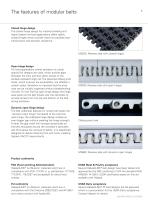
The features of modular belts Closed hinge design The closed hinge design for material handling and highly loaded non-food applications offers tightly closed hinges which provide maximum possible load transmission and abrasion resistance. M2620: Reverse side with closed hinges Open hinge design For food applications where sanitation is critical, special link designs are used, which provide gaps between the links and thus allow access to the partially exposed hinge rod. The patented oblong pivot holes, which improve the accessibility, are offered in certain styles. Sanitation is improved and the...
Open the catalog to page 5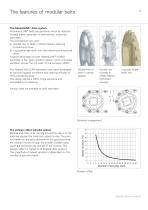
The features of modular belts The HabasitLINK® drive system All HabasitLINK® belts are positively driven by injection molded plastic sprockets or alternatively, machined sprockets. Two conceptions are used: a) Double row of teeth in offset relation, allowing bi-directional drive. b) Lug type single teeth row, also allowing bi-directional drive. Another advantage of most HabasitLINK® molded sprockets is the "open-window" design, which promotes sanitation across the full width of the conveyor shafts. The Habasit HyCLEAN sprockets have been developed to improve hygiene conditions and cleaning efcacy...
Open the catalog to page 6
Product range Product information on www.habasitlink.com Please visit our website for in-depth information on products and applications as well as for detailed technical data (product news, product series overview, information about accessories, product data sheets). Product information in brochures HabasitLINK® plastic modular belts are produced to the highest standards. The range comprises more than 80 belt types, with new types constantly under development to always ensure the most advanced offer. For detailed product information about our plastic modular belts refer to the brochures "4178...
Open the catalog to page 7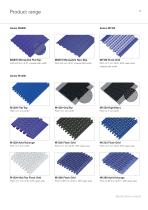
Product range Pitch 8.0 mm (0.3"), imperial belt width Pitch 8.0 mm (0.3"), imperial belt width Pitch 12.7 mm (0.5"), 50% open area, imperial belt width Pitch 12.7 mm (0.5"), 18% open area Pitch 12.7 mm (0.5"), 25% open area Pitch 12.7 mm (0.5"), 18% open area Pitch 12.85 mm (0.51"), 18% open area Pitch 12.85 mm (0.51"), 18% open area
Open the catalog to page 8
Product range Pitch 25.4 mm (1"), imperial belt width Pitch 25.4 mm (1"), imperial belt width Pitch 25.4 mm (1"), imperial belt width Pitch 25.4 mm (1"), imperial belt width Pitch 25.4 mm (1"), 5.9% open area, Pitch 25.4 mm (1"), 25% open area, Pitch 25.4 mm (1"), 25% open area, imperial belt width imperial belt width imperial belt width Pitch 25.6 mm (1"), 16% open area Pitch 25.6 mm (1"), 0% open area
Open the catalog to page 9
Product range Pitch 25.4 mm (1"), 35% open area Pitch 25.4 mm (1"), 35% open area Pitch 25.4 mm (1"), open area dependent Pitch 25.4 mm (1"), 35% open area M2585-P0 Flush Grid (plastic rod) M2585-S0 Flush Grid (steel rod) Pitch 25.7 mm (1"), 48% open area, Pitch 25.7 mm (1"), 54% open area, Pitch 25.7 mm (1"), 48% open area, imperial belt width imperial belt width imperial belt width
Open the catalog to page 10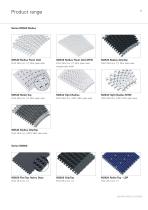
Product range M2540 Radius Flush Grid Pitch 25.6 mm (1"), 35% open area Pitch 25.6 mm (1"), 35% open area M2540 Radius Flush Grid MTW Pitch 25.6 mm (V), 35% open area, imperial belt width Pitch 25.8 mm (1021, 38% open area Pitch 25.6 mm (1"), 20% open area Pitch 25.8 mm (1.02"), 32% open area Pitch 25.8 mm (1.02"), 38% open area M2620 Flat Top Heavy Duty M2620 GripTop M2620 RollerTop - LBP Pitch 25.4 mm (V) Pitch 25.4 mm (V) Pitch 25.4 mm (V)
Open the catalog to page 11
Product range M2670 Flat Top Heavy Duty M2670 Flat Top Heavy Duty MTW Pitch 25.4 mm (1"), imperial belt width Pitch 25.4 mm (1"), imperial belt width Pitch 25.4 mm (1"), imperial belt width Pitch 25.4 mm (1"), imperial belt width M3840 Radius Flush Grid Pitch 38.2 mm (1.5"), 31% open area Pitch 38.2 mm (1.5"), 31% open area Pitch 38.2 mm (1.5"), 37% open area M3843 Tight Radius GripTop Pitch 38.2 mm (1.5"), 25% open area Pitch 38.2 mm (1.5"), 45% open area, imperial belt width
Open the catalog to page 12All Habasit catalogs and technical brochures
 Meat and Poultry Industry
24 Pages
 Textile Industry
24 Pages
 Bakery Industry
20 Pages
 HabaSYNC® Wide Timing Belts
4 Pages
 E-RB-F
2 Pages
 Higher Chain Conveyor Speeds
4 Pages
 NHM-10ELBV-E3
3 Pages
 ENI-5EE
3 Pages
 ENI-5P
3 Pages
 ENI-12P
3 Pages
 HabaSYNC Timing Belts
76 Pages
 Habasit America
4 Pages
 Specialty Belts & Components
2 Pages
 HabaSYNC® WH-A-02
2 Pages
 HabiPLZST Guides and Profiles
60 Pages
 Habasit Cleandrive™
16 Pages
 Habasit Crosslapper Belts
6 Pages
 Material Handling Industry
20 Pages
 Tape MVT-6P
2 Pages
 MVM-5E Machine Tape
2 Pages
 MAV-5E Machine Tape
2 Pages
 Flexfold
2 Pages
 HabaCHAIN
4 Pages
 Details about Yarn Processing
28 Pages
 Handling and Maintenance
24 Pages
 Textile Industry
12 Pages
 Confectionery Industry
22 Pages
 HySAN Food Conveyor Belts
4 Pages
 EU Food Regulations
6 Pages
 Beverage Industry
34 Pages
 Tire Industry
20 Pages
 Automotive Industry
4 Pages
 Airport Industry
12 Pages
 GRABBER FFS Series
4 Pages
 Habiblue
2 Pages
 Product Guide HabasitLINK
306 Pages
 Thermoplastic Extruded Profiles
19 Pages
 HabaDRIVE
4 Pages
 Habasit Spiral Belts
12 Pages
 MNI-7E Machine Tape
2 Pages
 Habasit Cleanline (4063)
12 Pages
 Printing Blanket ENU-50AXBD
2 Pages
 Habasit Fitline TMBE02404
4 Pages
 Habasit Eff-Line belts
4 Pages
 Habasit Cleanline
12 Pages
 HabaCHAIN Product Guide
128 Pages


Archived catalogs
 Packaging Industry
26 Pages
 Wood Industry (2055)
24 Pages
 Tobacco Industry (2010)
16 Pages
 Habasit Tire Industry (2036)
32 Pages
 Habasit Yarn Processing (2006)
28 Pages
 Habasit Bakery (2005)
28 Pages


- Habasit transmission belt
- Profile
- Metal profile
- Habasit industrial belt
- Habasit plastic conveyor belt
- Rubber strip
- Industrial profile
- Habasit industrial conveyor belt
- Flush grid conveyor belt
- Industrial belt
- Habasit conveyor chain
- Habasit plastic belt
- Modular conveyor belt
- Timing belt
- Habasit conveyor belt for the food industry
- Rectangular profile
- V power transmission belt
- Habasit sturdy belt
- Polyurethane power transmission belt