
- Catalogs
- Guangdong Bell Experiment Equipment Co., Ltd
- Penetration test chamber ECER100-BE-6047AP


- Company
- Products
- Catalogs
- News & Trends
- Exhibitions
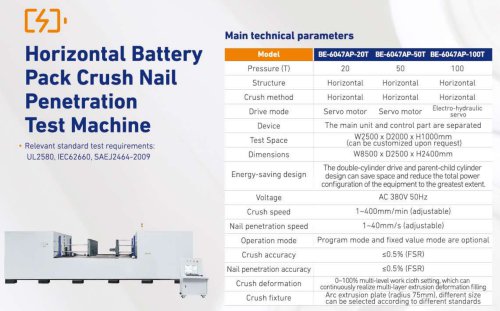
Penetration test chamber ECER100-BE-6047AP

Penetration test chamber ECER100-BE-6047AP
Overview
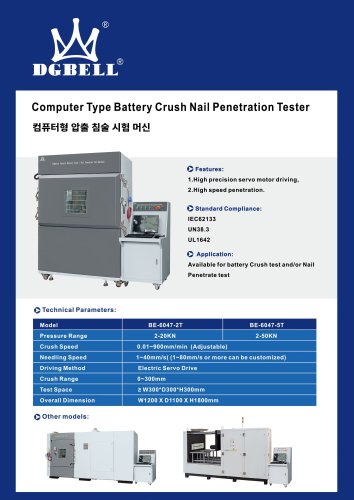
This document describes the specifications and operational procedures for a Horizontal Battery Crush and Nail Penetration Test Machine, designed to evaluate the mechanical safety and integrity of battery cells under crush and penetration conditions.
Specifications
- Test Types: Horizontal crush test and nail penetration test for battery cells.
- Machine Configuration: Horizontal orientation to simulate real-world mechanical abuse scenarios.
- Load Capacity: Sufficient to apply controlled crush forces as per relevant safety standards.
- Nail Penetration: Mechanism to drive a nail through the battery cell at controlled speed and force.
- Control System: Precise control of force, speed, and displacement with data acquisition capabilities.
Procedures
- Setup: Secure battery cell horizontally in the test fixture.
- Crush Test: Apply compressive force gradually until specified deformation or failure criteria are met.
- Nail Penetration Test: Drive nail through the battery at a controlled rate, monitoring force and penetration depth.
- Data Recording: Capture force, displacement, and time data for analysis.
Standards and Compliance
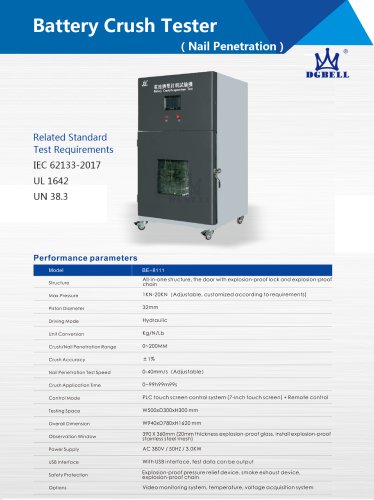
The equipment is designed to comply with international battery safety standards such as UN 38.3, IEC 62133, and UL 1642, ensuring reliable and repeatable test results.
Recommendations and Best Practices
- Ensure proper calibration of force and displacement sensors before testing.
- Use appropriate safety shielding and ventilation due to potential hazards during battery failure.
- Regular maintenance of mechanical components to ensure consistent performance.
- Follow manufacturer guidelines for battery cell placement and test parameter settings.
Summary of Key Parameters
| Parameter | Description | Typical Range |
|---|---|---|
| Crush Force | Maximum compressive force applied during crush test | Up to several kN depending on battery size |
| Nail Diameter | Diameter of the penetrating nail | Typically 3-6 mm |
| Penetration Speed | Speed at which nail penetrates battery | Controlled, typically 6-12 mm/s |
| Data Acquisition Rate | Frequency of data recording | High frequency for detailed analysis |
Catalog excerpts

Performance parameters Model Structure Horizontal Horizontal Horizontal Crush Mode Horizontal Horizontal Horizontal Drive Mode Electro-hydraulic servo Chamber Independent horizontal structure and control system Test Space W2500 X D2000 X H 1000mm [can be customized) Energy Saving Design PowerSupply Crush Speed Hail Penetration Speed Test Condition Adopt dual hydraulic cylinder driving, main-subsidiary hydraulic cylinder design. Maximized saving space and reduce the Iota! power configuration of the equipment, AC380V 50HZ 1 ‘-400rnm/min (Adjustable) 1 ~40mm/s (Adjustable] The variable of force, displacement, speed, time, auxiliary voltage, auxiliary temperature (.etc) can be used as control variable in naiE penetration and crush tests. Control Mode MCU+PC combined control mode, remote control operation to ensure the safety of testing. Punning Mode Available for Programming Mode and Constant Mode Hail Penetration Accuracy ^1%[F$R] Crush Deformation 0-100% multistage setting, multi-layer crush deformation loading available. Crush Fixture Arc crush plate ( Radius 75mm) , available for different fixtures according ta different test standards. Data Acquisition Module independent remote collection and isolation, Multiplex voltage, temperature, current acquisition channel, ensure the data correctly; Safety Alarm Device Electrical leakage, over voltage, overload and over temperature, over current protection, abnormal sound and light alarm, smoke alarm lamp, etc *FlQme resistance and explosion-proof design for the test area. Safety device *Ru$t-proof and anti-corrosion design for the lest area *Emergency stop button. *Over pressure protection *Crush limit protection device, *Water-proof for the test area. *Other safety design. Related Standard Test Requirements 1. Tost object: Battery storage pack or system. 2. Crush according to the following conditions 2.1 Crush plate: half cylinder with radius 75mm, length of the plate should be larger than the crushed battery size but shorter than 1 m; 2.2 Crush Direction: X and Y direction (car driving direction called X axis, another horizontal direction perpendicular to cor driving direction coiled Y axis). To ensure the safety of test operation, tests can be performed on two test objects separately. 2.3 Crush level: Stop the crush when the crush force reached 100KN or the crush deformed by 30% of the total size of the crush direction for the battery pack, remain for 1 Omins. 3. After testing, observe for 1 h under fhe testing temperature.
Open the catalog to page 1All Guangdong Bell Experiment Equipment Co., Ltd catalogs and technical brochures
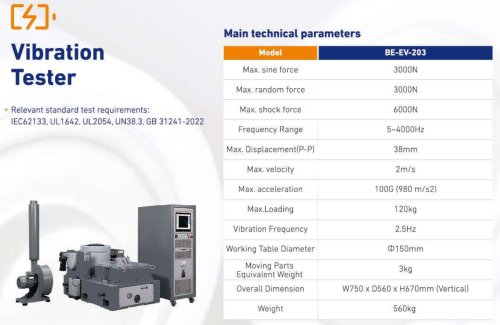 GDBELL Vibration Tester
1 Page
 Battery Safety Test Chamber C
28 Pages
 Environmental Test Chamber C
14 Pages
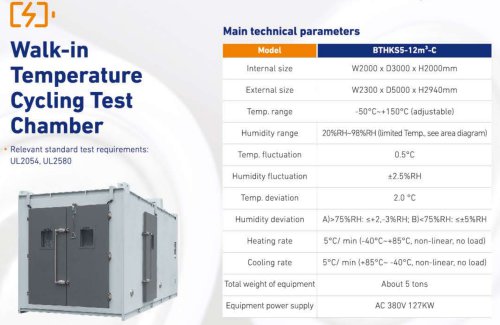
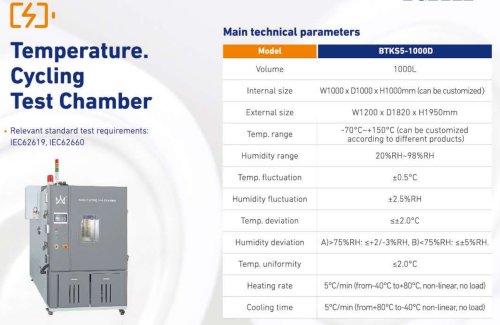
 climate test chambers
1 Page
 Leak testing machine
1 Page
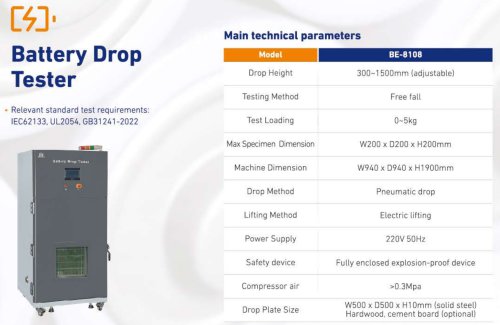
 Drop tester BE-8206-1500
1 Page


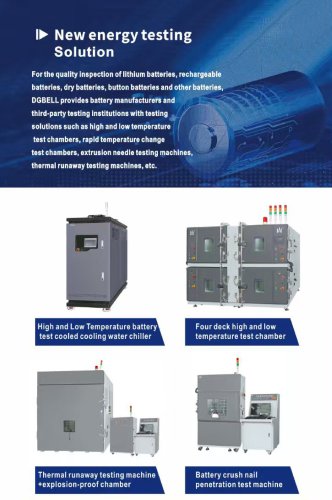
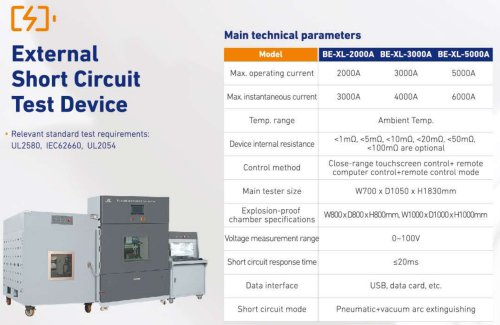
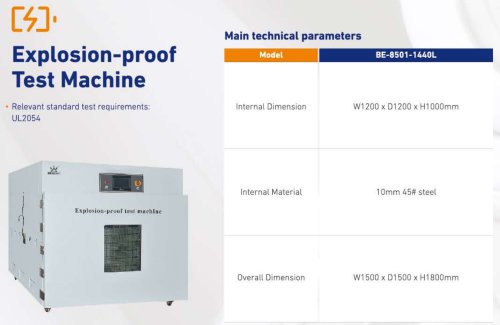


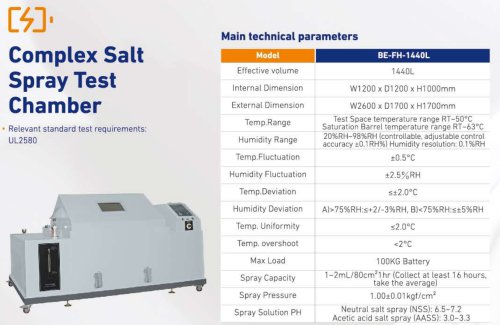












Archived catalogs


- Kiln
- Test machine
- Chamber kiln
- Test cabinet
- Electric furnace
- Heat treatment kiln
- Chiller
- Temperature test chamber
- Automated testing machine
- Material test machine
- Climatic test cabinet
- Quality control test cell
- Liquid recirculation chiller
- Computer-controlled test machine
- Humidity test cabinet
- Drying kiln
- Environmental test chamber
- Digital tester
- Laboratory kiln
- Industrial testing machine